
U.S. Treasury Turmoil Shatters Rate Cut Hopes! Market Expectations Reverse: Fed Rate Hike Probability Rises to 43% This Year

According to Zhitong Finance, the continued rise in US Treasury yields has completely changed market expectations regarding the timing of the next Federal Reserve rate hike. Data from prediction market platform Kalshi shows that traders believe there is a 63% probability the Federal Reserve will raise rates before July 2027, and a 43% probability of a rate increase this year. On another prediction platform, Polymarket, traders see a 35% chance of a rate hike in 2026.
Turbulence in US Treasuries Shatters Rate Cut Dreams, the “Ghost of Rate Hikes” Reappears
Although former US President Donald Trump’s original intention in nominating a new Federal Reserve Chair was to promote rate cuts, his nominee, Kevin Warsh, may initiate the first Fed rate-hike cycle since 2023.
Driven by surging Treasury yields, higher inflation, persistent tensions with Iran, and no clear signs of oil prices retreating, market expectations for Federal Reserve rate hikes have surged sharply in the past 24 hours. Previously, traders placed only a 50% probability on a rate increase in the first half of 2027.
The likelihood of a Federal Reserve rate hike before July 2027 has risen significantly
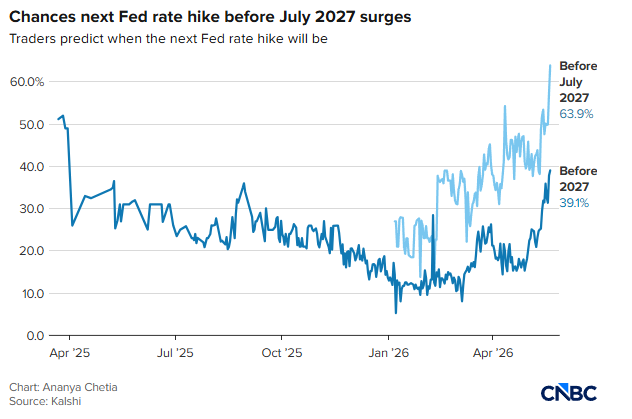
As rate hike expectations heat up, the new Federal Reserve Chair, Warsh, will be sworn in this Friday, succeeding Jerome Powell.
Trump nominated Warsh as Fed Chair at the end of January, after previously criticizing Powell for not cutting rates fast enough. Since then, expectations for rate cuts have faded. The resilient job market and resurging inflation have led many economists to downgrade their rate-cut forecasts, and multiple Federal Open Market Committee (FOMC) members clearly stated in the last meeting that they have no intention of signaling rate cuts in the future.
Constantly rising US Treasury yields have prompted investors to reassess the outlook. On Tuesday, the 30-year US Treasury yield climbed to its highest level since 2007.
Ed Yardeni, chief investment strategist at Yardeni Research and proponent of the “bond vigilantes” concept, said on Monday that the bond market may have more influence on monetary policy than the soon-to-be-inaugurated Chair Warsh.
He said: “Who is actually steering the direction of monetary policy? The answer is undoubtedly the bond market vigilantes.”
However, Chris Senyek, chief investment strategist at Wolfe Research, offered a different perspective in a Tuesday report, suggesting that bond market volatility could force a breakthrough in the Middle East situation, thereby easing upward pressure on inflation.
He stated: “We think the US Treasury market has been signaling high inflation, and this week’s trends are the straw that breaks the camel’s back. Our judgment is that the bond vigilantes may push Treasury yields higher in an attempt to pressure the Trump administration to quickly resolve the Iran issue.”
Trump “Retracts” Rate Cut Pressure, Status Quo in June Becomes Fed Consensus
It is noteworthy that as the new Fed Chair Warsh is about to take office, Trump’s insistence on lowering rates has moderated.
According to reports, Trump stated in a recent interview that rising inflation linked to Iran-related conflict has complicated the prospects for US rate cuts. Only when tensions in the Middle East stabilize, can inflation data be fully assessed. “You simply cannot really see the data before the war ends,” Trump said, referring to the impact of higher oil prices resulting from the Iran conflict.
Reportedly, Warsh will preside over his first FOMC meeting in mid-June, where he will face an increasingly hawkish stance. This week, Chicago Fed’s Goolsbee said that the US faces excessively high inflation, and controlling inflation should be Warsh’s priority as chair.
Yardeni from Yardeni Research also believes that given the current market environment is “no longer” suitable for easing, the Fed should remove its easing bias at the June meeting. He also expects the Fed to hold rates steady and transition to a tightening stance in June.
Currently, the interest rate futures market sees virtually zero probability of the Federal Reserve adjusting rates in June.
Disclaimer: The content of this article solely reflects the author's opinion and does not represent the platform in any capacity. This article is not intended to serve as a reference for making investment decisions.
You may also like
1.7 Trillion Unlock V.S 1.7 Trillion Buyback: Goldman Sachs Bets on the Latter to Sustain the US Stock Market Bull Run
Goldman Sachs expects US companies to raise $600 billion in 2027, sets S&P target at 8,700 points, and states that buybacks and profits can withstand supply shocks.
Next target 8%? US mortgage rates soar to a three-year high as “higher for longer” trades sweep the real estate market
U.S. mortgage rates are experiencing a sharp upward surge. In just over a month, the average 30-year fixed mortgage rate has climbed by a full percentage point, reaching above 7.5%, the highest level in three years. As a result, homebuyer demand has plummeted, and existing home sales in September are expected to show a significant decline.
Bank of America Hartnett: Interest rate hikes become the biggest bullish factor, the logic of ending the bond bubble is spreading
Bank of America strategist Hartnett has made a counterintuitive assessment: the most favorable event for the stock market before the end of the year would be for the Federal Reserve to proactively raise interest rates in October—using a tightening move to curb the out-of-control long end. If the Fed proves its willingness to control inflation and term premium through an October rate hike, the market may actually stop worrying about the 10-year yield surging toward 6%, thereby easing pressure on stocks. Currently, while US stocks have not yet been brought down by interest rates, cracks are quietly spreading in South Korean brokers, French government bonds, and CCC-rated credit bonds.
Goldman Sachs chart: "Gasoline prices determine the US midterm election"! Prediction market shows "Democrats have a 65% chance of sweeping both chambers"
A recent report from Goldman Sachs shows that the Iran war caused oil prices to surge from $3 to $5 per gallon, while the Democratic Party's lead in the general ballot simultaneously expanded from 5 to 9 percentage points—two trends that closely align. Goldman Sachs believes that Hurricane Isaias, once again impacting 63% of offshore capacity in the Gulf of Mexico, has made oil prices a true "ballot decider." Bank of America warns that if the Senate sweeps both chambers, it will trigger significant risk aversion, potentially causing the stock market to plunge by over 10% and weakening the US dollar.

Crypto prices
More


