
Prediction markets are now a multi-billion-dollar industry and have grown fourfold to over $20B in monthly trading volume. Yet, stakeholders are split on whether they are information aggregators for risk management or just gambling sites.
The spat has now devolved into a legal fight over who should police the booming sector. Both the U.S. federal agency Commodity Futures Trading Commission (CFTC) and state regulators now claim authority.
But the conflict goes beyond oversight control.
For the CFTC and its supporters, prediction markets present a revolutionary, real-time tool for hedging against risks. A fragmented and illiquid market would make these forecasting tools less effective.
In contrast, the states insist that the hedging narrative is an excuse to avoid paying local taxes and to bypass gambling regulations. So what’s at stake, and how will this friction impact the future of prediction markets?
Prediction markets as curators of crowd wisdom
One key area in which prediction markets (PMs) have made a breakthrough is economic data forecasting.
From Fed interest rates to tariffs, these markets have reportedly offered better insights than traditional Bloomberg Consensus and other conventional media surveys.
Citing Kalshi’s real-time data nature, the Federal Reserve called prediction markets a ‘rich benchmark’ for tracking economic expectations.
Interestingly, Ford’s internal PMs on weekly vehicle sales forecasting also outperformed expert forecasts with a 25% lower error rate, noted Dylan Dewdney, CEO of Kuvi.ai, the platform pioneering agentic finance. He added,
That matters because vehicle demand forecasting is real operational risk: production planning, inventory, staffing, and supply-chain allocation.
Cathie Woods, CEO of Ark Invest, made a similar framing after a recent funding round for Kalshi.
We believe prediction markets are emerging as a powerful new layer of financial infrastructure, enabling real-time price discovery around events, probabilities, and the evolving state of the world.
Institutional impact on prediction markets
That said, Polymarket has bagged an exclusive partnership with Nasdaq Private Market to offer prediction markets on pre-IPO (initial public offering) firms. This will let users trade on outcomes such as valuation, IPO timeline, and more.
Polymarket has made similar arrangements with the New York Stock Exchange (NYSE), Yahoo Finance, and Google.
Undoubtedly, this has further cemented prediction markets as a new financial infrastructure layer beyond just retail betting. Based on the odds, institutional investors can gauge market sentiment before a firm actually files for an IPO.
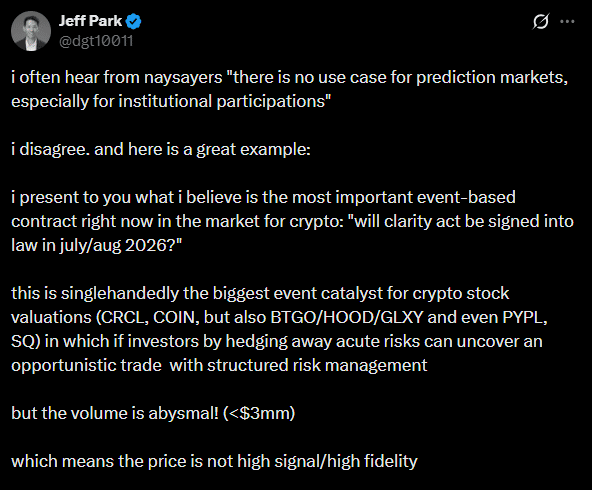
For Bitwise advisor Jeff Park, this was the only way to improve the accuracy of odds by boosting institutional liquidity.
The only way to get better prediction accuracy is to incentivize institutional liquidity flow. Whoever wins institutional partnerships (and then structured products around it) will cement a massive moat.
 Source: X
Similarly, Ivan Patriki, founder of QuantMap, also echoed that the reliability of these products as forecasting tools can only improve with better liquidity.
Unfortunately, the institutional liquidity can only be unlocked through clear regulation.
Which raises an interesting question: Can it be achieved amid the CFTC and states’ battle that threatens the liquidity?
CFTC vs. states: What’s next?
As stated earlier, institutional participation comes with asymmetric information and liquidity depth that improve the quality of the prediction odds. But states’ push for oversight could fragment the liquidity, or worse, ban the prediction markets.
In an attempt to block such scenarios, the CFTC has sued Minnesota, Arizona, Connecticut, Illinois, New York, and Wisconsin.
The federal regulator scored a partial win in New Jersey after the court ruled that the Commodity Exchange Act preempts state gambling laws on CFTC-approved operators.
But in Nevada, Ohio, and Maryland, the courts ruled that states have the absolute authority in these markets. The divergent rulings mean the fight may reach the Supreme Court for final clarity.
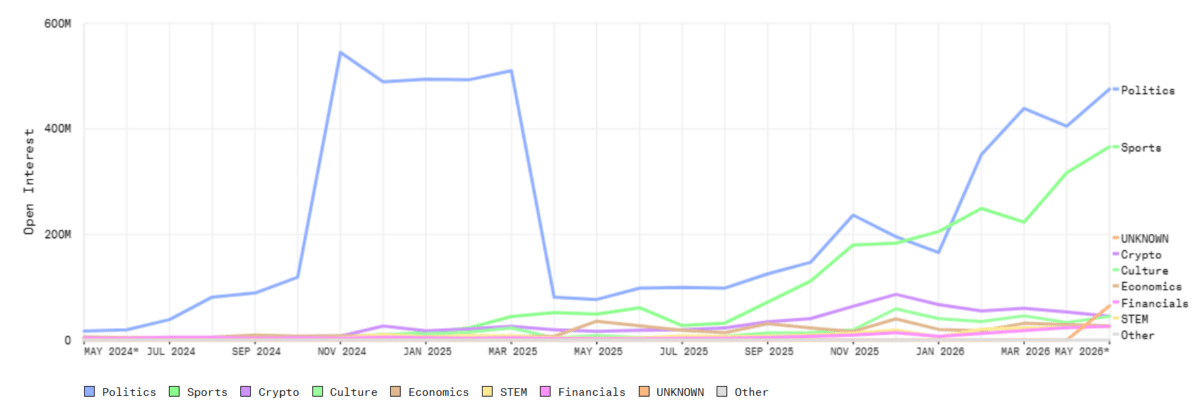
Interestingly, sports and politics dominate the open interest by nearly $900 million. On the contrary, the economics and financials category ranked fifth and seventh, respectively.
 Source: Paradigm
According to Adam Bjorn, CEO of Plannatech, which runs betting sites Prime Sportsbook and Betcris, the volume confirms that these are pure gambling platforms.
These are 100% gambling platforms. Call it event contracts, call it commodities, dress it up however you want. It’s sports betting, it’s gambling, it’s gaming. The volume tells you exactly what the product is.
Nonetheless, the CFTC is considering a sweeping regulatory framework for the sector, including measures against insider trading and manipulation.
Final Summary
- Prediction markets have exploded into a $20 billion monthly industry; however, their touted hedging benefit remains highly debated.
- The increasing institutional interest could accelerate its mainstream adoption, but that regulatory uncertainty could derail it.