
"White House Stock Guru" Endorses the "Hottest Storage"! Trump Publicly Praises Micron

Trump was "pumping" a stock again at a rally, this time calling out Micron.
On May 22 local time, Trump openly mentioned Micron Technology (Micron) at a large rally in Suffern, New York: "Big company Micron, boy, Micron is great…"

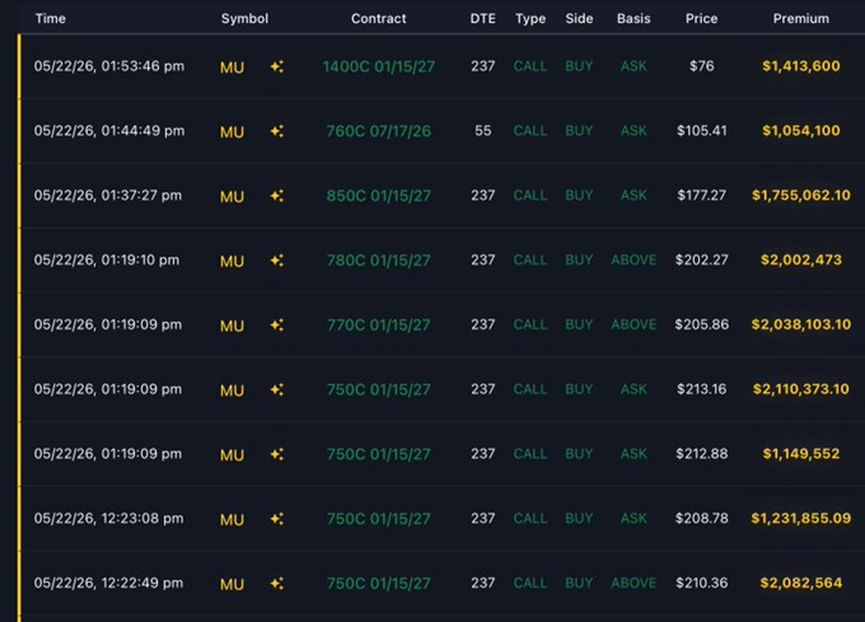
That afternoon, the options market just saw an influx of huge deep out-of-the-money (OTM) call options for Micron, with strike prices ranging from $750 all the way to $1,400, with single premiums starting at over a million dollars each.
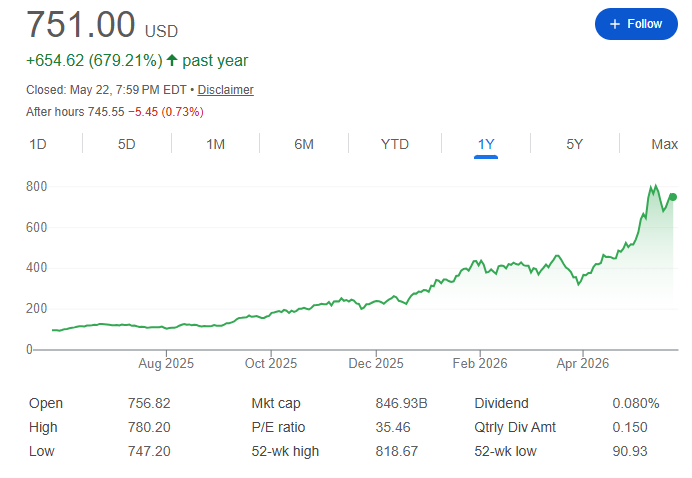
Currently, Micron's share price is around $751, up 680% over the past year.
Anyone familiar with Trump’s trading record wouldn’t be surprised. The latest financial disclosure files show that in March this year, the day after he bought Micron stock, he went on Fox News and announced, "I just met with the head of Micron. This is one of the hottest companies."
This “first build position, then shout out” play is already all too familiar in the market.
Before the Rally, the "Whales" Strike First in Options
According to the market flow tracking account Capital Flow, on the afternoon of May 22, several traders bought Micron deep OTM call options, with strike prices ranging from $750 to $1,400 and expiration dates concentrated on January 15, 2027 (237 days to expiry) and July 17, 2026 (55 days to expiry).
Between noon and afternoon that day, at least 9 large call option buy orders appeared, with 7 clustered between 1:19 PM and 1:53 PM. The most aggressive was a $1,400 strike expiring January 2027, with a $1,413,600 premium—meaning Micron would need to rise almost 90% from around $745 in under 8 months for the trade to profit.
Just at 1:19:09, four call options with different strike prices filled simultaneously, with premiums totaling over $7.3 million. All the trades were on the buy side, executed at the ask price (ASK) or above (ABOVE), showing clear intention of aggressive accumulation.
Soon after these trades, Trump praised Micron at the rally.
The timeline coincidence has made the market inevitably wonder: What did these option “whales” know in advance?
“Buy First, Then Hype”—Not a New Script
Looking back at Trump’s trading records, Micron is far from the only case.
According to disclosure documents made public by the U.S. Office of Government Ethics (OGE) on May 14, Trump conducted 3,711 securities trades in Q1 2026, valued between $220 million and $750 million.
Micron’s timeline is particularly eye-catching—between March 2 and 25, he cumulatively bought between $217,000 and $530,000 worth of Micron shares, across four trades marked as "unsolicited" (i.e., initiated by the client, not the broker). After buying between $50,000 and $100,000 on March 25, the next day he called Fox News’ “The Five” show and delivered the now-famous line: "I just met with the head of Micron. This is one of the hottest companies."
The same script has played out with other companies, too. Dell is a classic example: on February 10, Trump bought $1 million to $5 million worth of Dell stock; nine days later, during an economics speech in Georgia, he told the audience directly to "go buy a Dell computer" and also praised Dell CEO Michael Dell and his spouse for funding the “Trump account” for newborns. Later, he publicly recommended Dell products multiple times on Feb 27, March 9, April 16, and May 8—the endorsement at the White House Mother’s Day event on May 8 pushed Dell’s share price to a historic high.
The Thermo Fisher story is equally intriguing: On March 11, Trump visited their Ohio plant, called it “a great company,” and encouraged pharma companies to collaborate with them. On the same day, he purchased $15,000 to $50,000 in Thermo Fisher stock, marked as “unsolicited". He’d already built a position before, and after the visit, his total holdings could reach up to $215,000. That same afternoon in Kentucky, he praised Apple CEO Tim Cook, and bought $250,000 to $500,000 in Apple stock. Overall in March, he bought $2 million to $7.2 million worth of Apple.
In the face of criticism, the Trump Organization's response has been consistent: the president’s investments are independently managed by a third-party financial institution, executed through an “automated, model-driven portfolio,” and not personally decided by him. However, the assets are in a trust managed by his son Donald Trump Jr., rather than a compliant “blind trust” that completely separates beneficiary from investment decisions—which means there’s no legal or practical barrier to his involvement. Multiple trades marked “unsolicited” further add tension to the “independent management” claim.
Bipartisan lawmakers are already promoting legislation. Representative Magaziner and Republican Roy have jointly introduced a bipartisan bill to ban members of Congress from stock trading, while another bill would extend the ban to the president and vice president. Senator Gillibrand's comment was the bluntest: "This is a profound betrayal of the citizens they serve. Elected officials—especially the president—should not trade stocks."
There’s also a detail circulating on social media: Micron CEO Sanjay Mehrotra previously attended one of Trump’s private social events (referred to as a "bros trip"), highlighting their close relationship.
The Policy Card Behind Micron
There is policy context behind Trump repeatedly backing Micron.
According to Bloomberg, U.S. Trade Representative Jamieson Greer recently said at a Micron Virginia plant expansion event that the government is still considering imposing tariffs on imported semiconductors to promote domestic manufacturing, but will not implement them immediately. His comment: "We want to make sure we’re moving at the right timeline and the right magnitude to encourage manufacturing reshoring.”
Micron’s strategic status is key to all of this. It is the only U.S. manufacturer mass-producing advanced DRAM domestically. Korean rivals Samsung and SK Hynix have logical chip and packaging plants in the U.S., but do not produce memory wafers on U.S. soil. Commerce Secretary Gina Raimondo warned earlier this year that if Korean firms do not expand their U.S. capacity, they may face tariffs as high as 100%.
Micron has already committed $200 billion in U.S. investment in manufacturing and R&D, covering Idaho, New York and Virginia, and has received over $6 billion in direct subsidies under the CHIPS Act. CEO Mehrotra told Bloomberg TV that, driven by AI infrastructure demand, memory chip supply shortages “will last beyond 2026,” and the company is signing long-term supply deals with customers. Since the start of the year, Micron’s share price has risen over 163% cumulatively.
For the market, whenever this “White House stock god” talks about a company, there always seems to be an intertwining of positions, policy, and personal connections in the background. And with Micron, all three are present…
Disclaimer: The content of this article solely reflects the author's opinion and does not represent the platform in any capacity. This article is not intended to serve as a reference for making investment decisions.
You may also like
Chipmaker earnings growth cools to 136% as AI boom lifts S&P 500
Updated: Delta Air Lines warns that as fuel prices hit profits, airline capacity will tighten further
Delta Airlines lowers its annual profit forecast due to an expected increase in fuel costs to $6 billion. The CEO stated that ticket prices have risen by about 20% this year, with limited passenger resistance. Analysts warn that maintaining high ticket prices in 2027 is critical for improving profitability. The article includes comments from the earnings call and analyst remarks. Rajesh Kumar Singh/Shivansh Tiwary, Reuters Chicago, October 9 - Delta Airlines (DAL.N) said on Friday that, despite strong travel demand and rising ticket prices, soaring fuel costs have forced it to cut its 2026 profit expectations by nearly a quarter. So, the airline industry may need to further limit flight growth next year to protect profitability. This warning highlights the increasingly tough challenges faced by U.S. airlines. While strong demand and restricted seat growth have allowed airlines to significantly raise ticket prices and offset higher fuel costs, aggressively increasing flights to capture more demand may intensify competition, making it harder to maintain high fares and protect profits. Based in Atlanta, Delta now expects its annual fuel expenditure to increase by about $6 billion compared to last year—about $2 billion higher than its July forecast—due to the Iran war (link) causing global jet fuel prices to spike. Airlines worldwide are preparing for a prolonged fuel shock. Michael O’Leary, CEO of Ryanair Group RYA.I, said Thursday that high jet fuel prices could persist for another 12-18 months (link), adding more pressure on airlines to raise fares and control costs. https://www.reuters.com/graphics/AUTOMATED-20261008/A4A-JET-FUEL-DAILY-1Y/xmpjwjnmbvr/chart.png “In a high-cost environment, you can’t simply grow your way out,” Delta CEO Ed Bastian said on the earnings call. He noted that the industry has already taken steps to restrict capacity, but more measures will be needed next year to improve profitability. Bastian said Delta raised ticket prices about 20% this year, and passenger resistance has been limited. He is confident that even if fuel costs eventually drop, the high fares can still be maintained. Delta lowered its adjusted annual earnings per share forecast from the July prediction of $6.50-$7.50 to $5.10-$5.60. According to LSEG data, the midpoint of the new range is below analysts’ average expectation of $5.46. Third-quarter adjusted earnings per share were $1.72, four cents below analysts’ average forecast. In midday trading, shares of Delta dropped 1.7%, United Airlines UAL.O fell 1.4%, and both American Airlines AAL.O and Southwest Airlines LUV.N were down about 1%. Delta partly shields itself from rising fuel costs by owning a refinery outside Philadelphia (link), which is expected to generate over $700 million in profits this year. Even with this buffer, the airline expects its fourth-quarter fuel price to rise from $3.61 per gallon in Q3 to $4.25 per gallon. Delta forecasts adjusted fourth-quarter earnings per share to be between $1.15-$1.65, with the $1.40 midpoint roughly matching analysts’ average expectation of $1.39. Fare increases Government data shows that in the first eight months of 2026, U.S. airlines spent $42.9 billion on fuel, an increase of $13.2 billion compared to the same period last year despite slightly reduced consumption. According to the U.S. Bureau of Labor Statistics, strong demand and limited seat growth pushed average U.S. airline ticket prices up by about 25% year-on-year between April and August. https://www.reuters.com/graphics/USA-AIRLINES/FUEL/lbpgdnbzwvq/chart.png Analysts at Melius Research said that despite surging fuel costs, Delta’s ability to raise fares helps keep second-half profits roughly stable. Still, they warn that the company’s profit margin has struggled to improve over the years. “It is critical for margin improvement to maintain or raise fares in 2027,” they wrote in their research report. With industry capacity growth expected to accelerate in Q4, this challenge will likely become even tougher. Deutsche Bank analysts expect the proportion of fuel costs recouped through revenue measures to fall in Q4 and predict full recovery won’t happen until early 2027. Bastian noted that low industry returns are another reason for limiting capacity growth. He said Delta will be cautious with its 2027 capacity plan until the fuel price outlook becomes clearer. He added that international routes may account for a larger share of Delta’s capacity expansion compared to domestic routes. Currently, Delta says its premium cabins and corporate travel business remain strong, and its economy cabin business is gradually improving. With Q4 ticket bookings already exceeding 60%, Delta expects revenue to increase about 20% year-on-year, despite limited capacity growth. Executives said early booking trends for Q1 2027 are also encouraging. (For the convenience of non-native English speakers, Reuters automatically translates its reports into several
AI and Quantum: Trump's $6 Billion Plan Could Also Impact Bitcoin
Wall Street giants to release financial reports next week: stock trading revenue expected to approach $19 billion, "everyone is a winner" may be a thing of the past
According to analyst expectations compiled by Bloomberg, the combined equity trading revenue of the five major U.S. banks in the third quarter will approach $19 billion, but fixed income trading revenue is expected to drop to its lowest point of the year, and M&A activity has also cooled. Meanwhile, AI-driven cash optimization tools may lead to deposit outflows, sparking concerns about bank stocks in the market. Analysts believe that while the profit performance of each bank may further diverge, market concerns about the impact of AI may be overblown.
Crypto prices
More


