
Bitget App
Trade smarter
Buy cryptoMarketsTradeFuturesStocksEarnInstitutionAI & More
Are altcoins finally waking up or is Bitcoin still the only real leader?

Are altcoins finally waking up or is Bitcoin still the only real leader?

CryptoNewsNetCryptoNewsNet2026/05/24 15:45
By:CryptoNewsNet
Back to the list

Are altcoins finally waking up or is Bitcoin still the only real leader?

Are altcoins finally waking up or is Bitcoin still the only real leader? image 0  6 m
Are altcoins finally waking up or is Bitcoin still the only real leader? image 1

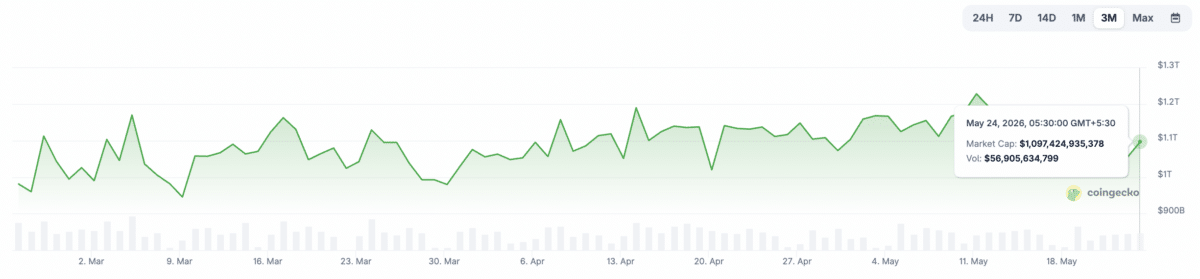
Compared to the early days of May, the global cryptocurrency market capitalization is not as strong. The value of the global cryptocurrency market was $2.56 trillion at the time of publication.

At the same time, the market cap of altcoin was $1.097 trillion.
Are altcoins finally waking up or is Bitcoin still the only real leader? image 2

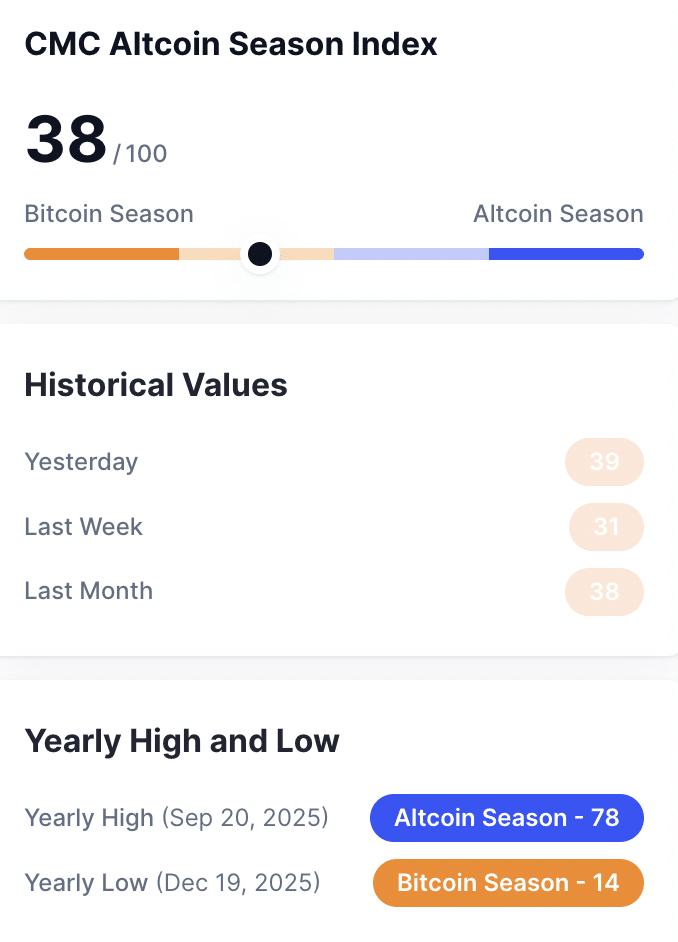
However, the CoinMarketCap altcoin index was at 38 at the time of writing, indicating that the altcoin season has little room to occur because the Bitcoin [BTC] season is still going strong.

Zooming out, however, shows that the cryptocurrency market is in a bullish zone because Bitcoin has returned above the $75,000 price level.

What’s behind this rebound?

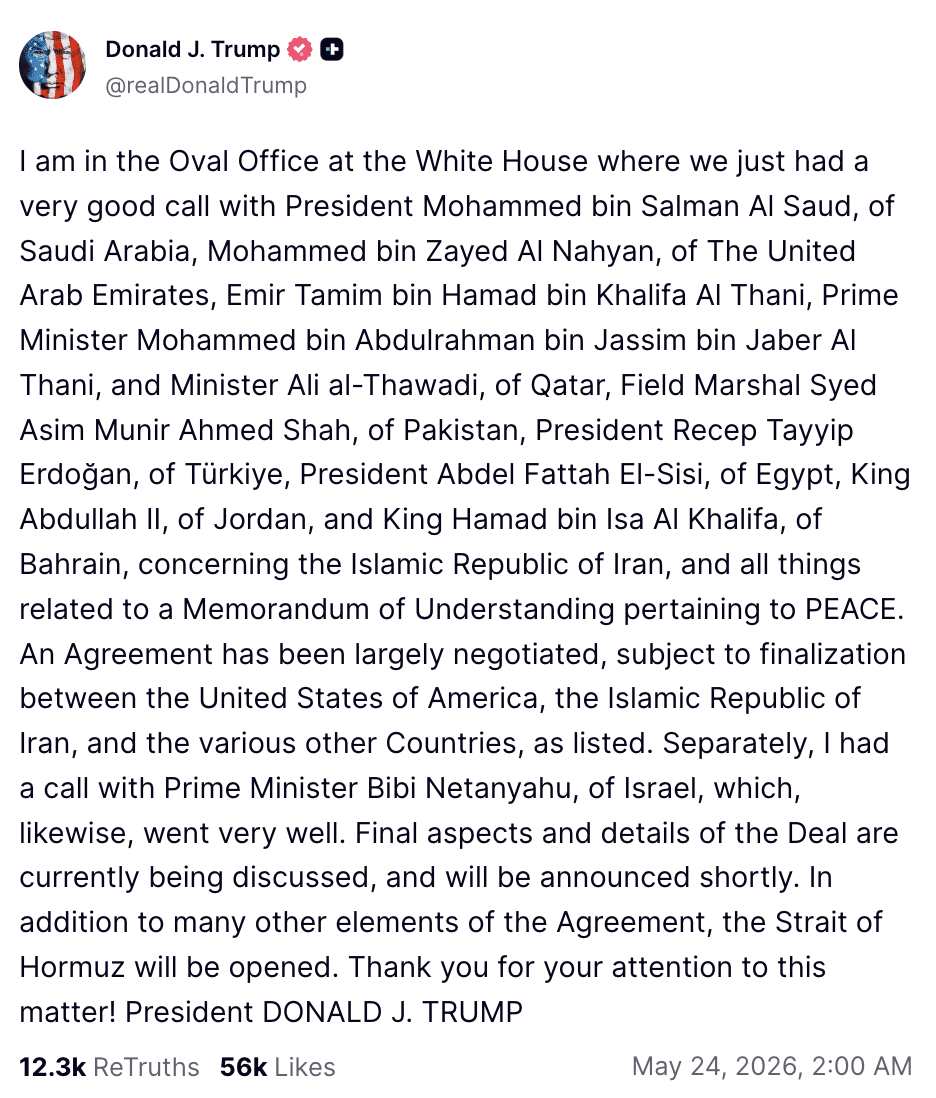
Following days of geopolitical pressure, US President Donald Trump’s announcement that a peace deal with Iran had been “largely negotiated” calmed market concerns and caused a spike in the cryptocurrency market.
Are altcoins finally waking up or is Bitcoin still the only real leader? image 3

Interestingly, altcoins outperformed Bitcoin in this instance. This indicated that traders returned to riskier assets after the headlines about the peace deal eased their immediate anxiety.

Part of the recovery was driven by AI-related tokens. Worldcoin [WLD] rose 11.7%, and $NEAR Protocol [$NEAR] rose 17.7% in a single day and over 58% in a week.

Zcash [ZEC] gained 7.1% over the course of a day, indicating that privacy-linked assets also increased. During the same time frame, other significant altcoins such as Ondo [ONDO] rebounded by 15%, and Hyperliquid [$HYPE] recovered by 12.3%.

Additionally, this jump also came after Bitcoin Pizza Day.

Even with all of this momentum, the altcoin index is still below the 75 level that would signal the beginning of altcoin season.
Are altcoins finally waking up or is Bitcoin still the only real leader? image 4

Then vs. now market sentiment around the altcoin season

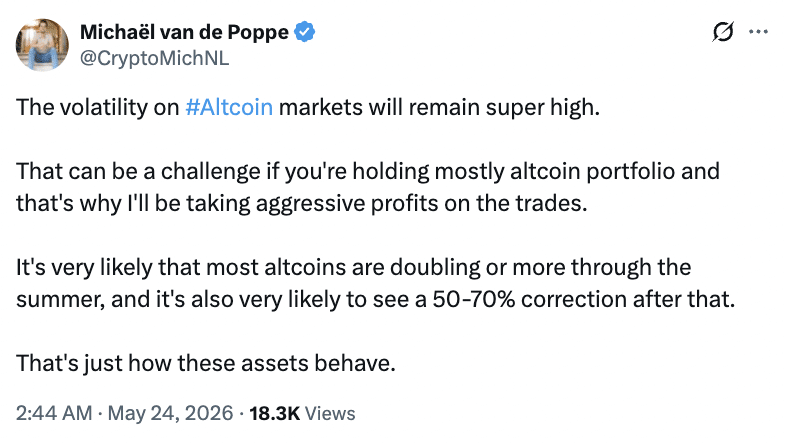
Remarking on the same, a known analyst, Michaël van de Poppe, said,
Are altcoins finally waking up or is Bitcoin still the only real leader? image 5

This is a very different situation from what was observed at the end of April.

According to what AMBCrypto previously reported, analysts at that time determined that the price action resembled the accumulation phase preceding earlier altseasons.

Therefore, they predicted that a significant altcoin rally may occur in 2026 or 2027 if the pattern repeats.

Indeed, there is a spike in the filing of such coins in the ETF space as well. $HYPE ETF inflows outpaced Ethereum [ETH] on five of the six days and Bitcoin on three of the six days.

Moreover, asset managers Grayscale and VanEck modified their S-1 filings with the SEC.

What are the other on-chain metrics hinting at?

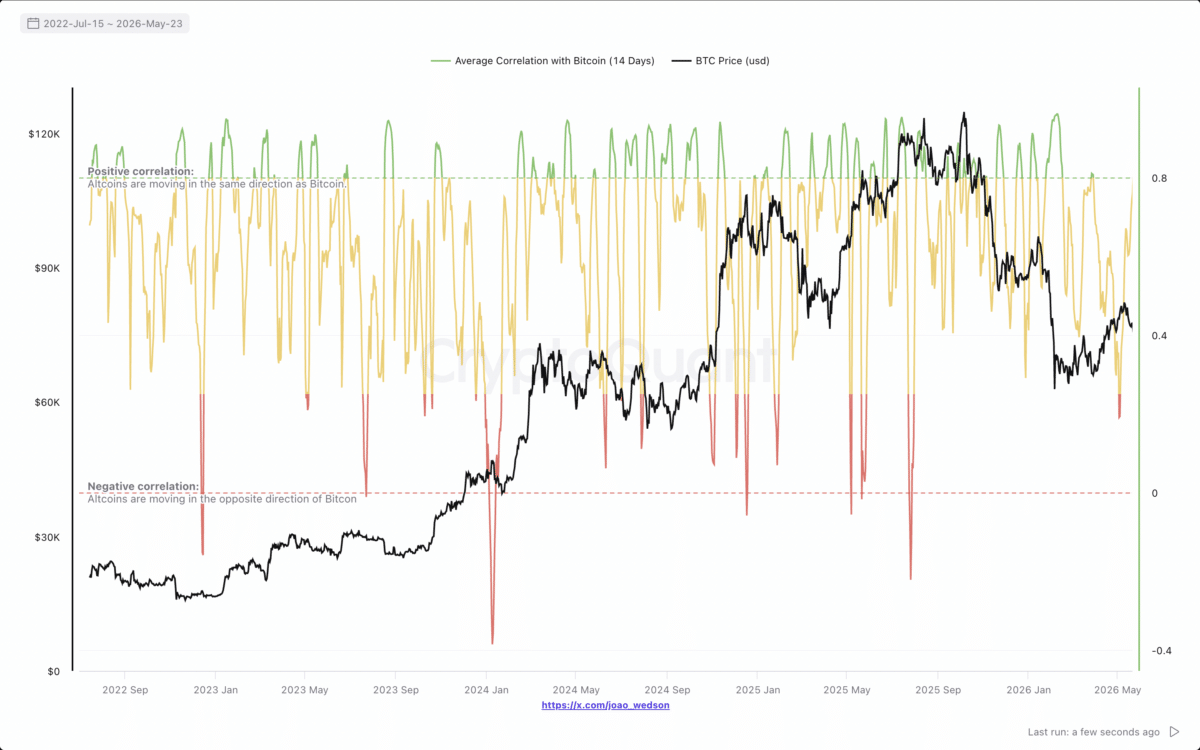
However, the average 14-day correlation of altcoins to bitcoin, which tracks the price movement of bitcoin, indicates that altcoin season is not yet here. According to the metric, the crypto market continues to act as though Bitcoin is the main driver and altcoins are primarily passengers.
Are altcoins finally waking up or is Bitcoin still the only real leader? image 6

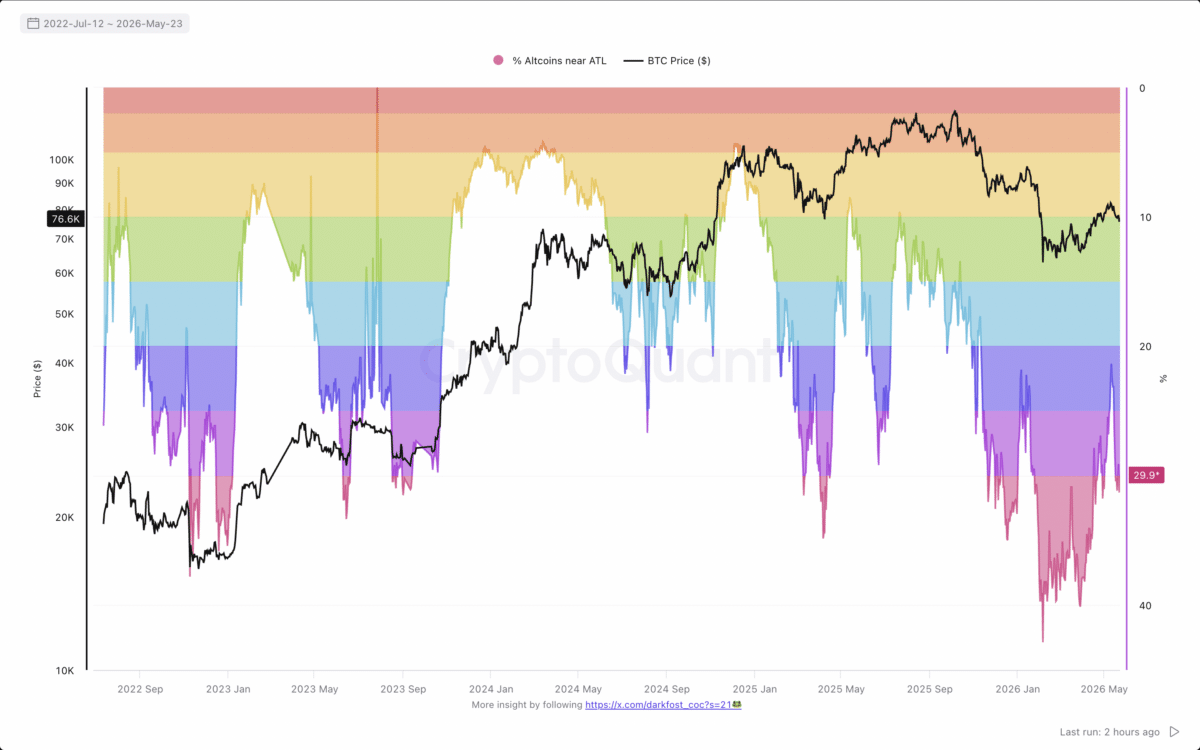
Furthermore, a chart showing the percentage of altcoins trading close to their all-time lows supported the idea that while Bitcoin might be doing well, the average altcoin is still having a terrible time.
Are altcoins finally waking up or is Bitcoin still the only real leader? image 7

Final Summary

  • The overall crypto market rebounded after President Trump’s announcement, but altcoins gained more.
  • However, the altcoin season and other on-chain metrics suggested that the altcoin season is not near the horizon.
0
1

Disclaimer: The content of this article solely reflects the author's opinion and does not represent the platform in any capacity. This article is not intended to serve as a reference for making investment decisions.

Understand the market, then trade.
Bitget offers one-stop trading for cryptocurrencies, stocks, and gold.
Trade now!

You may also like

Updated: Delta Air Lines warns that as fuel prices hit profits, airline capacity will tighten further

Delta Airlines lowers its annual profit forecast due to an expected increase in fuel costs to $6 billion. The CEO stated that ticket prices have risen by about 20% this year, with limited passenger resistance. Analysts warn that maintaining high ticket prices in 2027 is critical for improving profitability. The article includes comments from the earnings call and analyst remarks. Rajesh Kumar Singh/Shivansh Tiwary, Reuters Chicago, October 9 - Delta Airlines (DAL.N) said on Friday that, despite strong travel demand and rising ticket prices, soaring fuel costs have forced it to cut its 2026 profit expectations by nearly a quarter. So, the airline industry may need to further limit flight growth next year to protect profitability. This warning highlights the increasingly tough challenges faced by U.S. airlines. While strong demand and restricted seat growth have allowed airlines to significantly raise ticket prices and offset higher fuel costs, aggressively increasing flights to capture more demand may intensify competition, making it harder to maintain high fares and protect profits. Based in Atlanta, Delta now expects its annual fuel expenditure to increase by about $6 billion compared to last year—about $2 billion higher than its July forecast—due to the Iran war (link) causing global jet fuel prices to spike. Airlines worldwide are preparing for a prolonged fuel shock. Michael O’Leary, CEO of Ryanair Group RYA.I, said Thursday that high jet fuel prices could persist for another 12-18 months (link), adding more pressure on airlines to raise fares and control costs. https://www.reuters.com/graphics/AUTOMATED-20261008/A4A-JET-FUEL-DAILY-1Y/xmpjwjnmbvr/chart.png “In a high-cost environment, you can’t simply grow your way out,” Delta CEO Ed Bastian said on the earnings call. He noted that the industry has already taken steps to restrict capacity, but more measures will be needed next year to improve profitability. Bastian said Delta raised ticket prices about 20% this year, and passenger resistance has been limited. He is confident that even if fuel costs eventually drop, the high fares can still be maintained. Delta lowered its adjusted annual earnings per share forecast from the July prediction of $6.50-$7.50 to $5.10-$5.60. According to LSEG data, the midpoint of the new range is below analysts’ average expectation of $5.46. Third-quarter adjusted earnings per share were $1.72, four cents below analysts’ average forecast. In midday trading, shares of Delta dropped 1.7%, United Airlines UAL.O fell 1.4%, and both American Airlines AAL.O and Southwest Airlines LUV.N were down about 1%. Delta partly shields itself from rising fuel costs by owning a refinery outside Philadelphia (link), which is expected to generate over $700 million in profits this year. Even with this buffer, the airline expects its fourth-quarter fuel price to rise from $3.61 per gallon in Q3 to $4.25 per gallon. Delta forecasts adjusted fourth-quarter earnings per share to be between $1.15-$1.65, with the $1.40 midpoint roughly matching analysts’ average expectation of $1.39. Fare increases Government data shows that in the first eight months of 2026, U.S. airlines spent $42.9 billion on fuel, an increase of $13.2 billion compared to the same period last year despite slightly reduced consumption. According to the U.S. Bureau of Labor Statistics, strong demand and limited seat growth pushed average U.S. airline ticket prices up by about 25% year-on-year between April and August. https://www.reuters.com/graphics/USA-AIRLINES/FUEL/lbpgdnbzwvq/chart.png Analysts at Melius Research said that despite surging fuel costs, Delta’s ability to raise fares helps keep second-half profits roughly stable. Still, they warn that the company’s profit margin has struggled to improve over the years. “It is critical for margin improvement to maintain or raise fares in 2027,” they wrote in their research report. With industry capacity growth expected to accelerate in Q4, this challenge will likely become even tougher. Deutsche Bank analysts expect the proportion of fuel costs recouped through revenue measures to fall in Q4 and predict full recovery won’t happen until early 2027. Bastian noted that low industry returns are another reason for limiting capacity growth. He said Delta will be cautious with its 2027 capacity plan until the fuel price outlook becomes clearer. He added that international routes may account for a larger share of Delta’s capacity expansion compared to domestic routes. Currently, Delta says its premium cabins and corporate travel business remain strong, and its economy cabin business is gradually improving. With Q4 ticket bookings already exceeding 60%, Delta expects revenue to increase about 20% year-on-year, despite limited capacity growth. Executives said early booking trends for Q1 2027 are also encouraging. (For the convenience of non-native English speakers, Reuters automatically translates its reports into several

路透社•2026/10/09 17:36

Wall Street giants to release financial reports next week: stock trading revenue expected to approach $19 billion, "everyone is a winner" may be a thing of the past

According to analyst expectations compiled by Bloomberg, the combined equity trading revenue of the five major U.S. banks in the third quarter will approach $19 billion, but fixed income trading revenue is expected to drop to its lowest point of the year, and M&A activity has also cooled. Meanwhile, AI-driven cash optimization tools may lead to deposit outflows, sparking concerns about bank stocks in the market. Analysts believe that while the profit performance of each bank may further diverge, market concerns about the impact of AI may be overblown.

华尔街见闻•2026/10/09 16:11