
Weight loss effect comparable to surgery! Eli Lilly RETA becomes the strongest "weight loss miracle drug" in history—"Will obesity become a rare disease in a few years?"

The latest Phase III clinical data for Eli Lilly's next-generation weight loss drug, retatrutide (abbreviated as "RETA"), has shocked the medical community and capital markets — participants achieved an average maximum weight loss of 28% of body weight, approximately 70 pounds, with nearly half of patients losing more than 30%, and some severely obese patients losing an average of 85 pounds over 104 weeks. The level of weight loss has now fully entered the results range previously exclusive to weight loss surgery.
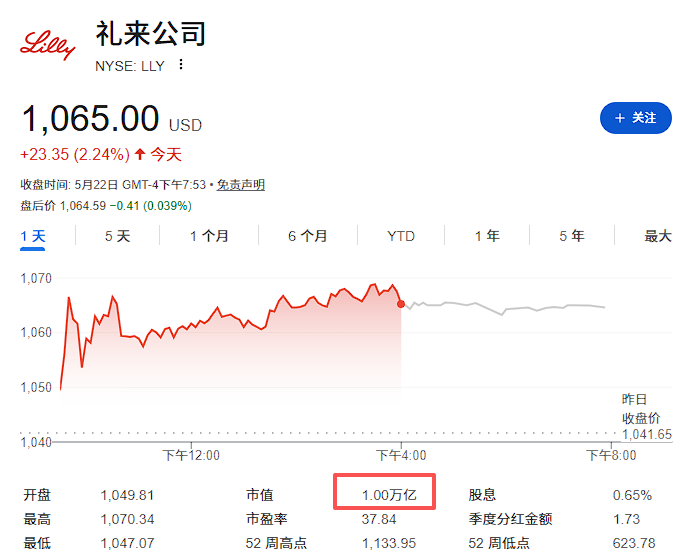
This result has been described by several independent medical experts not involved in the trial as "the greatest weight loss observed in any drug trial in history." Eli Lilly stated that it will submit the application for RETA to the U.S. Food and Drug Administration (FDA) as early as this year. After the news was announced, Eli Lilly's share price continued to strengthen, with its market value nearing the $1 trillion threshold.
The emergence of RETA not only marks a new evolutionary stage for GLP-1 drugs, but is also seen by the market as a systemic shock to the "overconsumption economy." Share prices in multiple industries — from restaurants and fast food to alcohol and processed foods — are already under pressure. Some in the medical field have even predicted:
"Within a few years, obesity will once again become a rare disease."
RETA Clinical Data: Weight Loss Comparable to Surgery
The core breakthrough of RETA lies in its "triple agonist" mechanism. Unlike previous GLP-1 drugs, RETA simultaneously targets three metabolic pathways: GLP-1, GIP, and glucagon, while Eli Lilly’s existing blockbuster drug Zepbound is only a dual agonist, targeting just GLP-1 and GIP.
According to NBC News, the Phase III clinical trial included about 2,300 obese or overweight patients over a period of 80 weeks. Results showed that patients receiving the highest dose lost on average 28% of body weight, or about 70 pounds, with nearly half losing over 30%. A group of severely obese patients who took the drug for 104 weeks lost an average of 85 pounds.
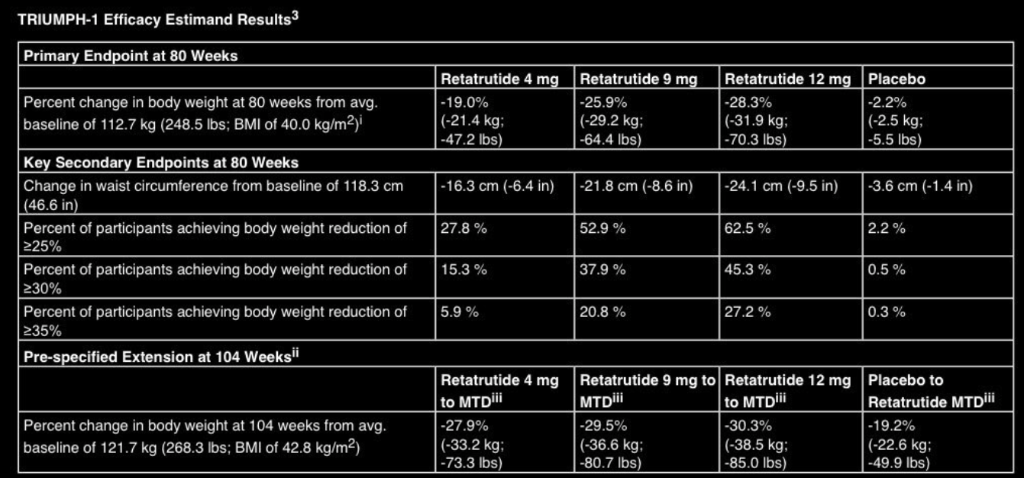
(Source: Eli Lilly)
For comparison, Zepbound’s highest dose group lost about 21% on average in a 72-week trial, and Wegovy’s highest dose group lost about 15% on average in a 68-week trial. It should be noted that these data come from separate, independent clinical studies.
Weight loss surgery typically helps patients lose 25% to 35% of their body weight within one to two years. RETA’s data now overlaps substantially with this range, prompting many experts to call it a "game changer."
Dr. Susan Spratt, Senior Medical Director of Population Health Management at Duke University Health System and an endocrinologist, stated:
"This is the greatest weight loss I’ve ever seen in any drug trial — it’s significant."
Filling the Effectiveness Gap of Existing GLP-1s
The clinical value of RETA lies not only in setting a new weight loss record, but also in its potential to cover populations who do not respond to existing GLP-1 drugs.
Dr. Shauna Levy, Medical Director of Tulane University Weight Loss Center, pointed out that for severely obese patients with a BMI of 35 and above, current GLP-1 drugs often fail to deliver sufficient weight loss.
"Weight loss surgery can provide sufficient results, but RETA also appears to be an effective tool to help high BMI patients reach a healthy weight."
Dr. Spratt further added that about 10% of patients are unresponsive to existing GLP-1 drugs, and RETA could be important for this group. “For GLP-1 non-responders, this drug could be very useful.”
In terms of side effects, RETA is similar to other GLP-1 drugs, with common adverse effects including nausea, constipation, and diarrhea.
Eli Lilly also disclosed that compared to the placebo group, patients on RETA reported higher rates of abnormal skin sensations and urinary tract infections. The dropout rate was higher than Zepbound, but similar to Wegovy.
Currently, Eli Lilly has not yet submitted an FDA application for RETA, but the company stated it plans to begin the submission process as early as this year.
More Than Weight Loss: GLP-1 as a "Master Metabolic Switch"
The advent of RETA is prompting the market to reassess the strategic value of the entire GLP-1 class — its impact now goes far beyond weight management.
Current research shows that GLP-1 drugs also have promising signals for reducing heart disease risk, improving sleep apnea, protecting kidney function, and reducing addictive behaviors. The latest potential breakthroughs are coming from the oncology field:
The Cleveland Clinic will release data at the world’s largest cancer research conference, showing that after tracking more than 10,000 cancer patients, GLP-1 users saw tumor progression rates decrease by 38% to 50% in multiple tumor types, including breast, lung, colon, and liver cancer. Researchers emphasized that these findings are still at an early stage.
On the drug development front, the pharmaceutical industry has already progressed from dual to triple, quadruple, and even quintuple agonists, targeting multiple metabolic pathways. Some believe that the race to develop anti-obesity drugs has now become an "arms race" centered on human metabolism.
Dr. Danish in the medical field gave a striking forecast: "Within a few years, obesity will be reclassified as a rare disease."
Eli Lilly Nears $1 Trillion, Consumer Sectors Under Pressure
Meanwhile, the surge of RETA-enabled data is driving significant structural shifts in the capital market.
Eli Lilly’s share price continues to benefit from RETA expectations, pushing toward historic highs and the $1 trillion valuation threshold. Its foundation now manages close to $100 billion in assets. However, the rise of GLP-1 drugs is having a direct impact on multiple consumer industries.
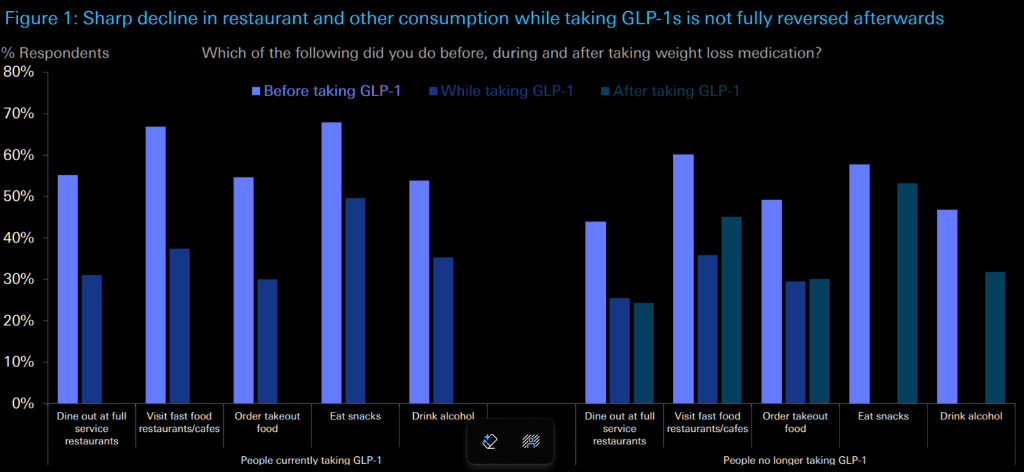
According to research from Deutsche Bank, after starting medication, the share of patients eating at restaurants fell sharply from 55% to 31%, those going to fast food chains and cafes dropped from two-thirds to 37%, and both food delivery and alcohol consumption also fell from over half to about one-third. More importantly, even after stopping medication, the majority of GLP-1 users maintained their new eating habits — “once ingrained, these new habits tend to persist.”
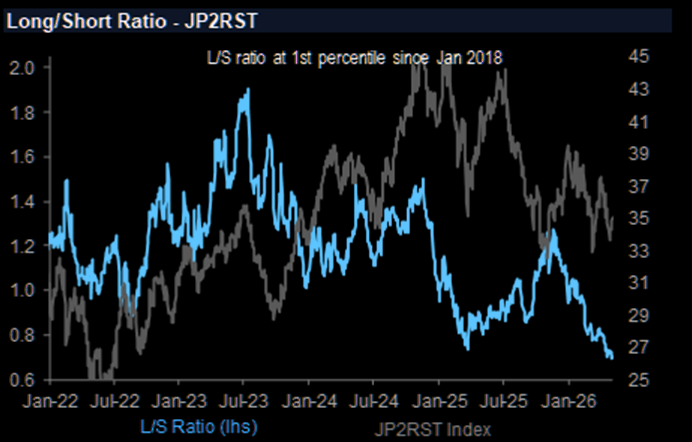
According to JPMorgan data, the overall net performance of the U.S. restaurant sector continues to decline, with the long-short ratio dropping to its lowest percentile in years.
The alcohol industry is likewise deeply troubled. Tequila brand Cuervo has seen its stock price fall by about 70% over the past five years, with over 70% of enterprise value lost since 2021; Diageo has also shown a clear downward trend, losing about $50 billion in market value.
Additionally, the processed food sector is also listed as one of the potential casualties of the GLP-1 wave.
Disclaimer: The content of this article solely reflects the author's opinion and does not represent the platform in any capacity. This article is not intended to serve as a reference for making investment decisions.
You may also like
Gold price holds critical $4,100 support, but can it break $4,200 as inflation risks loom?
Hinkal joins Mastercard Crypto Partner Program for private stablecoin payments
Chipmaker earnings growth cools to 136% as AI boom lifts S&P 500
Updated: Delta Air Lines warns that as fuel prices hit profits, airline capacity will tighten further
Delta Airlines lowers its annual profit forecast due to an expected increase in fuel costs to $6 billion. The CEO stated that ticket prices have risen by about 20% this year, with limited passenger resistance. Analysts warn that maintaining high ticket prices in 2027 is critical for improving profitability. The article includes comments from the earnings call and analyst remarks. Rajesh Kumar Singh/Shivansh Tiwary, Reuters Chicago, October 9 - Delta Airlines (DAL.N) said on Friday that, despite strong travel demand and rising ticket prices, soaring fuel costs have forced it to cut its 2026 profit expectations by nearly a quarter. So, the airline industry may need to further limit flight growth next year to protect profitability. This warning highlights the increasingly tough challenges faced by U.S. airlines. While strong demand and restricted seat growth have allowed airlines to significantly raise ticket prices and offset higher fuel costs, aggressively increasing flights to capture more demand may intensify competition, making it harder to maintain high fares and protect profits. Based in Atlanta, Delta now expects its annual fuel expenditure to increase by about $6 billion compared to last year—about $2 billion higher than its July forecast—due to the Iran war (link) causing global jet fuel prices to spike. Airlines worldwide are preparing for a prolonged fuel shock. Michael O’Leary, CEO of Ryanair Group RYA.I, said Thursday that high jet fuel prices could persist for another 12-18 months (link), adding more pressure on airlines to raise fares and control costs. https://www.reuters.com/graphics/AUTOMATED-20261008/A4A-JET-FUEL-DAILY-1Y/xmpjwjnmbvr/chart.png “In a high-cost environment, you can’t simply grow your way out,” Delta CEO Ed Bastian said on the earnings call. He noted that the industry has already taken steps to restrict capacity, but more measures will be needed next year to improve profitability. Bastian said Delta raised ticket prices about 20% this year, and passenger resistance has been limited. He is confident that even if fuel costs eventually drop, the high fares can still be maintained. Delta lowered its adjusted annual earnings per share forecast from the July prediction of $6.50-$7.50 to $5.10-$5.60. According to LSEG data, the midpoint of the new range is below analysts’ average expectation of $5.46. Third-quarter adjusted earnings per share were $1.72, four cents below analysts’ average forecast. In midday trading, shares of Delta dropped 1.7%, United Airlines UAL.O fell 1.4%, and both American Airlines AAL.O and Southwest Airlines LUV.N were down about 1%. Delta partly shields itself from rising fuel costs by owning a refinery outside Philadelphia (link), which is expected to generate over $700 million in profits this year. Even with this buffer, the airline expects its fourth-quarter fuel price to rise from $3.61 per gallon in Q3 to $4.25 per gallon. Delta forecasts adjusted fourth-quarter earnings per share to be between $1.15-$1.65, with the $1.40 midpoint roughly matching analysts’ average expectation of $1.39. Fare increases Government data shows that in the first eight months of 2026, U.S. airlines spent $42.9 billion on fuel, an increase of $13.2 billion compared to the same period last year despite slightly reduced consumption. According to the U.S. Bureau of Labor Statistics, strong demand and limited seat growth pushed average U.S. airline ticket prices up by about 25% year-on-year between April and August. https://www.reuters.com/graphics/USA-AIRLINES/FUEL/lbpgdnbzwvq/chart.png Analysts at Melius Research said that despite surging fuel costs, Delta’s ability to raise fares helps keep second-half profits roughly stable. Still, they warn that the company’s profit margin has struggled to improve over the years. “It is critical for margin improvement to maintain or raise fares in 2027,” they wrote in their research report. With industry capacity growth expected to accelerate in Q4, this challenge will likely become even tougher. Deutsche Bank analysts expect the proportion of fuel costs recouped through revenue measures to fall in Q4 and predict full recovery won’t happen until early 2027. Bastian noted that low industry returns are another reason for limiting capacity growth. He said Delta will be cautious with its 2027 capacity plan until the fuel price outlook becomes clearer. He added that international routes may account for a larger share of Delta’s capacity expansion compared to domestic routes. Currently, Delta says its premium cabins and corporate travel business remain strong, and its economy cabin business is gradually improving. With Q4 ticket bookings already exceeding 60%, Delta expects revenue to increase about 20% year-on-year, despite limited capacity growth. Executives said early booking trends for Q1 2027 are also encouraging. (For the convenience of non-native English speakers, Reuters automatically translates its reports into several
Crypto prices
More


