
Bitget App
Trade smarter
Buy cryptoMarketsTradeFuturesStocksEarnInstitutionAI & More
Brent Crude Tumbles Below $99 as Trump Signals US-Iran Deal, Bitcoin Holds Near $77K

Brent Crude Tumbles Below $99 as Trump Signals US-Iran Deal, Bitcoin Holds Near $77K

CryptoNewsNetCryptoNewsNet2026/05/25 01:42
By:CryptoNewsNet

  Brent Crude Tumbles Below $99 as Trump Signals US-Iran Deal, Bitcoin Holds Near $77K image 0

Oil markets slid over the Memorial Day weekend as President Trump said a deal to reopen the Strait of Hormuz is “largely negotiated,” pulling Brent crude below $99 while bitcoin held near $77,000 with U.S. stock exchanges shuttered for the holiday.

Key Takeaways:

  • Brent crude fell below $99 on May 24 as Trump declared a U.S.-Iran deal “largely negotiated,” targeting the reopening of the Strait of Hormuz.
  • JPMorgan forecasts Brent averaging $60 long-term if tensions ease, with WTI potentially sliding into the $80s on confirmed supply restoration.
  • Bitcoin held near $77,000 through the Memorial Day weekend as crypto markets stayed open while NYSE, CME, and bond markets will be closed on May 25.

Trump Signals U.S.-Iran Deal Pushes Brent Crude Below $99 as WTI Eyes $80s

Brent crude dropped roughly 4.87% in weekend CFD trading to around $98.87, extending a pullback from Friday’s settlement near $103. The West Texas Intermediate (WTI) July 2026 contract closed Friday at $97.00, up 0.67% on the session, though weekend indications pointed lower. Earlier in May, Brent had traded above $110 on supply fears tied to the U.S.-Iran conflict before retreating sharply each time talks advanced.

The Strait of Hormuz remains the pivot point. The waterway carries roughly 20% of global oil trade, and Iranian restrictions alongside U.S. naval actions have cut off more than 10 million barrels per day at peak disruption levels since fighting escalated in late February. Each round of ceasefire signals has knocked prices down by double digits in single sessions.

Trump’s weekend statements added weight to bearish sentiment. The president remarked that a deal is close, with terms expected to include a 60-day ceasefire extension, potential sanctions relief, and deferred nuclear talks. Iran has submitted revised proposals, and regional players, including Saudi Arabia and the UAE, are reportedly involved in the process. Sticking points remain around Iranian control of the strait, uranium stockpiles, and concerns raised by Israel.
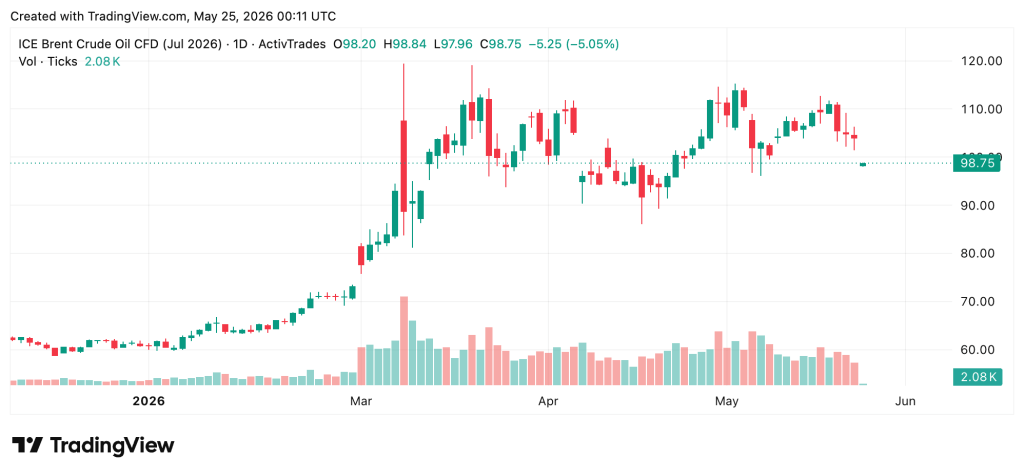
Brent Crude Tumbles Below $99 as Trump Signals US-Iran Deal, Bitcoin Holds Near $77K image 1 Brent futures. Image source via Tradingview

Traders expect a confirmed deal to push WTI toward the $80s. Infrastructure repairs and shipping logistics could delay full supply normalization by weeks or months, but the market is already pricing in restored flow. If talks collapse, the risk premium returns fast.

The futures curve reflects the split outlook. Brent contracts for August traded near $99.50, September near $96.00, with further months declining as markets price in eventual normalization. Analysts at JPMorgan have flagged a $60 average for Brent if geopolitical tensions ease and projected surpluses materialize later in 2026. Other forecasters see Q2 averages closer to $90 to $100, given the disruption period.

Pakistan-mediated ceasefire rounds earlier this spring triggered some of the steepest single-day price drops of the year. The same pattern is repeating. Deal optimism compresses the risk premium; any breakdown restores it. Traders heading into Tuesday’s session are watching for formal confirmation.

Bitcoin held between $76,700 and $77,200 through the weekend with no meaningful breakout in either direction. Crypto markets operate 24 hours a day and remain the only major financial market active during the U.S. holiday. Ethereum and altcoins moved in line with bitcoin, with overall volume thin and momentum flat. At least for now, at 8:30 p.m. ET on Sunday evening.

U.S. stock markets, bond markets, and CME energy futures operate under holiday restrictions tomorrow, May 25. Normal trading resumes Tuesday, May 26. That session will absorb any deal developments that emerge over the long weekend. Anything could happen in between that time.

Oil’s near-term direction stays event-driven. A confirmed Hormuz reopening flips the supply picture fast. Traders who rode prices above $110 in early May have already seen what deal optimism does on the way down.

Bitcoin’s consolidation near $77,000 has held through a period of macro and geopolitical noise. Whether that changes on Tuesday depends largely on what happens in a Strait 7,000 miles away. Per usual, crypto may feel it first.

0
0

Disclaimer: The content of this article solely reflects the author's opinion and does not represent the platform in any capacity. This article is not intended to serve as a reference for making investment decisions.

Understand the market, then trade.
Bitget offers one-stop trading for cryptocurrencies, stocks, and gold.
Trade now!

You may also like

Updated: Delta Air Lines warns that as fuel prices hit profits, airline capacity will tighten further

Delta Airlines lowers its annual profit forecast due to an expected increase in fuel costs to $6 billion. The CEO stated that ticket prices have risen by about 20% this year, with limited passenger resistance. Analysts warn that maintaining high ticket prices in 2027 is critical for improving profitability. The article includes comments from the earnings call and analyst remarks. Rajesh Kumar Singh/Shivansh Tiwary, Reuters Chicago, October 9 - Delta Airlines (DAL.N) said on Friday that, despite strong travel demand and rising ticket prices, soaring fuel costs have forced it to cut its 2026 profit expectations by nearly a quarter. So, the airline industry may need to further limit flight growth next year to protect profitability. This warning highlights the increasingly tough challenges faced by U.S. airlines. While strong demand and restricted seat growth have allowed airlines to significantly raise ticket prices and offset higher fuel costs, aggressively increasing flights to capture more demand may intensify competition, making it harder to maintain high fares and protect profits. Based in Atlanta, Delta now expects its annual fuel expenditure to increase by about $6 billion compared to last year—about $2 billion higher than its July forecast—due to the Iran war (link) causing global jet fuel prices to spike. Airlines worldwide are preparing for a prolonged fuel shock. Michael O’Leary, CEO of Ryanair Group RYA.I, said Thursday that high jet fuel prices could persist for another 12-18 months (link), adding more pressure on airlines to raise fares and control costs. https://www.reuters.com/graphics/AUTOMATED-20261008/A4A-JET-FUEL-DAILY-1Y/xmpjwjnmbvr/chart.png “In a high-cost environment, you can’t simply grow your way out,” Delta CEO Ed Bastian said on the earnings call. He noted that the industry has already taken steps to restrict capacity, but more measures will be needed next year to improve profitability. Bastian said Delta raised ticket prices about 20% this year, and passenger resistance has been limited. He is confident that even if fuel costs eventually drop, the high fares can still be maintained. Delta lowered its adjusted annual earnings per share forecast from the July prediction of $6.50-$7.50 to $5.10-$5.60. According to LSEG data, the midpoint of the new range is below analysts’ average expectation of $5.46. Third-quarter adjusted earnings per share were $1.72, four cents below analysts’ average forecast. In midday trading, shares of Delta dropped 1.7%, United Airlines UAL.O fell 1.4%, and both American Airlines AAL.O and Southwest Airlines LUV.N were down about 1%. Delta partly shields itself from rising fuel costs by owning a refinery outside Philadelphia (link), which is expected to generate over $700 million in profits this year. Even with this buffer, the airline expects its fourth-quarter fuel price to rise from $3.61 per gallon in Q3 to $4.25 per gallon. Delta forecasts adjusted fourth-quarter earnings per share to be between $1.15-$1.65, with the $1.40 midpoint roughly matching analysts’ average expectation of $1.39. Fare increases Government data shows that in the first eight months of 2026, U.S. airlines spent $42.9 billion on fuel, an increase of $13.2 billion compared to the same period last year despite slightly reduced consumption. According to the U.S. Bureau of Labor Statistics, strong demand and limited seat growth pushed average U.S. airline ticket prices up by about 25% year-on-year between April and August. https://www.reuters.com/graphics/USA-AIRLINES/FUEL/lbpgdnbzwvq/chart.png Analysts at Melius Research said that despite surging fuel costs, Delta’s ability to raise fares helps keep second-half profits roughly stable. Still, they warn that the company’s profit margin has struggled to improve over the years. “It is critical for margin improvement to maintain or raise fares in 2027,” they wrote in their research report. With industry capacity growth expected to accelerate in Q4, this challenge will likely become even tougher. Deutsche Bank analysts expect the proportion of fuel costs recouped through revenue measures to fall in Q4 and predict full recovery won’t happen until early 2027. Bastian noted that low industry returns are another reason for limiting capacity growth. He said Delta will be cautious with its 2027 capacity plan until the fuel price outlook becomes clearer. He added that international routes may account for a larger share of Delta’s capacity expansion compared to domestic routes. Currently, Delta says its premium cabins and corporate travel business remain strong, and its economy cabin business is gradually improving. With Q4 ticket bookings already exceeding 60%, Delta expects revenue to increase about 20% year-on-year, despite limited capacity growth. Executives said early booking trends for Q1 2027 are also encouraging. (For the convenience of non-native English speakers, Reuters automatically translates its reports into several

路透社•2026/10/09 17:36

Wall Street giants to release financial reports next week: stock trading revenue expected to approach $19 billion, "everyone is a winner" may be a thing of the past

According to analyst expectations compiled by Bloomberg, the combined equity trading revenue of the five major U.S. banks in the third quarter will approach $19 billion, but fixed income trading revenue is expected to drop to its lowest point of the year, and M&A activity has also cooled. Meanwhile, AI-driven cash optimization tools may lead to deposit outflows, sparking concerns about bank stocks in the market. Analysts believe that while the profit performance of each bank may further diverge, market concerns about the impact of AI may be overblown.

华尔街见闻•2026/10/09 16:11