
Starship “passes with damage”! SpaceX’s trillion-dollar IPO critical battle: The market has even more faith in Musk

SpaceX’s 12th Starship test flight was unable to achieve full success, as the booster recovery failed, leaving an obvious flaw in this mission. However, analysts and investors believe that this is already sufficient.
On May 22, SpaceX completed Starship’s 12th test flight at its Starbase in Texas, which was also the maiden flight of the V3 iteration. The vehicle successfully deployed a batch of simulated satellites and executed a controlled splashdown in the Indian Ocean, but the Super Heavy booster failed to be recovered, ending up in the Gulf of Mexico. Reports indicate that SpaceX’s IPO roadshow is scheduled to begin on June 4. If the issuance goes smoothly, the fundraising amount could reach as high as $80 billion, potentially setting a record for the world’s largest IPO.
Analysts have characterized this test as a "lukewarm success"—neither a total failure, nor a comprehensive breakthrough. After a seven-month gap since the previous flight, simply completing the test carries strong significance in reassuring the market. Mark Vena, CEO of SmartTech Research, said, “SpaceX didn’t need this flight to be perfect; it needed to show progress in the upgraded vehicle, and investors have by and large seen that.”
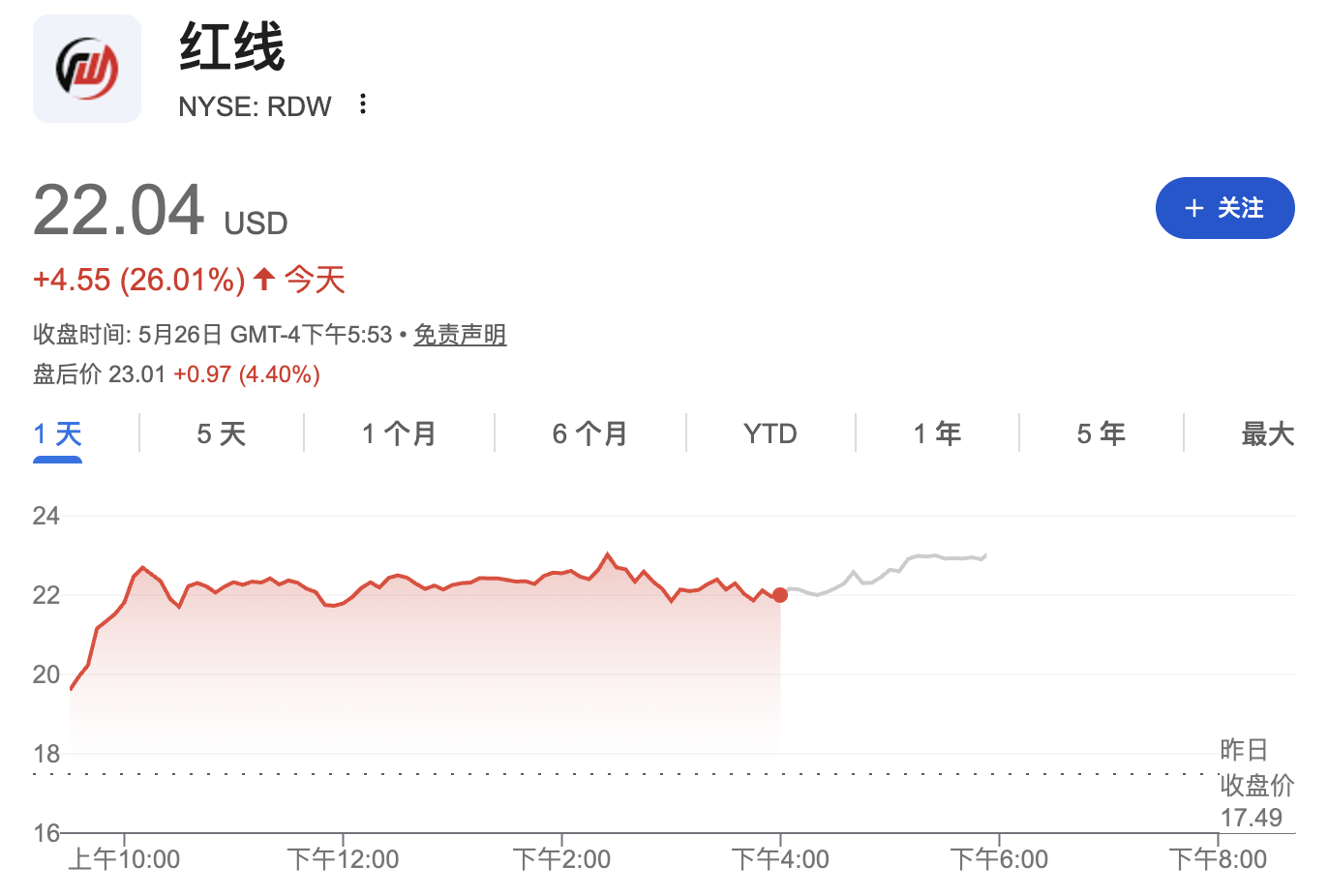
The SpaceX IPO has ignited a wave of enthusiasm for space on Wall Street. On Tuesday, shares of space infrastructure company Redwire surged as much as 31%, closing up 26%. Firefly, buoyed by winning a NASA lunar contract, jumped 19%. Bank of America’s Space Basket stocks have soared 61% this year, while the Procure Space ETF is up nearly 69%, far outpacing the S&P 500’s 9.8%. Investors are increasingly viewing SpaceX through a broader lens, positioning it as a future provider of AI infrastructure. However, whether Starship can maintain stable, commercial-scale operations remains a key point of contention between bulls and bears.
"Lukewarm Success"
Since 2023, SpaceX’s 12th Starship test reflects distinctly mixed results.
On the positive side, the V3 version successfully completed the simulated satellite deployment and achieved a controlled splashdown in the Indian Ocean. On the downside, the Super Heavy booster—which is a core reusable component—failed to execute a controlled landing as planned, ultimately plunging into the Gulf of Mexico.
Antoine Grenier, Partner and Head of Space Consulting at Analysys Mason, described the “lukewarm success” as “a good result, possibly even the best outcome.” He explained, "A total failure would be problematic, while a comprehensive success could fuel excessive market hype ahead of the IPO."
SpaceX has invested over $15 billion in Starship’s development, aiming to create a fully reusable heavy-lift rocket with capabilities far beyond current launch systems. As of now, this remains a work in progress.
Critical Window Ahead of IPO
It’s been seven months since the previous Starship test. Analysts point out that this gap made completing the test before the IPO nearly essential.
Antoine Grenier said that if SpaceX had failed to complete the launch ahead of its IPO, “it would spark more questions from investors about the company’s execution pace.” From this perspective, the completion of the test itself is as symbolically significant as its outcome.
Starship’s strategic value extends far beyond launch services. In its IPO filing, SpaceX emphasized that Starship is crucial for lowering launch costs, expanding the Starlink satellite internet business (currently the company’s main cash source), and supporting orbital AI data center satellite deployment, crewed lunar missions, and Mars exploration. If the roadshow progresses smoothly, the $80 billion issuance would surpass all previous IPOs.
Bullish Case: From Rockets to AI Infrastructure
Investor and analyst bullishness remains largely undented by the flaws in the test, underpinned by a broader macro investment thesis.
James Bruegger, CIO of UK investment firm Seraphim Space, stated, “Full reusability is key to radically lowering launch costs, and that’s where the real value lies.”
Investors are increasingly viewing SpaceX as a potential core provider of AI infrastructure, betting on orbital data centers and next-generation satellite constellations. This Tuesday, Musk also endorsed his AI company xAI, saying that this three-year-old company remains in an early stage compared to OpenAI and Anthropic, and promising its models “will be outstanding.”
MarketVector Indexes researcher Jesse Nacht noted, “This launch reduces the long-tail risk of Starship entering a failure loop but does not completely eliminate execution risks. Barring a catastrophic failure, I don’t see it significantly shifting market expectations.”
Execution Risks Remain
Despite overall bullish market sentiment, analysts consistently stress that Starship remains some distance from stable, economical operations at commercial scale.
Austin Moeller, Executive Director of Equity Research at Canaccord Genuity, said, “SpaceX clearly needs to demonstrate successful launches, payload deployment, orbital insertion, and controlled landings of both booster and vehicle to enable large-scale system deployment and build orbital data center mega-constellations.”
SpaceX itself cautioned in its IPO filing that delays in development or cost targets could increase operating expenses, potentially impeding the rollout of next-generation satellites and AI infrastructure. Some investors fear that Starship could become stuck in a “fix-fail” loop, never delivering a fully validated end-to-end system.
For the market, this test offers incremental confirmation of confidence rather than a decisive technological breakthrough. Whether the booster can achieve stable recovery and rapid turnaround in future flights will remain a key metric for investors throughout the roadshow period.
Disclaimer: The content of this article solely reflects the author's opinion and does not represent the platform in any capacity. This article is not intended to serve as a reference for making investment decisions.
You may also like
Morgan Stanley Bullish on SpaceX: "Tera’Merica" Potential Undervalued, Enterprise AI and Computing Power Expansion Unlock Growth Space
Morgan Stanley believes that SpaceX's growth logic is expanding from aerospace and satellite communications to enterprise AI and computational infrastructure, while the reconstruction of U.S. advanced manufacturing may also open up broader long-term opportunities. The commercialization of enterprise AI and the expansion of computational power provide more direct growth support, while the manufacturing opportunities represented by "Tera’Merica" offer additional long-term growth potential for the company.
Bitcoin Price LIVE: Buyers Absorb Selling as $87,220 Liquidity Target Looms
Standard Chartered maintains $250 year end target for SOL despite price drop
SpaceX to Acquire Low-Band Spectrum Portfolio From Grain Management in Mobile Connectivity Push
06:50 AM EDT, 10/09/2026 (MT Newswires) -- SpaceX (SPCX) shares rose early Friday after the rocket and satellite company agreed to acquire a nationwide low-band spectrum portfolio from investment firm Grain Management as it seeks to establish Starlink Mobile as a major US mobile carrier. SpaceX will buy Grain Management's entire portfolio of up to 14 megahertz of paired spectrum in the 800 MHz band, the companies said in separate statements late Thursday. The deal is subject to the Federal Communications Commission's approval and other customary closing conditions. SpaceX's stock gained 3.7% in the most recent premarket activity. The companies did not disclose the financial terms, and neither immediately responded to MT Newswires' request for comment on the reported transaction value. SpaceX will pay about $8 billion in cash for the assets, The Wall Street Journal reported Thursday, citing people familiar with the matter. Grain Management, which specializes in digital infrastructure, acquired the 800 MHz spectrum portfolio from T-Mobile US (TMUS) in August in exchange for $2.9 billion in cash and all of Grain's 600 MHz spectrum licenses. "This prime low-band spectrum addresses one of the key remaining technical gaps that will pave the way for Starlink Mobile to become a major mobile carrier in the US," SpaceX said in its statement. Following regulatory approval, SpaceX intends to combine its satellite-to-mobile constellation in space with a terrestrial deployment that will enable Starlink Mobile's signals and services to reach customers from both the ground and space, according to the companies. SpaceX said most existing mobile devices already support the band. "Our spectrum expertise allows us to connect the strategic value of these assets with the technologies and operators that can realize their potential," Grain Management Chief Executive David Grain said in a separate statement. "This agreement with SpaceX brings that capability to bear at extraordinary scale." Shares of Verizon Communications (VZ), AT&T (T)
Crypto prices
More


