
Bitcoin's 4-Year Rhythm Is Still Playing Out, Says Crypto CEO

By:Newsbtc
Bitget offers one-stop trading for cryptocurrencies, stocks, and gold. Trade now!
A welcome pack worth 6200 USDT for new users! Sign up now!
A countertrend rally that pushed Bitcoin to $82,800 has done little to change one analyst’s bearish outlook — because he says the bounce itself is proof the pattern is repeating.

What The Charts Are Showing
Benjamin Cowen, founder and CEO of Into The Cryptoverse, points to a recurring rejection at the 200-day simple moving average as a key signal. The same thing happened in 2018 and 2022, and both times it came just before the final leg down.
Cowen also noted that some countertrend rallies in past cycles ran longer than 20 weeks. The current one clocked in at 16 weeks, which he says undercuts the argument that Bitcoin has already found its floor.
var rnd = window.rnd || Math.floor(Math.random()*10e6); var pid607465 = window.pid607465 || rnd; var plc607465 = window.plc607465 || 0; var abkw = window.abkw || ''; var absrc = 'https://servedbyadbutler.com/adserve/;ID=172179;size=0x0;setID=607465;type=js;sw='+screen.width+';sh='+screen.height+';spr='+window.devicePixelRatio+';kw='+abkw+';pid='+pid607465+';place='+(plc607465++)+';rnd='+rnd+';click=CLICK_MACRO_PLACEHOLDER'; document.write('
');
if (!window.AdButler){(function(){var s = document.createElement("script"); s.async = true; s.type = "text/javascript";s.src = "https://servedbyadbutler.com/app.js";var n = document.getElementsByTagName("script")[0]; n.parentNode.insertBefore(s, n);}());}
var AdButler = AdButler || {}; AdButler.ads = AdButler.ads || []; var abkw = window.abkw || ""; var plc366606 = window.plc366606 || 0; (function(){ var divs = document.querySelectorAll(".plc366606:not([id])"); var div = divs[divs.length-1]; div.id = "placement_366606_"+plc366606; AdButler.ads.push({handler: function(opt){ AdButler.register(172179, 366606, [728,90], "placement_366606_"+opt.place, opt); }, opt: { place: plc366606++, keywords: abkw, domain: "servedbyadbutler.com", click:"CLICK_MACRO_PLACEHOLDER" }}); })();
The four year cycle for Bitcoin is not dead.
Bitcoin topped when it always topped (to within 1 week when measure from low-to-high), so why can’t it bottom near the end of the midterm year, just as it generally has? (1/x)
— Benjamin Cowen (@benjamincowen) May 25, 2026
Bitcoin Peaked On Schedule
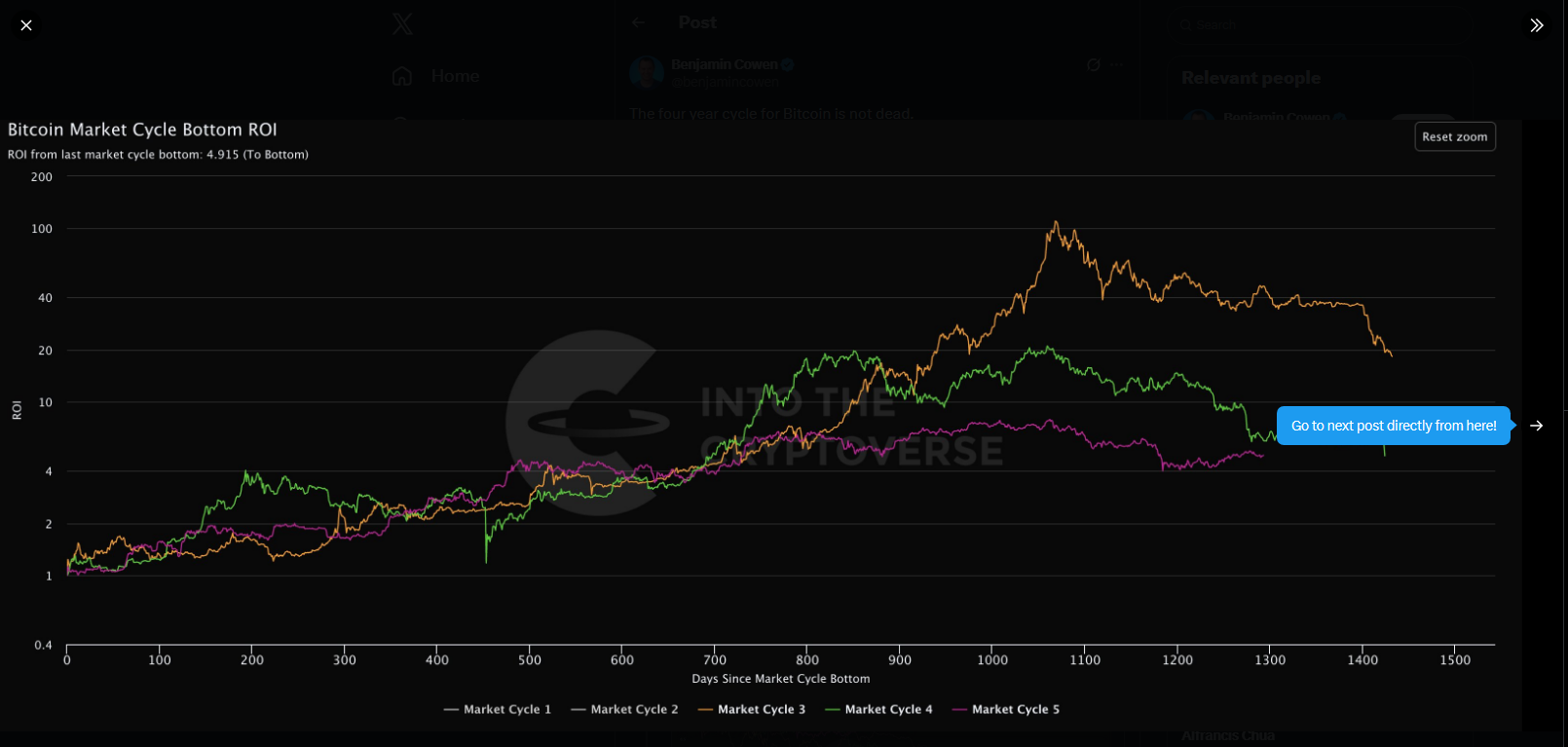
According to Cowen, Bitcoin’s run-up to $126,200 in October 2025 landed within the expected cycle window when measured from the previous low to the high. That kind of timing at the top, he argues, makes it harder to dismiss the same framework when looking at where the bottom might land.
Past cycles put their lows in the closing months of the midterm year — December 2018 and November 2022, specifically. Based on that pattern, Cowen believes the bottom is still ahead, likely toward the end of 2026.
var rnd = window.rnd || Math.floor(Math.random()*10e6); var pid607472 = window.pid607472 || rnd; var plc607472 = window.plc607472 || 0; var abkw = window.abkw || ''; var absrc = 'https://servedbyadbutler.com/adserve/;ID=172179;size=0x0;setID=607472;type=js;sw='+screen.width+';sh='+screen.height+';spr='+window.devicePixelRatio+';kw='+abkw+';pid='+pid607472+';place='+(plc607472++)+';rnd='+rnd+';click=CLICK_MACRO_PLACEHOLDER'; document.write('
');
if (!window.AdButler){(function(){var s = document.createElement("script"); s.async = true; s.type = "text/javascript";s.src = "https://servedbyadbutler.com/app.js";var n = document.getElementsByTagName("script")[0]; n.parentNode.insertBefore(s, n);}());}
var AdButler = AdButler || {}; AdButler.ads = AdButler.ads || []; var abkw = window.abkw || ""; var plc452518 = window.plc452518 || 0; (function(){ var divs = document.querySelectorAll(".plc452518:not([id])"); var div = divs[divs.length-1]; div.id = "placement_452518_"+plc452518; AdButler.ads.push({handler: function(opt){ AdButler.register(172179, 452518, [728,90], "placement_452518_"+opt.place, opt); }, opt: { place: plc452518++, keywords: abkw, domain: "servedbyadbutler.com", click:"CLICK_MACRO_PLACEHOLDER" }}); })();
Two charts he shared support the view. One tracks the return on investment from the market cycle peak to the bear market low. The other tracks the multiplier from bear market lows to the next bull market peak. Both are following the shape of prior cycles, even if the raw numbers are smaller this time around.
When The Drop Could Come
Cowen had previously flagged May and June as the window when the next significant decline would begin. He expects that move to carry Bitcoin below the February 6 low of $60,000 — a level that a number of other analysts have called the cycle bottom.
Crypto Market Sees $1.46B Fund Exodus As Traders Turn Cautious
Not everyone sees another drop coming. Analyst Sykodelic has predicted Bitcoin will climb past $90,000 in June after retesting a key level of support.
var rnd = window.rnd || Math.floor(Math.random()*10e6); var pid607473 = window.pid607473 || rnd; var plc607473 = window.plc607473 || 0; var abkw = window.abkw || ''; var absrc = 'https://servedbyadbutler.com/adserve/;ID=172179;size=0x0;setID=607473;type=js;sw='+screen.width+';sh='+screen.height+';spr='+window.devicePixelRatio+';kw='+abkw+';pid='+pid607473+';place='+(plc607473++)+';rnd='+rnd+';click=CLICK_MACRO_PLACEHOLDER'; document.write('
');
if (!window.AdButler){(function(){var s = document.createElement("script"); s.async = true; s.type = "text/javascript";s.src = 'https://servedbyadbutler.com/app.js';var n = document.getElementsByTagName("script")[0]; n.parentNode.insertBefore(s, n);}());}
var AdButler = AdButler || {}; AdButler.ads = AdButler.ads || []; var abkw = window.abkw || ''; var plc452519 = window.plc452519 || 0; (function(){ var divs = document.querySelectorAll(".plc452519:not([id])"); var div = divs[divs.length-1]; div.id = "placement_452519_"+plc452519; AdButler.ads.push({handler: function(opt){ AdButler.register(172179, 452519, [728,90], 'placement_452519_'+opt.place, opt); }, opt: { place: plc452519++, keywords: abkw, domain: 'servedbyadbutler.com', click:'CLICK_MACRO_PLACEHOLDER' }}); })();
The debate reflects a broader split in how analysts are reading the market right now. Cowen’s position rests on the idea that the four-year cycle, tied to Bitcoin’s halving schedule, continues to drive price behavior in a predictable way despite the asset’s growth and changing market structure.
Featured image from Pexels, chart from TradingView
0
0
Disclaimer: The content of this article solely reflects the author's opinion and does not represent the platform in any capacity. This article is not intended to serve as a reference for making investment decisions.
Understand the market, then trade.
Bitget offers one-stop trading for cryptocurrencies, stocks, and gold.
Trade now!
You may also like
"SaaS Apocalypse" Debunked? Autodesk (ADSK.US) and Intuit (INTU.US) Lead Growth Against the Trend as Wall Street Reprices the "AI Eating Software" Narrative
This week, Autodesk and Intuit are expected to record their strongest weekly gains in months, defying pressure on the overall technology sector. This strong performance signals a renewed optimism in the market regarding the growth prospects of the SaaS (Software as a Service) industry.
智通财经•2026/10/09 09:56
Starlink Targets the US Mobile Communication Market, SpaceX (SPCX.US) Opens New Growth Opportunities: Wall Street Focuses on the Reshaping of the Telecom Industry Landscape
Combining the existing satellite capacity, SpaceX is supplementing its capabilities to upgrade from “occasional emergency connectivity” to “daily mobile service.” The satellite network provides wide-area coverage and fills ground blind spots, while low-frequency terrestrial networks improve connectivity inside buildings and in environments with complex obstructions. The two form a complement to each other.
智通财经•2026/10/09 09:56

The Decisive Significance of Next Week's U.S. CPI: Will the Federal Reserve Hold Off on Raising Interest Rates in October?
Barclays and Morgan Stanley both expect the month-on-month increase in core CPI for September to slow from 0.29% in August to 0.24%, mainly due to a decline in the price increase of wireless communication services. Energy is driving overall inflation, but the marginal core pressure is easing, providing justification for the Federal Reserve to keep rates unchanged in October.
华尔街见闻•2026/10/09 09:27

Crypto prices
More
Bitcoin
BTC
$82,628.04
-0.49%

Ethereum
ETH
$2,501.3
-2.49%

Tether USDt
USDT
$0.9991
-0.01%

BNB
BNB
$742.41
-3.39%

XRP
XRP
$1.4
-1.03%

USDC
USDC
$0.9998
+0.01%

Solana
SOL
$110.37
-4.10%

TRON
TRX
$0.3320
-1.28%

Hyperliquid
HYPE
$86.16
-1.08%

Zcash
ZEC
$1,229.87
+0.38%
How to buy BTC
Bitget lists BTC – Buy or sell BTC quickly on Bitget!
Trade now
Become a trader now?A welcome pack worth 6200 USDT for new users!
Sign up now