Bitget App
Trade smarter
Buy cryptoMarketsTradeFuturesStocksEarnInstitutionAI & More
CHARTS: How the sulphuric acid crunch is driving up critical minerals costs

CHARTS: How the sulphuric acid crunch is driving up critical minerals costs

Mining.comMining.com2026/05/28 13:00
By:Mining.com

Conflict in the Middle East and the closure of the Strait of Hormuz have sent sulphuric acid prices soaring, sharply increasing production costs for lithium, nickel and other critical minerals essential to the energy transition.

var rnd = window.rnd || Math.floor(Math.random() * 10e6); var pid472436 = window.pid472436 || rnd; var plc472436 = window.plc472436 || 0; var abkw = window.abkw || ''; var absrc = 'https://servedbyadbutler.com/adserve/;ID=181210;size=0x0;setID=472436;type=js;sw=' + screen.width + ';sh=' + screen.height + ';spr=' + window.devicePixelRatio + ';kw=' + abkw + ';pid=' + pid472436+ ';place=' + (plc472436++) + ';rnd=' + rnd + ';click=CLICK_MACRO_PLACEHOLDER'; document.write('
');

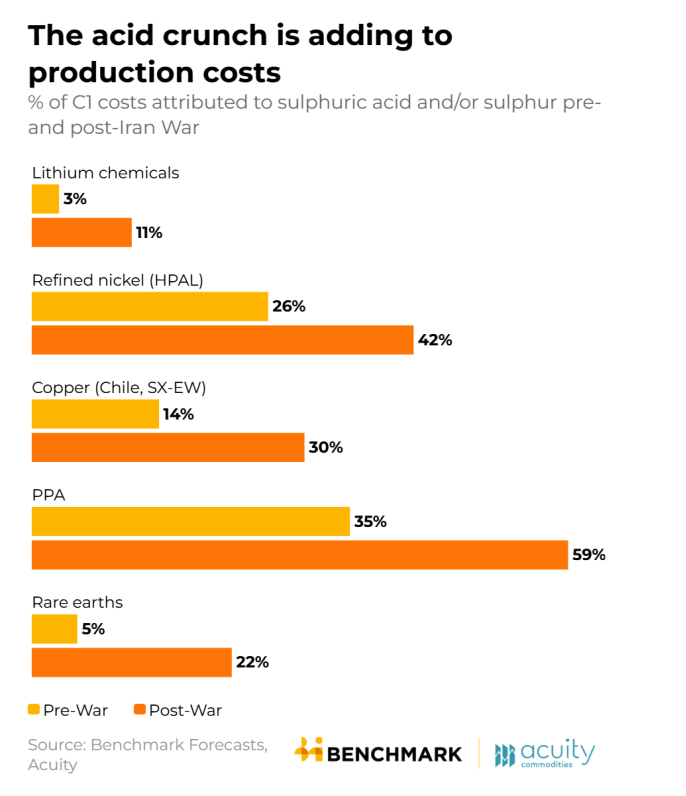
Benchmark Mineral Intelligence said sulphur prices have climbed more than 50% since the start of the war in Iran, while sulphuric acid prices have more than doubled in some regions, disrupting supply chains for battery metals and forcing some refiners to curb production amid shortages of physical sulphur supply.
CHARTS: How the sulphuric acid crunch is driving up critical minerals costs image 0

“Sulphuric acid is a vital feedstock for many critical minerals, and the disruption to the sulphur market from the ongoing Middle East conflict has had knock-on effects across key markets,” Benchmark raw materials research manager Will Talbot said. “The outstanding risk is that more critical minerals players cut production or even shut down operations entirely.”

Lithium squeeze

The supply shock is reshaping the economics of battery materials production. Benchmark said sulphuric acid previously represented about 3% of the cost of producing lithium chemicals from hard rock sources but now accounts for 11%, overtaking energy as the largest individual C1 cost component. The consultancy’s special report said sulphuric acid now contributes 22% of total hard-rock lithium conversion costs and has become “the single most volatile and material input” in lithium processing.

Nickel production via high-pressure acid leaching has also become heavily exposed to sulphur markets. Benchmark said sulphur now represents 42% of HPAL nickel costs, up from 26% before the conflict. Indonesia, the world’s largest nickel producer, sourced 76% of its sulphur imports from the Middle East last year, while more than 10 tonnes of sulphur are required to produce one tonne of nickel through HPAL processing.

Supply risks

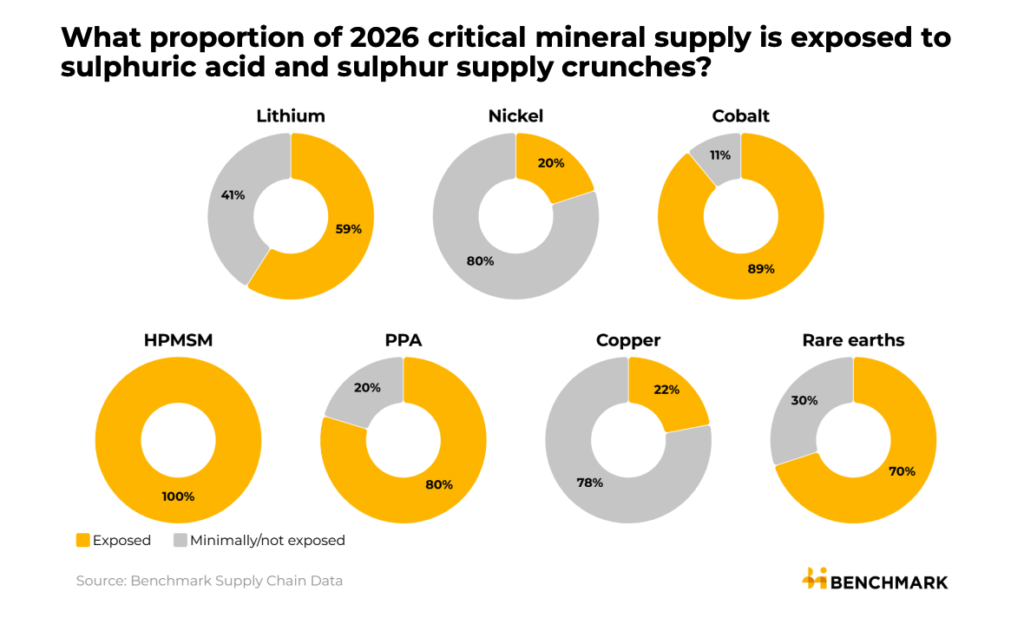
The report warned that physical availability, not just pricing, has become the industry’s biggest risk because at least half of global seaborne sulphur trade passes through the Strait of Hormuz. More than half of global lithium, cobalt, rare earth and purified phosphoric acid production expected in 2026 is exposed to sulphur and sulphuric acid disruptions, according to Benchmark. High-purity manganese sulphate monohydrate, used in EV batteries, is entirely dependent on sulphuric acid supply.
CHARTS: How the sulphuric acid crunch is driving up critical minerals costs image 1

China’s unofficial restriction on sulphuric acid exports has compounded the pressure on refiners outside the country. Benchmark said spot acid prices in Indonesia and Chile have climbed above $380 and $440 per tonne respectively as converters scramble for alternative supplies. Battery-grade lithium carbonate prices in China have already risen about 65% this year in US dollar terms.

Wider fallout

Copper producers are feeling the impact unevenly. While solvent extraction and electrowinning operations that account for 22% of global mined copper output require large volumes of acid, copper smelters are benefiting because sulphuric acid is a profitable byproduct of the smelting process. Benchmark said treatment and refining charges for copper concentrate have dropped sharply since strikes on Iran as rising acid prices improve smelter economics.

The supply squeeze highlights how geopolitical conflict is increasingly colliding with energy transition supply chains. Benchmark said countries with domestic sulphur and acid production capacity, such as the US, are likely to be more insulated than import-reliant jurisdictions including Australia. Even if the Strait of Hormuz reopens quickly, the firm warned damaged Gulf refining infrastructure could take significant time and investment to restore, prolonging pressure across global critical minerals markets.

0
0

Disclaimer: The content of this article solely reflects the author's opinion and does not represent the platform in any capacity. This article is not intended to serve as a reference for making investment decisions.

Understand the market, then trade.
Bitget offers one-stop trading for cryptocurrencies, stocks, and gold.
Trade now!

You may also like

NEWMARK GROUP INC <NMRK.O>: KBW CUTS TARGET PRICE TO $16 FROM $17.50

NEWMARK GROUP INC : KBW CUTS TARGET PRICE TO $16 FROM $17.50

Reuters•2026/10/09 05:31

VALERO ENERGY CORP <VLO.N>: JEFFERIES CUTS TARGET PRICE TO $394 FROM $401

VALERO ENERGY CORP : JEFFERIES CUTS TARGET PRICE TO $394 FROM $401

Reuters•2026/10/09 04:52

The Shopify Stock Rally Isn't Done: Chart of the Week -- Barrons.com

By Doug Busch Shopify is no longer a pandemic-era growth story that simply failed to slow down. It is compounding at a pace few software platforms its size still manage. In the second quarter of 2026, sales on its platform rose 32%. That was the fifth straight quarter of growth exceeding 30%. Merchants are also using more of Shopify's own tools, from payments to Shop Pay, and new channels like AI shopping agents are starting to increase demand. The simple bull case is that the stock already commands a huge share of independent online commerce, and that position should become more valuable as more buying moves through its checkout. A rule of market mechanics is that the vast majority of an individual security's gain is driven by its underlying sector. Within technology, software has staged a robust recovery, joining semiconductors to power the broader sector higher. The iShares Expanded Tech-Software Sector ETF has maintained an upward trajectory since its mid-April lows, though the advance from $74 to $112 has been choppy as bulls repeatedly stepped in to defend when necessary. Breadth across large-cap software has expanded significantly, with 24 constituents surging over 20% over the past three months. During that same three-month window, Shopify generated outstanding relative strength, advancing 36%, more than doubling the IGV's 17% gain over the same period. Expect the stock's outperformance to persist as software momentum broadens. Let's examine the daily and monthly charts to outline the technical drivers behind this thesis. Looking at the daily chart, the ratio chart against the IGV shows persistent outperformance extending back to mid-May. The stock is riding an eight-session winning streak, during which price action cleared a double-bottom-with-handle pivot at $151.39. Within this broader base, the stock recorded a bullish golden cross in late August and successfully filled its Sept. 10 price gap, tracing back to its Aug. 4 session, the day before a powerful earnings reaction sent the stock surging 17% hi

Dow Jones•2026/10/09 03:10