
Prediction markets legal battles heat up in Minnesota, Rhode Island

The US Commodity Futures Trading Commission (CFTC) and companies behind prediction market platforms are continuing legal fights against state-level authorities, with the latest battlegrounds centered in Rhode Island and Minnesota.
Last week, Minnesota Governor Tim Walz signed a bill into law amended statutes to prohibit advertising, creating, operating or otherwise facilitating prediction market platforms. The move prompted CFTC Chair Michael Selig to file in federal court less than 24 hours later, alleging Minnesota and its officials had enacted the “first outright ban” on prediction markets.
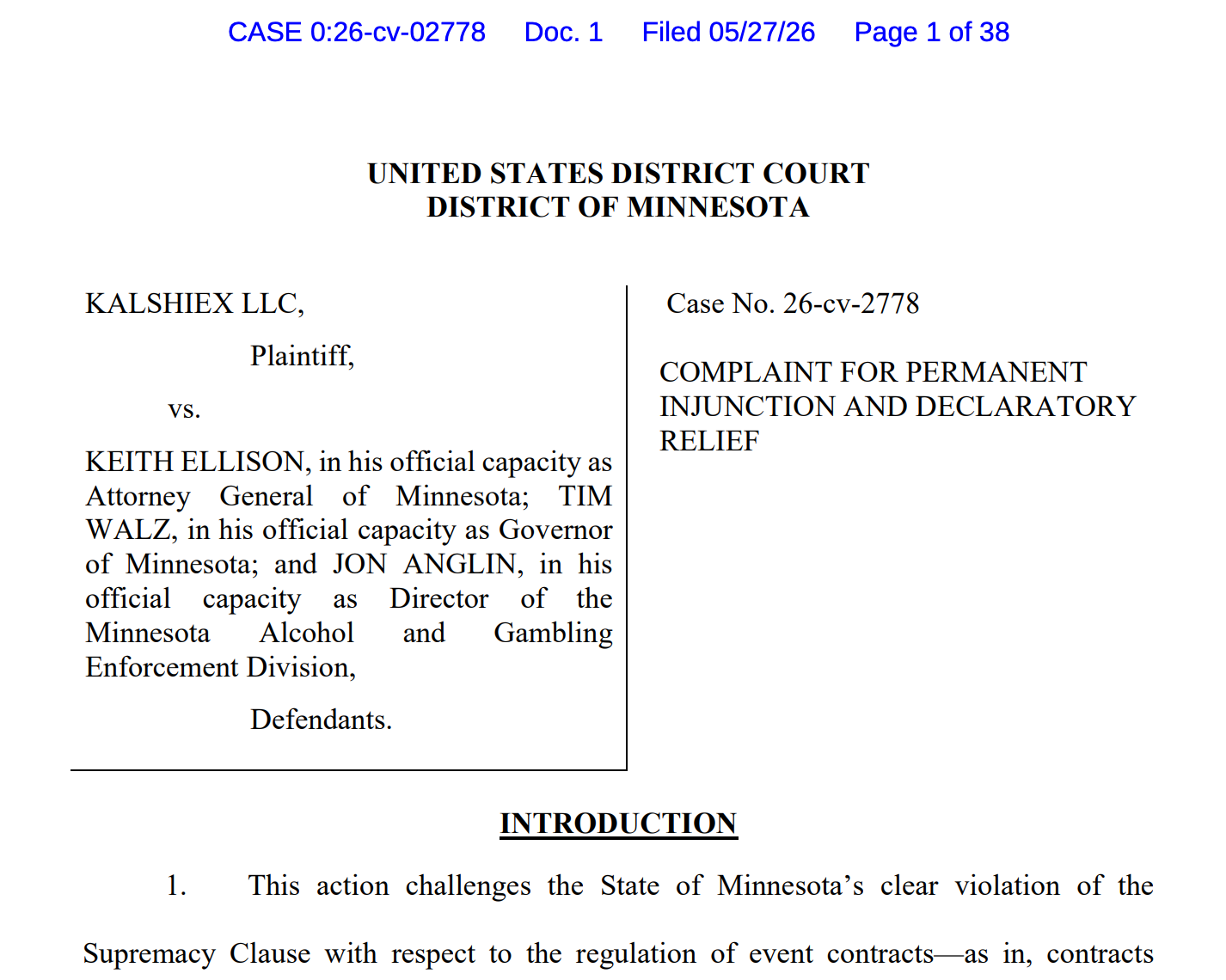
Source: PACER
That set up a move by Kalshi on Wednesday challenging the Minnesota law on constitutional grounds. The company echoed arguments made by Selig, claiming that the CFTC had “exclusive authority” over prediction markets under the Commodity Exchange Act and under the Supremacy Clause of the US Constitution, the federal law took precedence over state laws.
Central to Kalshi’s and Selig’s claims is that event contracts on prediction market platforms are “swaps” traded on federally designated contract markets and subject to the CFTC’s jurisdiction rather than state authorities. Although some courts have rejected this argument, others have sided with Kalshi and the CFTC, setting up a potential case for the US Supreme Court.
Related:
On Thursday, the CFTC announced a joint filing with Kalshi against Rhode Island officials. The motion to intervene reiterated the agency’s previous claims on its authority over prediction markets, stemming from Rhode Island Attorney General Peter Neronha suing Kalshi and Polymarket and asking for a declaration that the platforms’ sports-related “event contracts” amounted to bets.
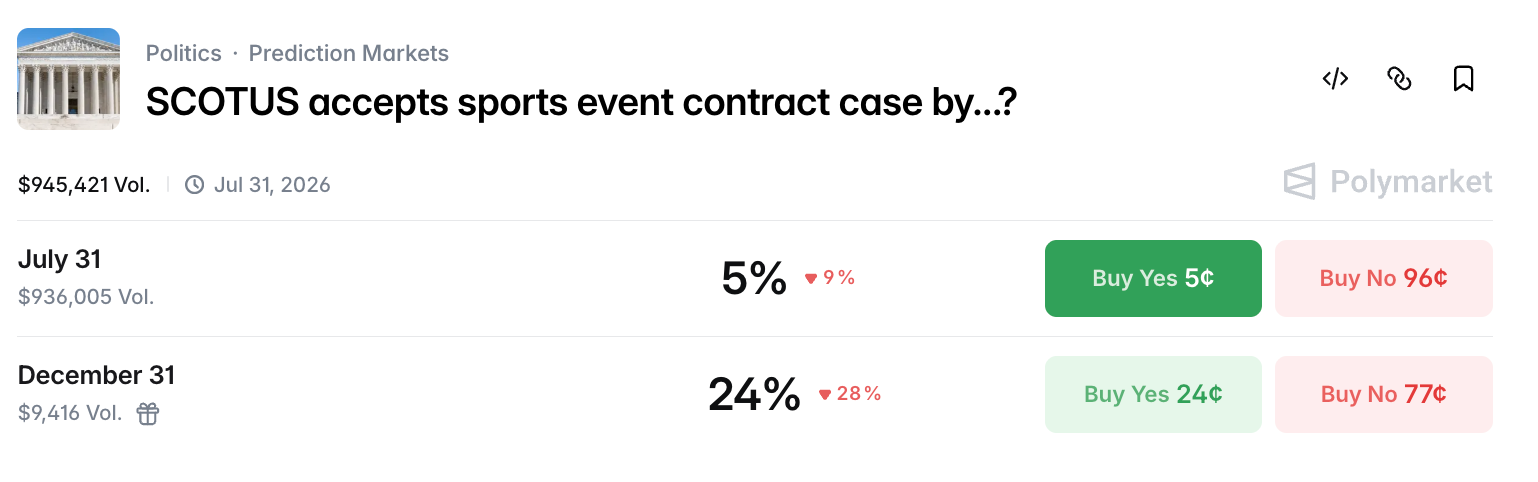
Event contract on when a prediction markets case could go to the US Supreme Court. Source:
Donald Trump weighs in, despite family ties to prediction markets
On Wednesday, US President Donald Trump took to social media, claiming that it was “critically important” that the CFTC had sole authority over prediction markets. His son, Donald Trump Jr., is an adviser to Kalshi and Polymarket and invested in the latter through his venture capital firm, 1789 Capital.
“We want to remain at the top,” said Trump, referring to prediction markets and insulting state officials behind some of the lawsuits against Kalshi and Polymarket.
The platforms have come under scrutiny in the US Congress amid concerns over elected officials potentially being engaged in insider trading. Last week, the chair of the House of Representatives’ Oversight and Government Reform Committee called on the CEOs of Kalshi and Polymarket to answer questions related to the companies’ response to insider trading.
Magazine:
Disclaimer: The content of this article solely reflects the author's opinion and does not represent the platform in any capacity. This article is not intended to serve as a reference for making investment decisions.
You may also like
NEWMARK GROUP INC <NMRK.O>: KBW CUTS TARGET PRICE TO $16 FROM $17.50
NEWMARK GROUP INC : KBW CUTS TARGET PRICE TO $16 FROM $17.50
VALERO ENERGY CORP <VLO.N>: JEFFERIES CUTS TARGET PRICE TO $394 FROM $401
VALERO ENERGY CORP : JEFFERIES CUTS TARGET PRICE TO $394 FROM $401
Gold prices rise Rs 1,500/10g; silver up Rs 3,100/kg ahead of US economic data, softer yields. Buy, sell or hold?
The Shopify Stock Rally Isn't Done: Chart of the Week -- Barrons.com
By Doug Busch Shopify is no longer a pandemic-era growth story that simply failed to slow down. It is compounding at a pace few software platforms its size still manage. In the second quarter of 2026, sales on its platform rose 32%. That was the fifth straight quarter of growth exceeding 30%. Merchants are also using more of Shopify's own tools, from payments to Shop Pay, and new channels like AI shopping agents are starting to increase demand. The simple bull case is that the stock already commands a huge share of independent online commerce, and that position should become more valuable as more buying moves through its checkout. A rule of market mechanics is that the vast majority of an individual security's gain is driven by its underlying sector. Within technology, software has staged a robust recovery, joining semiconductors to power the broader sector higher. The iShares Expanded Tech-Software Sector ETF has maintained an upward trajectory since its mid-April lows, though the advance from $74 to $112 has been choppy as bulls repeatedly stepped in to defend when necessary. Breadth across large-cap software has expanded significantly, with 24 constituents surging over 20% over the past three months. During that same three-month window, Shopify generated outstanding relative strength, advancing 36%, more than doubling the IGV's 17% gain over the same period. Expect the stock's outperformance to persist as software momentum broadens. Let's examine the daily and monthly charts to outline the technical drivers behind this thesis. Looking at the daily chart, the ratio chart against the IGV shows persistent outperformance extending back to mid-May. The stock is riding an eight-session winning streak, during which price action cleared a double-bottom-with-handle pivot at $151.39. Within this broader base, the stock recorded a bullish golden cross in late August and successfully filled its Sept. 10 price gap, tracing back to its Aug. 4 session, the day before a powerful earnings reaction sent the stock surging 17% hi
Crypto prices
More


