
Shiba Inu Spot Buyers Step In As Futures Interest Drops 190%

Traders pulled over 204 billion SHIB tokens off exchanges in a single day, a 3.6% jump from the day before, even as demand for Shiba Inu futures contracts slid sharply.

Futures Flow Turns Negative
Data from Coinglass shows that futures outflows hit $5.6 million over the past 24 hours, outpacing inflows of $4.74 million. The net gap — roughly $865,790 in closed contracts — effectively removed 156.56 billion SHIB tokens from the futures market in one session.
Open interest, which tracks the total value of active futures positions, fell 6% to over $49 million over the same period. The 24-hour futures trading volume also slipped 0.88% to $78.6 million as activity across the derivatives market stayed thin.
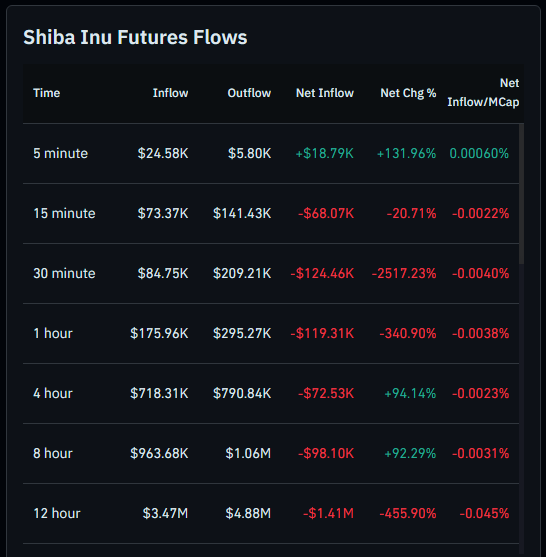 Source:
The pullback in futures demand tracks with SHIB’s price behavior over the past four days, during which the token has barely budged. The coin hasn’t moved more than 2% in either direction, leaving derivative traders with little reason to stay in.
Quiet Price, Slow Momentum
SHIB was trading at $0.00000553 at the time of writing, showing almost no change in the past day. Low price movement tends to push futures traders toward other assets, and that rotation appears to be underway here.
When a token sits still, futures traders tend to leave. They need volatility to make money on leveraged positions, and SHIB hasn’t been delivering that.
Spot Demand Holds Up
While the derivatives side weakened, spot activity told a different story. Spot trading volume climbed 18% in 24 hours to nearly $12 million, and exchange reserves dropped 0.25% to 80.32 trillion SHIB.

The exchange netflow remained negative, meaning more tokens left platforms than arrived. That kind of sustained outflow is often read as holders moving assets into self-custody rather than preparing to sell.
Some analysts have pointed to this pattern as a sign the recent downward pressure on prices may be running out of steam.
Featured image from Unsplash, chart from TradingView
Disclaimer: The content of this article solely reflects the author's opinion and does not represent the platform in any capacity. This article is not intended to serve as a reference for making investment decisions.
You may also like
NEAR, JUP, and QNT Flash Breakdown Warnings — Key Levels to Watch

Bitcoin’s Effective Supply Is Far Smaller Than Markets Assume
Tokenized Commodity Adoption Accelerates as Holders Climb Past 450K

AI wants money, and Western governments want money too! The global "capital battle" has begun, and the bond storm has "just started"
AI infrastructure development and government fiscal deficits are both competing for the world's limited capital. The five largest AI data center operators in the US have issued about $220 billion in bonds so far this year, while the US fiscal deficit has surpassed $1.99 trillion. The combined massive financing demand from these two sectors is driving a systemic rise in global capital costs. The financing costs for lower-rated borrowers are approaching double digits, and the credit market is beginning to stratify in terms of allocation. European bank stocks have plummeted, and French assets are also being repriced. This "great capital tightening" may first impact capital markets, and subsequently deal a severe blow to the real economy.
Crypto prices
More


