
Gold launches a sudden counterattack! Trump releases major Middle East positive news, gold surges $100 to approach $4600

On Friday (May 29), as traders closely assessed the latest prospects of a potential agreement between the United States and Iran, spot gold (XAU/USD) extended its rebound. At the time of writing, spot gold saw a strong recovery after hitting a two-month low of $4,366 on Thursday, briefly reaching an intraday high of $4,595.35/oz (UTC+8).
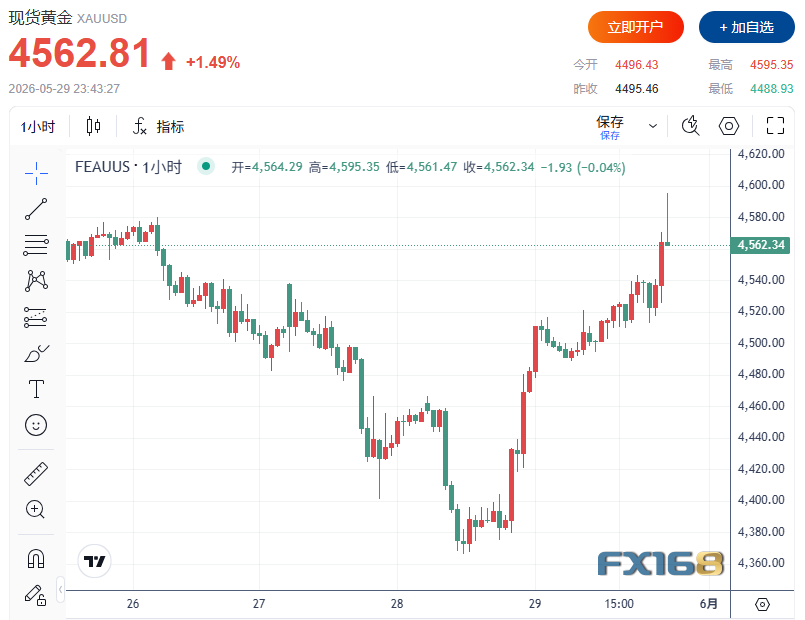
(Image Source:FX168)
Market risk sentiment has noticeably warmed up. Previously, U.S. President Donald Trump stated on Friday that the “naval blockade on Iran is now about to be lifted,” adding that he was heading to the White House Situation Room to make a “final decision” on the Iran issue. On Thursday, Axios reported that the United States and Iran had reached a 60-day Memorandum of Understanding (MOU). #Iran Crisis Tracker#
Ceasefire agreement takes shape, oil prices set for first monthly close lower in five months
It is understood that this agreement will extend the current ceasefire and reopen the critical shipping passage of the Strait of Hormuz. Over the next 60 days, the U.S. and Iran will continue negotiations on Iran’s nuclear program. However, Iran's Tasnim News Agency reported that the agreement has not yet been finalized or officially confirmed.
Affected by these latest developments, international oil prices dropped accordingly. WTI crude is currently fluctuating near $85 per barrel and is poised for its first monthly decline in five months. Nevertheless, as current oil prices remain far above pre-war levels, concerns over inflation persist in the market.
Previously, U.S. Treasury Secretary Scott Bessent revealed on Thursday that Trump set out three hard conditions for any agreement: Iran must reopen the Strait of Hormuz, hand over its enriched uranium, and fully terminate its nuclear program.
USD index retreats from highs, Fed’s hawkish rhetoric suppresses gold prices
The improved ceasefire expectations have visibly weighed on the U.S. dollar. The U.S. Dollar Index (DXY), which tracks the dollar against six major currencies, hit a seven-week high of 99.54 on Thursday but has now slipped below its range of the past two weeks, trading near 98.80 at the time of writing (UTC+8).
Although the dollar has weakened, gold’s upside remains constrained as high oil prices are sending hawkish signals from the Fed, acting as a drag on gold’s rise—leaving gold potentially facing its third consecutive monthly decline. The latest U.S. PCE inflation data further solidified market expectations that, as inflation remains above the Fed's 2% target, the central bank may keep rates elevated for a longer period.
On Friday, several Fed officials once again made hawkish statements. Kansas City Fed President Jeff Schmid said policymakers “may need to consider how to make monetary policy more restrictive,” emphasizing that the Fed “must signal its commitment to lowering inflation.” Philadelphia Fed President Anna Paulson stated: “Inflation is too high and has been so even before the outbreak of war. Keeping rates steady gives the Fed room to assess data.” She considers current monetary policy “well positioned.”
With a relatively light U.S. economic calendar on Friday, the fate of gold in the near term will depend entirely on public statements from Fed officials and the latest headlines from U.S.-Iran negotiations.
Technical analysis: Gold rebounds from two-month low, short-term neutral consolidation
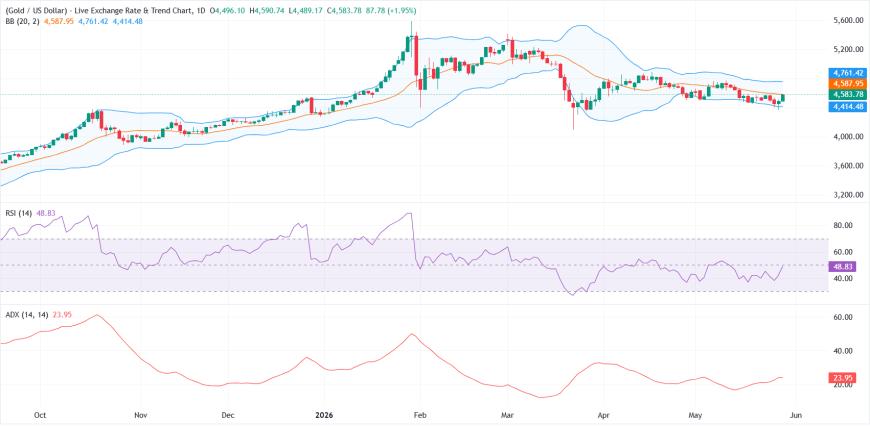
(Image Source:FXStreet)
From a technical standpoint, spot gold (XAU/USD) is currently positioned just below the 20-day Bollinger simple moving average (around $4,587.97), making the short-term trend broadly neutral to slightly weak and suppressed by the mid-band; meanwhile, the lower Bollinger band near $4,414.50 provides distant volatility support.
Momentum indicators: The Relative Strength Index (RSI) is now hovering around 48, suggesting a relatively balanced tug-of-war between bulls and bears. The Average Directional Index (ADX) sits near 24, indicating that, as gold prices consolidate in the upper half of the recent Bollinger range, the overall trend strength remains fairly subdued.
Upside resistance: Should gold prices continue higher, the initial resistance is directly at the 20-day moving average near $4,588 (UTC+8). A successful breakout would see the upper Bollinger band near $4,761 become a broader resistance barrier for bullish extension.
Downside support: If gold retreats, spot buying support is anticipated at the lower Bollinger band near $4,415 (UTC+8). Should this level be breached, gold may enter a deeper correction within a broader consolidation structure.
Disclaimer: The content of this article solely reflects the author's opinion and does not represent the platform in any capacity. This article is not intended to serve as a reference for making investment decisions.
You may also like
U.S. budget deficit soars to nearly $2 trillion, exceeding 6% of GDP; high interest rates and tax cuts further worsen the deficit
The US budget deficit for fiscal year 2026 has risen to $1.993 trillion, a year-on-year increase of 12%, marking the highest level since 2021 and projected to account for over 6% of GDP. High interest rates have pushed net interest payments to over $1.1 trillion, accounting for more than half of the deficit increase; lower-than-expected tax and tariff revenues have further worsened the financial shortfall. With just weeks left before the midterm elections, neither party intends to implement substantial fiscal consolidation, and the deficit outlook is highly dependent on the election results.
To deliver computing power, Oracle uses trucks to transport natural gas to power its data centers
To address pipeline delays in AI data center construction, Oracle has adopted an unconventional energy supply method by transporting compressed natural gas via trucks, which has already been implemented in Utah and Texas, and is also being considered for the "Project Jupiter" in New Mexico. However, this solution costs four times as much as pipeline natural gas and is limited in scale, covering only a small fraction of the project's total capacity.
Aptos insider vesting ends, cutting APT unlocks by 60%
US Treasury yields soar to a 24-year high; US Treasury advisors expect future declines as AI investments and energy shocks drive up borrowing costs
David Zervos, senior advisor to U.S. Treasury Secretary Yellen and a veteran Wall Street professional, stated on Thursday that despite the recent surge in U.S. Treasury yields to their highest levels in decades, the current real yields are significantly elevated compared to historical levels, suggesting room for a decline in the future.
Crypto prices
More


