
After inventories hit rock bottom: Can the restocking wave ignite tanker freight rates again?

The US-Iran conflict has led to the closure of the Strait of Hormuz for nearly three months. Currently, actual traffic through the Strait of Hormuz has plummeted by over 90%, effectively cutting off this vital route that carries about one-fifth of the world’s oil trade. However, this most severe energy supply shock since the oil crises of the 1970s has not caused an excessive spike in oil prices, nor has it surpassed the $120 per barrel highs seen during the Russia-Ukraine conflict in 2022.
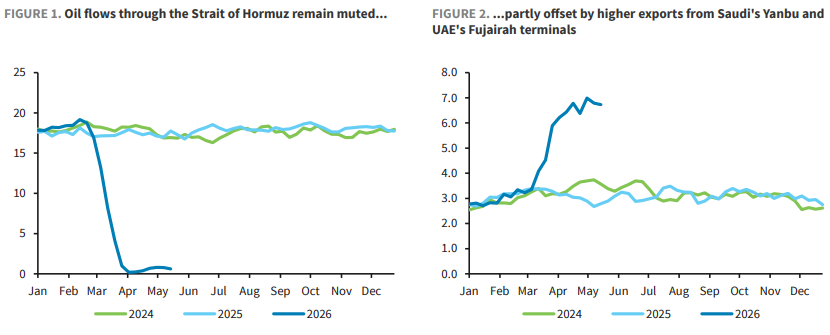
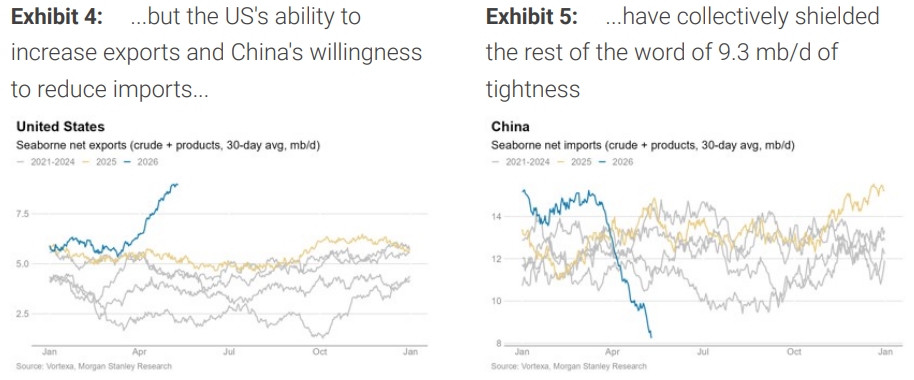
The core reason why the market has remained stable is that the global inventory system has acted as a buffer. Countries have consistently released strategic petroleum reserves (SPR), commercial inventories, and floating storage at sea, using existing resources to fill the supply gap from the Middle East. At the same time, high oil prices have suppressed demand, Asian refineries have actively reduced output, and China’s imports have declined, all of which have further eased the imbalance of global crude oil supply and demand.
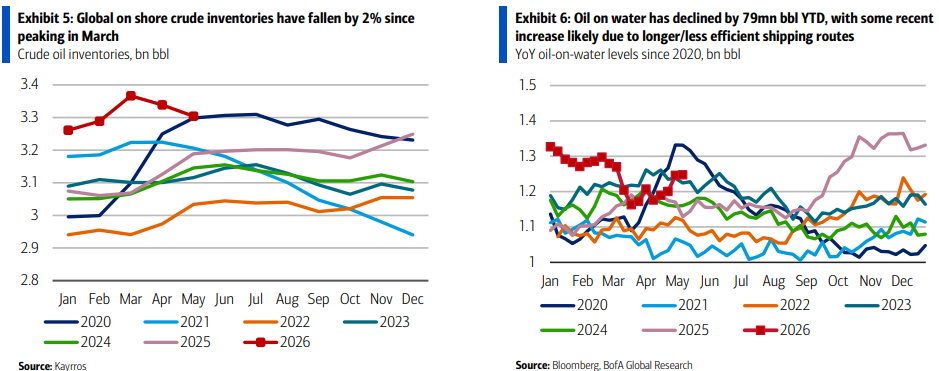
However, this buffer mechanism is rapidly depleting. Between March and April, global oil inventories fell by about 4 million barrels per day on average. After May began, the rate of decline in visible global inventories accelerated further, reaching 8.7 million barrels per day—a record high. By the end of May, about 250 million barrels had already been drawn down globally.
US crude oil and refined product exports have surged to a record 5.9 million barrels per day, while the strategic petroleum reserve (SPR) has also been released into the market at a record pace of 1.4 million barrels per day. This combination of high-intensity exports and SPR drawdowns has caused total US crude inventories (including SPR) to plummet, with weekly drops of up to 17.8 million barrels. Commercial inventories are approaching their lowest levels in decades, and the SPR is also at its lowest point in decades. Japan has drawn down about 70 million barrels of reserves, South Korea has released more than 22 million barrels of its strategic reserve, and India has also begun to rely on commercial inventories to maintain its supply.
Of the 8.4 billion barrels of global surface crude oil inventory, after deducting pipeline fill, tank bottoms, and the minimum operating requirements needed to keep the system functioning, only about 800 million barrels remain as usable buffer stocks before a systemic crisis would be triggered. With available inventories falling sharply, the shock absorber of the global oil system is rapidly being worn down.
Such extreme inventory drawdowns also send a seemingly contradictory but logically coherent signal to the tanker market, dividing the market into two phases: weak reality and strong expectations.
Dampeners Conceal the Supply Disruption Crisis; Oil Shipping Markets Ready to Surge
Disclaimer: The content of this article solely reflects the author's opinion and does not represent the platform in any capacity. This article is not intended to serve as a reference for making investment decisions.
You may also like
To deliver computing power, Oracle uses trucks to transport natural gas to power its data centers
To address pipeline delays in AI data center construction, Oracle has adopted an unconventional energy supply method by transporting compressed natural gas via trucks, which has already been implemented in Utah and Texas, and is also being considered for the "Project Jupiter" in New Mexico. However, this solution costs four times as much as pipeline natural gas and is limited in scale, covering only a small fraction of the project's total capacity.
Aptos insider vesting ends, cutting APT unlocks by 60%
US Treasury yields soar to a 24-year high; US Treasury advisors expect future declines as AI investments and energy shocks drive up borrowing costs
David Zervos, senior advisor to U.S. Treasury Secretary Yellen and a veteran Wall Street professional, stated on Thursday that despite the recent surge in U.S. Treasury yields to their highest levels in decades, the current real yields are significantly elevated compared to historical levels, suggesting room for a decline in the future.
St. Louis Fed President: Further rate hikes needed over the next 6 to 9 months; inflation remains the top issue for the US economy
St. Louis Federal Reserve President Musalem said on Thursday that the Federal Reserve still needs to raise interest rates further in order to bring U.S. inflation back to the 2% target in a timely manner.
Crypto prices
More


