
Bitcoin Is Still Following This Descending Channel Pattern And The Endgame Shows The Bottom

By:Newsbtc
Bitget offers one-stop trading for cryptocurrencies, stocks, and gold. Trade now!
A welcome pack worth 6200 USDT for new users! Sign up now!
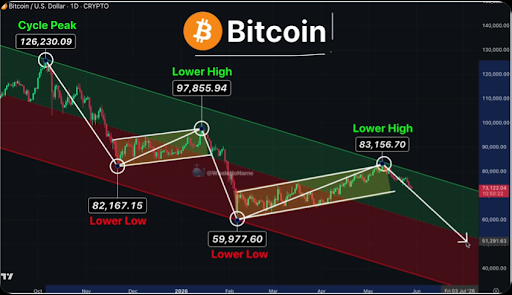
Bitcoin’s recovery attempts are still being judged against a larger structure that has controlled price action for months. An interesting technical analysis of the daily candlestick timeframe chart shows that Bitcoin is still following a descending channel, with every major rebound failing near the upper diagonal and every major sell-off finding a reaction near the lower boundary.
The latest rejection around $83,100 in May has now become the main focus, and Bitcoin is now moving back into the lower half of the channel, where the final bottom could be waiting.
Bitcoin’s Descending Channel Still Controls The Bigger Trend
Eight months into a correction path defined by lower highs and lower lows from $126,000, Bitcoin is showing no signs of deviation. The daily candlestick chart shows Bitcoin has transitioned into a broad descending channel that has stayed intact for these eight months.
var rnd = window.rnd || Math.floor(Math.random()*10e6); var pid607465 = window.pid607465 || rnd; var plc607465 = window.plc607465 || 0; var abkw = window.abkw || ''; var absrc = 'https://servedbyadbutler.com/adserve/;ID=172179;size=0x0;setID=607465;type=js;sw='+screen.width+';sh='+screen.height+';spr='+window.devicePixelRatio+';kw='+abkw+';pid='+pid607465+';place='+(plc607465++)+';rnd='+rnd+';click=CLICK_MACRO_PLACEHOLDER'; document.write('
');
if (!window.AdButler){(function(){var s = document.createElement("script"); s.async = true; s.type = "text/javascript";s.src = "https://servedbyadbutler.com/app.js";var n = document.getElementsByTagName("script")[0]; n.parentNode.insertBefore(s, n);}());}
var AdButler = AdButler || {}; AdButler.ads = AdButler.ads || []; var abkw = window.abkw || ""; var plc366606 = window.plc366606 || 0; (function(){ var divs = document.querySelectorAll(".plc366606:not([id])"); var div = divs[divs.length-1]; div.id = "placement_366606_"+plc366606; AdButler.ads.push({handler: function(opt){ AdButler.register(172179, 366606, [728,90], "placement_366606_"+opt.place, opt); }, opt: { place: plc366606++, keywords: abkw, domain: "servedbyadbutler.com", click:"CLICK_MACRO_PLACEHOLDER" }}); })();

The upper boundary has acted as resistance each time Bitcoin has attempted a stronger recovery, first around the $97,855 lower high and later around the $83,156 lower high. Each rejection has kept the larger bearish structure alive. The lower boundary has also been important. Bitcoin previously reacted near $82,167 before bouncing into the first major lower high, then fell again to around $60,000 in early February 2026.
The rejection move from the $83,156 resistance level in May also fits that same structure. Bitcoin is currently down by over 12% since that rejection and opened in June at around $73,670.
Now that Bitcoin is trending downwards, the projection is that the next move lower may not be just another ordinary lower low. The projection by a crypto analyst that goes by the name NoName on X places the projected end of the channel near $51,291, which can also be seen as the possible cycle bottom.
var rnd = window.rnd || Math.floor(Math.random()*10e6); var pid607472 = window.pid607472 || rnd; var plc607472 = window.plc607472 || 0; var abkw = window.abkw || ''; var absrc = 'https://servedbyadbutler.com/adserve/;ID=172179;size=0x0;setID=607472;type=js;sw='+screen.width+';sh='+screen.height+';spr='+window.devicePixelRatio+';kw='+abkw+';pid='+pid607472+';place='+(plc607472++)+';rnd='+rnd+';click=CLICK_MACRO_PLACEHOLDER'; document.write('
');
if (!window.AdButler){(function(){var s = document.createElement("script"); s.async = true; s.type = "text/javascript";s.src = "https://servedbyadbutler.com/app.js";var n = document.getElementsByTagName("script")[0]; n.parentNode.insertBefore(s, n);}());}
var AdButler = AdButler || {}; AdButler.ads = AdButler.ads || []; var abkw = window.abkw || ""; var plc452518 = window.plc452518 || 0; (function(){ var divs = document.querySelectorAll(".plc452518:not([id])"); var div = divs[divs.length-1]; div.id = "placement_452518_"+plc452518; AdButler.ads.push({handler: function(opt){ AdButler.register(172179, 452518, [728,90], "placement_452518_"+opt.place, opt); }, opt: { place: plc452518++, keywords: abkw, domain: "servedbyadbutler.com", click:"CLICK_MACRO_PLACEHOLDER" }}); })();
 Source:
Chart from NoName on X
Source:
Chart from NoName on X
Prediction Markets Favor $60,000 Before $100,000
There are multiple technical outlooks that are predicting a further bottom before Bitcoin embarks on a new rally. These predictions also line up with a separate sentiment signal from prediction markets.
Bitcoin Is Still Following This Descending Channel Pattern And The Endgame Shows The Bottom
Most notably, prediction markets Kalshi Crypto currently has a 60% implied chance that Bitcoin hits $60,000 before $100,000, meaning crypto participants are currently assigning more weight to another major downside move before a six-figure recovery
Kalshi also gives Bitcoin only a 34% chance of moving back above $100,000 before January 2027, which is a major reversal from the start of 2026, when the market priced a 94% implied probability of BTC trading above $100,000 by the middle of the year.
var rnd = window.rnd || Math.floor(Math.random()*10e6); var pid607473 = window.pid607473 || rnd; var plc607473 = window.plc607473 || 0; var abkw = window.abkw || ''; var absrc = 'https://servedbyadbutler.com/adserve/;ID=172179;size=0x0;setID=607473;type=js;sw='+screen.width+';sh='+screen.height+';spr='+window.devicePixelRatio+';kw='+abkw+';pid='+pid607473+';place='+(plc607473++)+';rnd='+rnd+';click=CLICK_MACRO_PLACEHOLDER'; document.write('
');
if (!window.AdButler){(function(){var s = document.createElement("script"); s.async = true; s.type = "text/javascript";s.src = 'https://servedbyadbutler.com/app.js';var n = document.getElementsByTagName("script")[0]; n.parentNode.insertBefore(s, n);}());}
var AdButler = AdButler || {}; AdButler.ads = AdButler.ads || []; var abkw = window.abkw || ''; var plc452519 = window.plc452519 || 0; (function(){ var divs = document.querySelectorAll(".plc452519:not([id])"); var div = divs[divs.length-1]; div.id = "placement_452519_"+plc452519; AdButler.ads.push({handler: function(opt){ AdButler.register(172179, 452519, [728,90], 'placement_452519_'+opt.place, opt); }, opt: { place: plc452519++, keywords: abkw, domain: 'servedbyadbutler.com', click:'CLICK_MACRO_PLACEHOLDER' }}); })();
Bitcoin would still need to lose important support zones before that deeper target becomes realistic. The first test is whether sellers can keep the price above the middle of the channel at $70,000 and prevent another rebound back above $78,000 and $83,000.
BTC trading at $72,771 on the 1D chart | Source: BTCUSDT on
Tradingview.com
0
0
Disclaimer: The content of this article solely reflects the author's opinion and does not represent the platform in any capacity. This article is not intended to serve as a reference for making investment decisions.
Understand the market, then trade.
Bitget offers one-stop trading for cryptocurrencies, stocks, and gold.
Trade now!
You may also like
Aptos insider vesting ends, cutting APT unlocks by 60%
Cryptopolitan•2026/10/08 22:57
US Treasury yields soar to a 24-year high; US Treasury advisors expect future declines as AI investments and energy shocks drive up borrowing costs
David Zervos, senior advisor to U.S. Treasury Secretary Yellen and a veteran Wall Street professional, stated on Thursday that despite the recent surge in U.S. Treasury yields to their highest levels in decades, the current real yields are significantly elevated compared to historical levels, suggesting room for a decline in the future.
智通财经•2026/10/08 22:37
St. Louis Fed President: Further rate hikes needed over the next 6 to 9 months; inflation remains the top issue for the US economy
St. Louis Federal Reserve President Musalem said on Thursday that the Federal Reserve still needs to raise interest rates further in order to bring U.S. inflation back to the 2% target in a timely manner.
智通财经•2026/10/08 22:37
Trump's tariffs increase U.S. consumer costs: New York Fed reports prices of related goods up nearly 3%, impact may last until 2027
The latest research by the Federal Reserve Bank of New York shows that the tariff policies implemented by U.S. President Trump have significantly increased the cost for American consumers to purchase everyday goods.
智通财经•2026/10/08 22:37
Crypto prices
More
Bitcoin
BTC
$81,781.04
-1.63%

Ethereum
ETH
$2,474.31
-3.62%

Tether USDt
USDT
$0.9992
-0.03%

BNB
BNB
$737.15
-4.51%

XRP
XRP
$1.38
-2.33%

USDC
USDC
$0.9998
+0.00%

Solana
SOL
$110.23
-4.95%

TRON
TRX
$0.3328
-0.64%

Hyperliquid
HYPE
$84.3
-4.33%

Zcash
ZEC
$1,186.68
-11.06%
How to buy BTC
Bitget lists BTC – Buy or sell BTC quickly on Bitget!
Trade now
Become a trader now?A welcome pack worth 6200 USDT for new users!
Sign up now