Take-profit and stop-loss orders have been standard equipment in FX and crypto trading for years. Their absence from prediction markets has nothing to do with the asset class – binary contracts are mathematically friendly to conditional orders – and everything to do with where platform builders chose to spend their engineering time. On Outpoll, a global prediction market platform launching now, take-profit and stop-loss are available on open positions out of the box.
You set your levels, walk away, and the platform executes when the conditions are met. That’s what risk management is supposed to look like – protective orders that fire automatically, on a platform that’s been built to assume traders aren’t going to be at their screens for every event.
What has not kept pace is the infrastructure traders actually use to operate inside these markets.
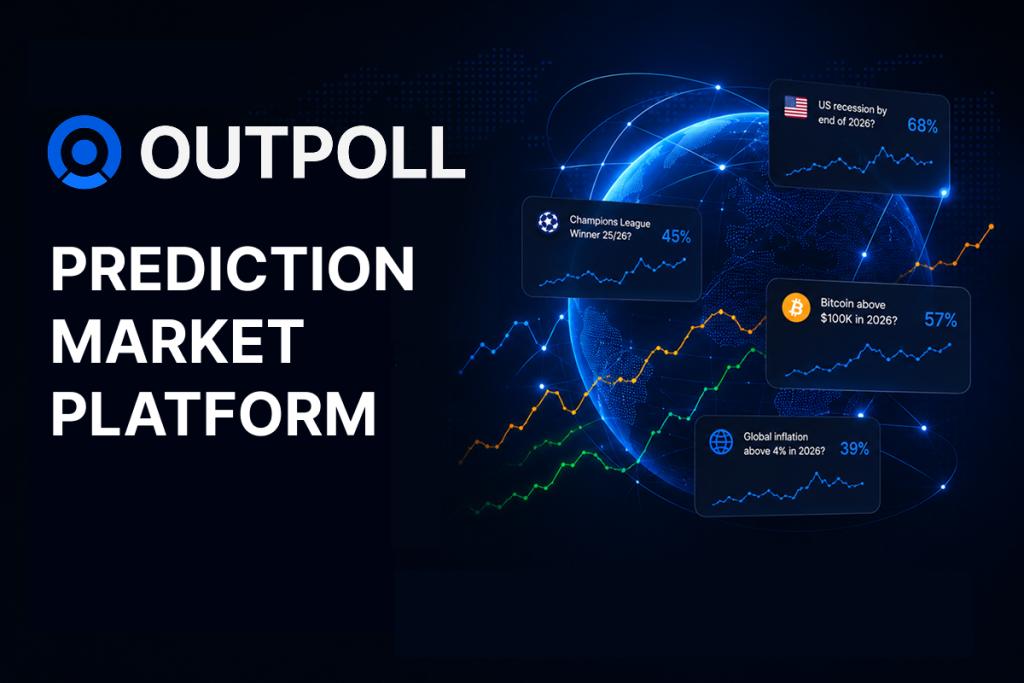
Until recently, the experience of trading on a prediction market platform looked a lot like the early days of any new financial venue. You picked a side – YES or NO – bought in at the going price, and watched the chart. If the market moved against you while you were away, that was your problem. If it moved in your favor, you had to be at the screen to capture it. There was little in the way of conditional orders, limited flexibility on order types, and almost no programmatic access for anyone who wanted to operate at the level they were used to in FX or crypto. The basics that retail traders take for granted on most other venues simply weren’t there.
That gap is starting to close. Outpoll is the prediction market platform which is pushing in this direction – and the rest of this piece uses it as a working example of what “professional tooling for prediction markets” actually looks like in practice. The principles, though, apply broadly: this is the direction the entire category needs to move.
The category grew up. The product layer is catching up.
The thesis behind prediction markets has always been that they aggregate information better than polls, surveys, or expert forecasts. As volumes grew and participation deepened, that thesis held up. Markets on geopolitical events, macro decisions, and cultural moments now move with enough liquidity that their pricing is genuinely informative.
But informative pricing only matters if traders can act on it efficiently. And acting efficiently requires three things the category has historically under-delivered on. Each of them is straightforward to fix once a platform decides to treat its users as traders rather than as casual participants.
Risk management
Anyone who has held a position through a binary resolution event knows the feeling: the market is doing something violent, you are not at your screen, and there is no protective order sitting under your position. Take-profit and stop-loss orders have been standard equipment in FX and crypto trading for years. Their absence from prediction markets has nothing to do with the asset class – binary contracts are mathematically friendly to conditional orders – and everything to do with where platform builders chose to spend their engineering time.
On Outpoll, take-profit and stop-loss are available on open positions out of the box. You set your levels, walk away, and the platform executes when the conditions are met. That is what risk management is supposed to look like, and it should be table stakes everywhere in the category – not a differentiator.
Order flexibility
The original prediction market UX was built around a single primitive: hit the button, buy the share at market. That works for casual participants placing small directional bets. It is inadequate for anyone trying to build a position with discipline.
Limit orders matter because thinly liquid markets punish anyone forced to take the spread. Market orders matter because, when the price is moving, certainty of fill beats price improvement. A serious platform has to support both, and let the trader choose. Outpoll does – the order ticket exposes both order types, and you decide which one fits the moment.
Programmatic access
The most sophisticated participants in any financial market do not click buttons. They operate through APIs – running models, hedging across venues, monitoring price drift. A prediction market without a public API is a prediction market that has decided, implicitly, to keep professional capital out. That is a strategic choice, and it shows up in the depth and quality of liquidity.
Outpoll publishes a public REST and WebSocket API, with documented examples for TP/SL automation, copy-trading, and cross-platform price monitoring. The full reference is open at docs.outpoll.com/api. The point is not that an API exists – it’s that anyone who wants to think about prediction markets the way they think about other liquid markets can actually do so.
The second-order effect
There’s a flywheel worth naming here. When professional traders can operate efficiently, spreads tighten and liquidity deepens. Price discovery becomes more accurate. The retail user who just wants to express an opinion benefits from infrastructure they will never directly touch. Better tooling does not just serve a narrow professional segment – it improves the markets themselves for everyone.
This is why the upgrade matters beyond the user experience layer. Prediction markets earn their seat at the table by producing prices that are worth paying attention to. The more efficiently traders can express views, the more those prices are worth.
Where this is going
Prediction markets have proven they can scale. The next question is whether they can become real trading venues, or whether they stay as casual prediction screens with extra steps.
We’re building Outpoll on the bet that they can – and that the platforms that build serious tooling earliest will compound a structural advantage as the category matures. Native mobile, multi-currency deposits with in-app conversion, creator-led markets that let community leaders launch and curate their own events for their audiences – all of it sits on top of the same conviction: treat the user as a trader, not as a tourist. Visit outpoll.com to explore live markets, or download the Android app on Google Play.