
Even GitLab is starting to lay off programmers

Became successful thanks to programmers, but now is laying off programmers because of AI.
Standing alongside GitHub as a cornerstone in the developer world, GitLab has just laid off 14% of its employees to fully pivot towards AI.
To be honest, although GitLab’s actions go against the tradition of “not forgetting the people who dug the well when drinking water,” in today's Silicon Valley, this isn’t all that surprising.
Under the current AI boom, layoffs and organizational restructuring have become almost standard procedure, whether for big companies or startups.
What’s really surprising is that this round of layoffs at GitLab wasn’t due to declining performance, nor financial stress.
Quite the opposite.
The latest Q1 earnings report shows that the company’s revenue grew 23% year-over-year, outperforming market expectations, and its stock price jumped 7% in after-hours trading following the report.
On one hand, revenue is growing and the share price is rising; on the other hand, 14% of the workforce is being laid off.
If I were a GitLab employee, I’d probably be feeling pretty chilly inside right now—
A preemptive layoff, a fine example of sharing hardships but not prosperity.
So here’s the question:
Why would a profitable company lay off the people who make it money?
“A Proactive Transformation for the Intelligent Agent Era”
GitLab may not be as well known outside developer circles as GitHub, but in the developer infrastructure sector, it is an unavoidable name.
This company has its roots in a classic programmer’s story.
In 2011, Eastern European developer Dmytro Zaporozhets wrote an open-source project that he later turned into a company together with Dutchman Sid Sijbrandij.
GitLab offers a DevSecOps platform that covers the entire software development lifecycle—from code management and security scanning to deployment and launch, nearly all the tools required for development are included in a single platform.
About ten years later, the company went public on Nasdaq, reaching a peak market capitalization of over $15 billion.
By the end of 2025, GitLab had over 50 million registered users worldwide, with half of the Fortune 100 as its customers.
Uniquely, from day one, GitLab has been a fully remote company—with no headquarters, about 2,500 employees scattered across more than 60 countries and regions worldwide.
Logically, a company that grew up with developers should most appreciate the value of programmers.
But now, GitLab has turned the axe on nearly 14% of its employees—about 350 people.
People can’t help but ask: What on earth happened? Why is GitLab doing this?
From financial reports and the CEO’s layoff letter, we may find some answers:
GitLab is undergoing the biggest transformation since its founding:
Layoffs, restructuring, and an AI strategy are all being implemented simultaneously.

Not long ago, GitLab released its Q1 financials (ending April 30, 2026), along with layoff details.
First, let’s talk about performance—some key metrics look very healthy:
-
Q1 revenue reached $264.2 million, up 23% year-over-year, surpassing analysts’ expectations of $254 million;
-
Subscription revenue grew from $194.5 million last year to $239.3 million;
-
The number of customers generating over $100,000 in annual recurring revenue increased by 18%;
-
GAAP net loss narrowed significantly from $35.9 million to $5 million;
-
Adjusted earnings per share were $0.23, exceeding Wall Street’s estimate by $0.02, and full-year profitability guidance was raised as well.
Everything looks positive, right? But who would have thought that layoffs would soon follow.
GitLab had announced plans for layoffs as early as May this year, but the final plan wasn’t determined until recently; now everything is settled—
About 350 full-time employees will be let go, with expected severance costs between $30 and $35 million, including severance pay, compensation, and retention costs, of which around $19 million will be paid out by late July.
At the same time, GitLab will exit 22 countries and regions, reducing its geographical footprint by 37%, while its R&D team will be restructured into around 60 smaller autonomous teams.
The core reason for GitLab’s “growing and downsizing at once” directly points to AI.
In CEO Bill Staples’ words, this is a proactive transformation for the “agentic era.”
Back in May, Bill published an open letter titled “GitLab Act 2,” followed by 14 posts on X, explaining the logic behind the layoffs step by step.
This move was even praised by netizens as:
So far, the most honest layoff and AI transition statement ever made by any public CEO.
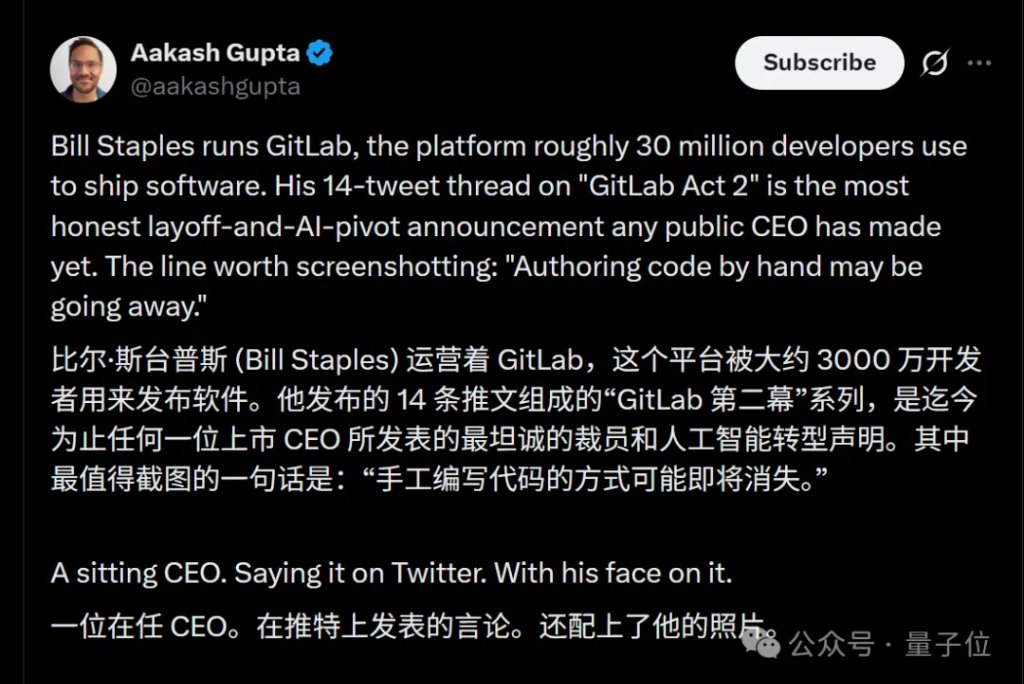
In Bill’s view, AI agents are impacting developer infrastructure at “machine speed,” and GitLab must rebuild its architecture to handle this kind of traffic.
Most of the money saved “will not become profit,” but be reinvested in R&D and AI products.
He also revealed that the company is deepening its integration with Anthropic’s Claude model, and is working with AWS and Google Cloud to run agent functions on Bedrock and Vertex AI.
It’s clear that intelligent agents are becoming the core narrative of GitLab’s reboot.
However, even though Bill specifically emphasized, “this isn’t AI optimization or cost-cutting,” the market’s reaction was telling:
After the earnings announcement, shares rose as much as 7% after hours, but when the market opened and fully processed the layoff news the next day, all gains were wiped out.
Overall, starting from about $104 on its IPO day in 2021, GitLab’s share price has since dropped, and its market value is now down about 80%.
This shows that, at least for now, Wall Street remains skeptical of this restructuring logic—
Investors recognize the performance growth, but still have questions about whether layoffs and the agent strategy will truly drive long-term value.
Silicon Valley Tech Companies’ Q1 Layoffs Up 40% Year-Over-Year
In reality, GitLab isn’t an isolated case.
Just flip through this year’s Silicon Valley tech layoff cases and you’ll see—
Preemptive layoffs like GitLab’s, “growing revenue while cutting personnel,” have become standard practice for them.
And AI is almost the universal answer companies use to explain this contradiction.
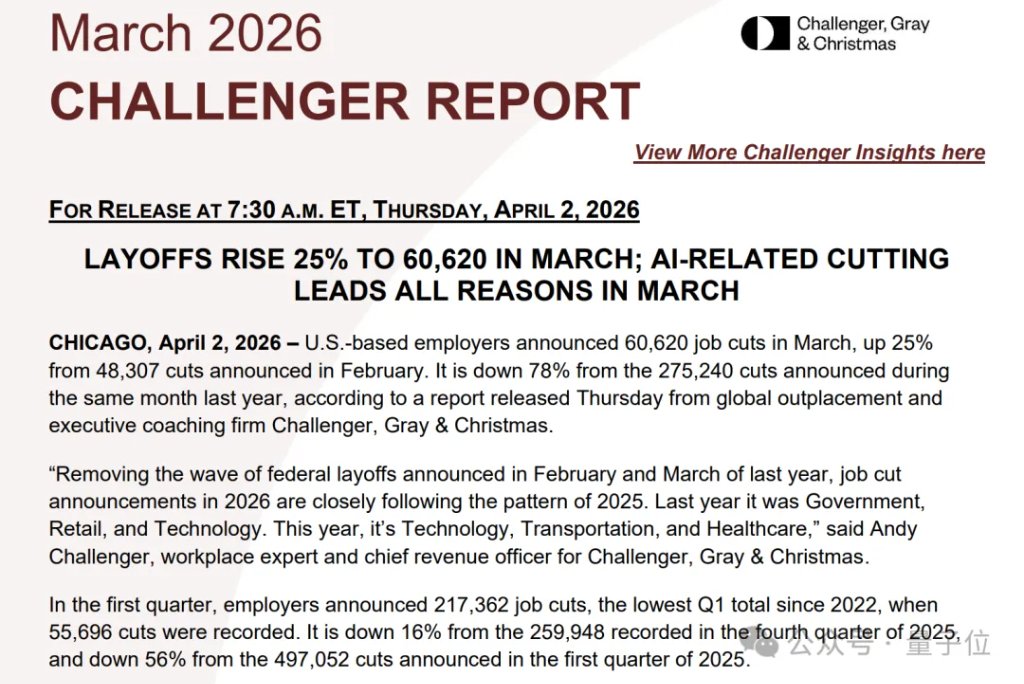
A recent report released in April by Challenger, Gray & Christmas, the authoritative US layoff tracker, pointed out:
In March 2026, AI became the No. 1 reason for layoffs among US companies for the first time, with 15,341 AI-driven layoffs in a single month, accounting for 25% of all layoffs that month.
The tech sector was hit hardest. In Q1 2026, tech companies cut 52,050 jobs, a 40% increase year-over-year, with Dell, Oracle, and Meta leading the way.
The agency’s head, Andy Challenger, spoke directly:
Firms are shifting budgets from labor to AI investment (mainly into computational power), and in tech companies, AI can already replace coding roles.
However, the so-called “AI layoff” narrative itself is also coming under scrutiny.
The one stepping in to question it is the familiar “old actor”—OpenAI CEO Sam Altman.
In an interview this February, he said something that isn’t quite what you’d expect from a CEO:
I don’t know the exact proportion, but there’s definitely some “AI washing”—some companies are blaming layoffs that were going to happen anyway on AI.
If performance is poor, blame not keeping up with the AI trend; if performance is good, credit good use of AI.
Who can look at this and not say AI is the biggest “brick” (doge) on Wall Street today?
Of course, saying that AI will lead to unemployment is only one side of the story—there are voices to the contrary as well.
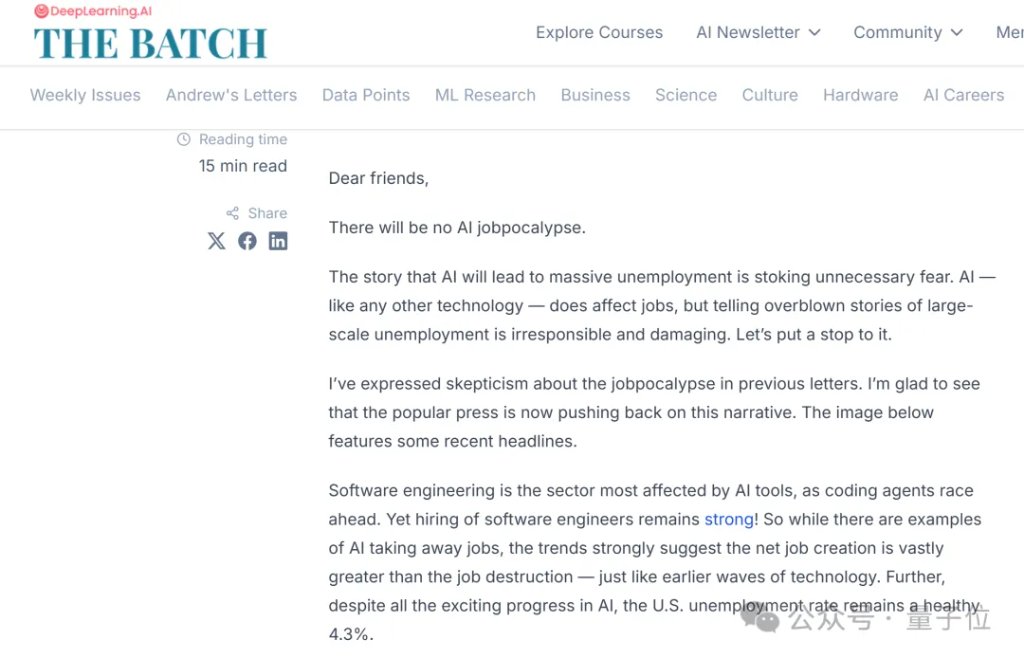
Familiar to all, Andrew Ng published a widely-shared essay this May, “There will be no AI jobpocalypse.”
His attitude is quite direct: AI will not cause a jobs doomsday.
He pointed out that software engineering is the field most affected by AI, but recruitment remains strong.
In his view, there are two motivations driving this narrative—
Frontier AI labs have an incentive to make AI seem even more powerful, so that products are easier to sell; companies have an incentive to attribute layoffs to AI, making themselves look more forward-thinking.
In other words, the impact of AI on employment is real, but often, the narrative about AI spreads faster than AI itself.
Thus, Andrew Ng’s projection is not about a coming jobs doomsday, but rather the opposite—a “Jobapalooza.”
His reasoning is that as software development costs are dramatically reduced by AI, people won’t develop less, but more software, generating new demand and ultimately creating more, not fewer, jobs.
That said, 350 people at GitLab have indeed already left.
A company started by programmers has just laid off programmers—regardless of whether it’s called “proactive transformation” or “AI washing,” it makes no difference for those laid off.
And GitLab’s story is probably not just GitLab’s story.
When a company that lives by developers replaces them with AI agents, it clearly reflects the broader shift happening in the industry.
Bill said something that many people took a screenshot of:
Software will be built by machines, directed by humans.
Who knows how many will be left...
Disclaimer: The content of this article solely reflects the author's opinion and does not represent the platform in any capacity. This article is not intended to serve as a reference for making investment decisions.
You may also like
Pi Network dips 1% as falling Open Interest leaves $0.0801 support at risk

Nasdaq Hits New High, Igniting Earnings Season Expectations! Citi Predicts Nearly 90% of Tech Stocks Will Deliver “Earnings Surprises”, with Nvidia and AMD Leading the Outperformance List
The latest quantitative research on earnings season released by Citigroup provides concrete evidence for this profit trend: the model predicts that 66.2% of Russell 1000 constituents will deliver positive earnings surprises (i.e., earnings exceeding market consensus expectations) and corresponding positive stock price return trajectories (i.e., Citigroup's model also predicts positive stock price return directions), significantly higher than last quarter's already strong 60.9%, reaching the highest level since Q4 2021.

Analysis - European Dilemma Provides New Reason for Dollar Bulls to Remain Optimistic
The US dollar has risen 5% against the euro, with some investors expecting further strengthening. The options market has become strongly bearish on the euro, as concerns over France’s fiscal situation and political uncertainty are creating pressure points for the eurozone. Laura Matthews/Saqib Iqbal Ahmed, Reuters New York, October 8 – This fall, the dollar surged to an 18-month high, with the latest rally fueled by uncertainty across the Atlantic, prompting some investors to bet the dollar will appreciate further. Analysts say the dollar continues to receive support from high—and possibly rising—US interest rates, robust economic growth, and persistent inflation risks. However, broader pressure centered on France’s massive fiscal deficit, potentially spreading to Italy and the wider eurozone, is emerging as a primary driver for the dollar in the coming months. So far this year, the dollar has appreciated about 5% against the euro, boosting the dollar index .DXY, which measures the dollar’s strength against six major currencies, including the euro (its largest component). “The euro remains under pressure, limiting one of the main alternatives to the dollar,” said Yuuto Shinohara, Senior Investment Strategist at Mesirow Currency Management. Last week, the yield spread between French and German 10-year government bonds recorded its largest weekly increase in decades, while the Italy-Germany yield spread saw its biggest weekly surge since the pandemic. The euro EUR= was last at 1.1183, down 0.67% against the dollar. “The market is focused on countries that, due to political dysfunction, cannot restore sustainable fiscal trajectories,” said Karl Schamotta, Chief Market Strategist at Toronto’s Corpay. One concern is that the euro no longer receives much support from the European Central Bank’s hawkish signals. The ECB raised rates by 25 basis points in September—its second hike this year to counter energy-driven inflation—but the euro fell after the decision, as markets worried about the impact of future hikes on the economy. Typically, rising European bond yields support the euro, but the euro's muted response suggests investors are increasingly concerned about growth and fiscal risks. Rising energy prices could add further pressure. “Structurally, Europe is a major energy importer and is more manufacturing-dependent than the US. The impact is obvious: high energy prices will drag down the region,” said Benjamin Ford, a researcher at Macro Hive. Ford expects the euro to fall to $1.10 within the next month, nearly 2% lower than current levels. “The US medium-term outlook seems stronger, while Europe is more susceptible to shocks,” Ford said. Policy Missteps Investors are also weighing whether the ECB can continue fighting inflation without causing greater harm to already weakening economies. The eurozone inflation rate (link) exceeded expectations in September, and with energy costs surging, it may rise further in coming months, keeping pressure on the ECB to hike rates. “There’s clear asymmetric downside risk for the euro at present,” said Dan Tobon, Citi’s Head of G10 FX Strategy in New York. “One of the likeliest triggers is policy error—if the ECB overtightens at a time when markets can’t bear it.” Euro risk reversal for one-month options, which measures whether traders are paying more to hedge against euro losses than gains, hit its most bearish level since March last Friday, while the three-month indicator touched its lowest point since June 2024. Federal Reserve policymakers have signaled that inflation risks remain high, which has helped keep US Treasury yields at multi-year highs. “Yields continue to rise, and US rates have an absolute advantage over most developed markets,” Shinohara said. Federal funds futures show about an 84% chance of at least one more 25-basis-point hike by December. Although few strategists expect the dollar to surge dramatically from current levels, they note that US economic resilience, sustained high yields, and Europe’s unique risks continue to tilt the balance toward the dollar. “For now, this imbalance looks very unfavorable for Europe,” Citi’s Tobon said. (For the convenience of non-native English speakers, Reuters automates translation of its reports into several other languages. As automated translation may be flawed or lack necessary context, Reuters does not guarantee the accuracy of such translations. They are provided solely for the readers’ convenience, and Reuters accepts no liability for any damage or loss arising from use of automated translation.)

Privacy coins: the missing layer between crypto and institutions
Crypto prices
More


