
Bitcoin fell 21% after Strategy’s debt buyback news— Is a Terra Luna-style doom loop next?

Key takeaways:
- Strategy faces tighter short-term liquidity, but its conservative 11% net leverage protects it from forced BTC liquidations.
- A Bitcoin rally above $70,000 remains unlikely as long as STRC trades under $100 and spot ETFs show net selling pressure.
Bitcoin (BTC) faced a 21% price correction in 10 days, retesting the $61,000 level for the first time in 4 months. This movement coincided with Strategy (MSTR US) company's decision to buy back some corporate debt, temporarily pausing its Bitcoin accumulation. Traders now fear that Strategy could be forced to liquidate some of its Bitcoin holdings.
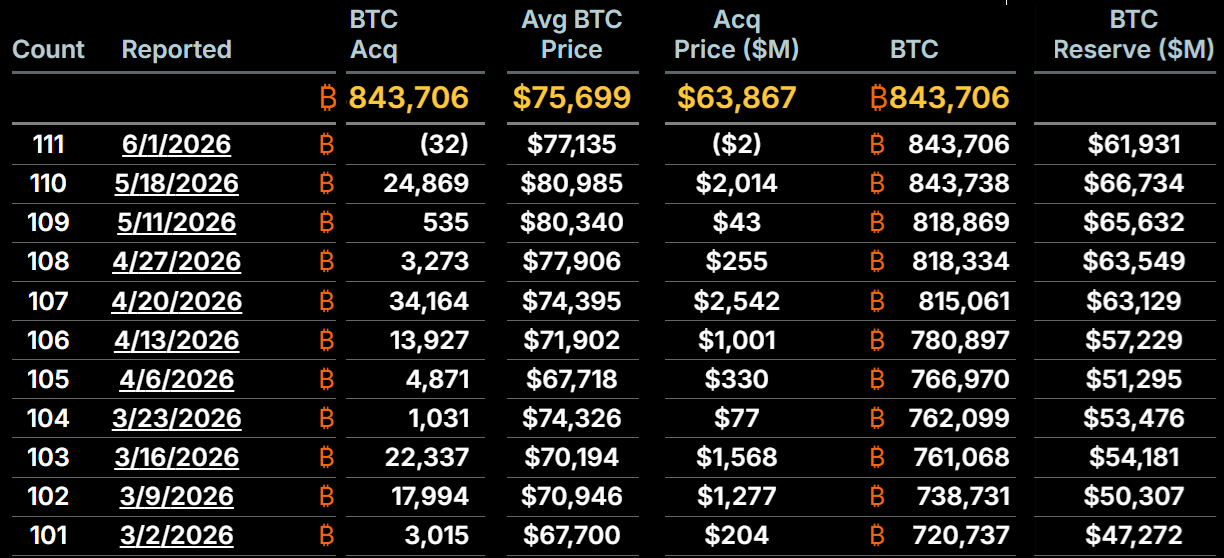
Strategy (MSTR US) Bitcoin reserve changes & average price. Source: Strategy
Strategy had been the largest known Bitcoin buyer, accumulating 126,016 BTC for $9.31 billion since March. However, the company used $1.38 billion of cash raised by recent equity issuances to buy back some of its convertible debt. The decision, announced on May 15, coincided with the Stretch preferred stock (STRC US) distancing itself from $100.
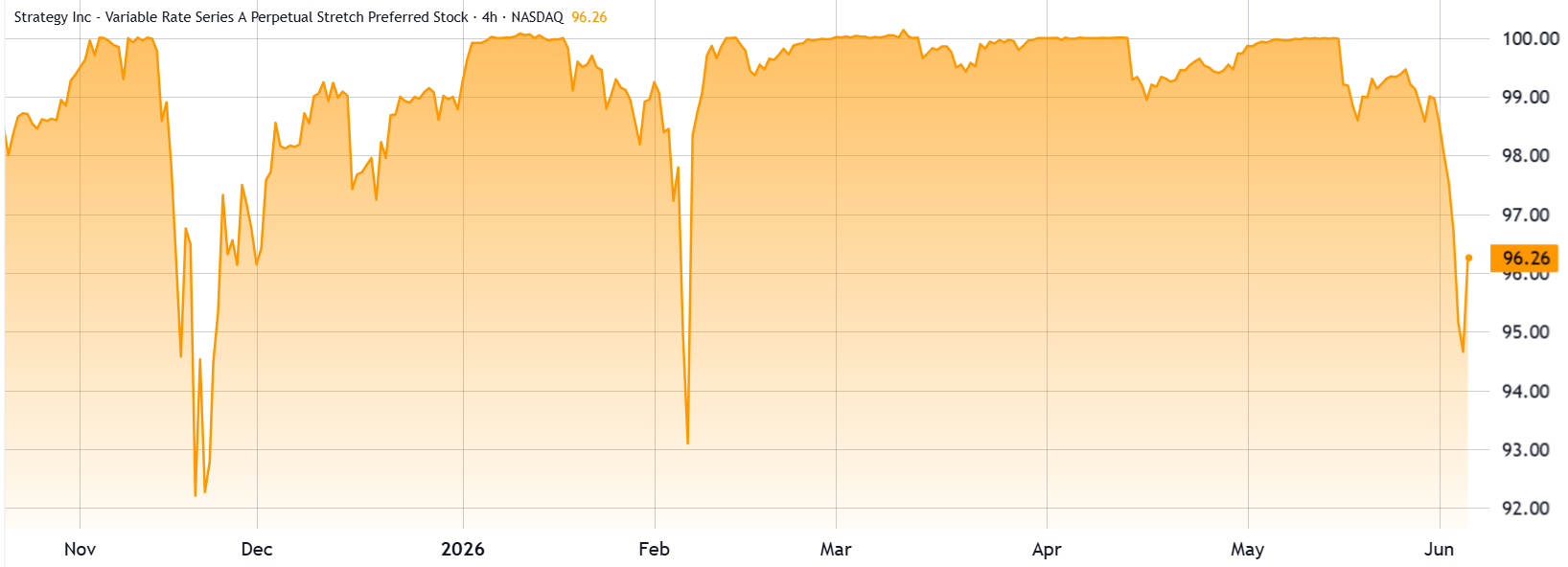
Strategy Series A Perpetual Stretch preferred stock (STRC US). Source:
The STRC preferred stock allows Strategy to issue new shares whenever its price reaches $100 and offers holders a variable dividend, currently set at 11.5% annually, paid monthly in cash. If traders decide it is no longer worth $100, new buyers step in at lower levels, which is equivalent to demanding a higher dividend. So, at first sight, this should be a non-event for Strategy’s risk perception.
Strategy raised $7.5 billion through preferred stock issuances in the first 5 months of 2026, which was highly supportive of Bitcoin’s price. Now, the company faces a rough path, given its cash position has been reduced to $900 million, which is enough to cover dividends for 6 months.
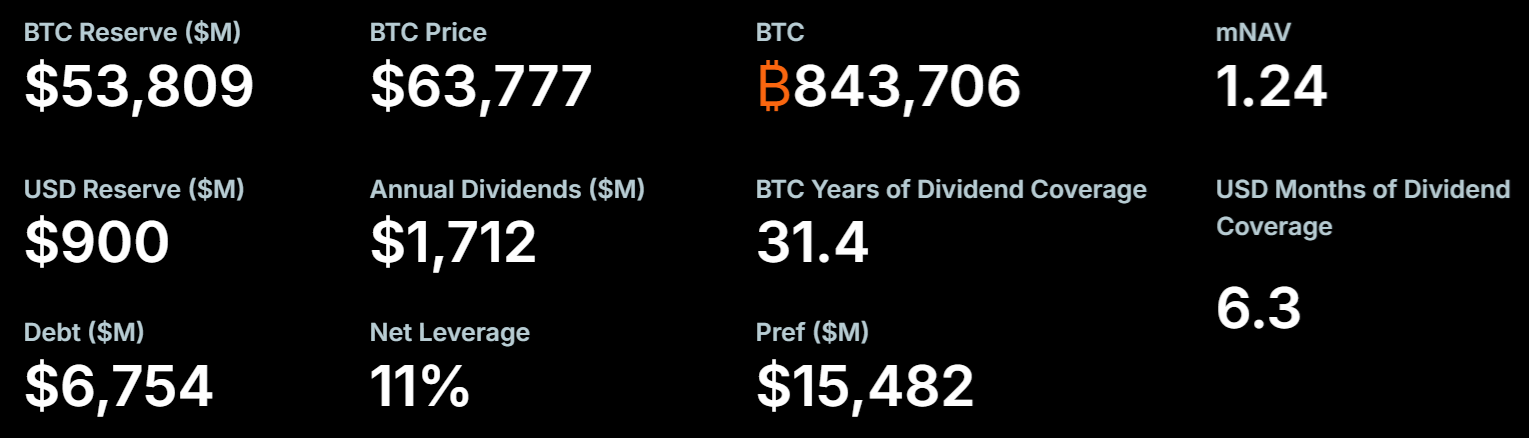
Strategy (MSTR US) financial highlights. Source: Strategy
Strategy’s 11% net leverage is the key financial metric to monitor, as it represents the amount of debt the company holds relative to its assets. By any standard, the coverage provided by its Bitcoin holdings–even at a $30,000 price–should be considered conservative.
Will Strategy be forced to liquidate some of its Bitcoin holdings?
While short-term liquidity conditions have certainly deteriorated, there is no contractual floor set in Strategy’s convertible debt that would force a Bitcoin reserve liquidation. Moreover, there is no prohibition on selling MSTR stock at a discount to its market-adjusted net asset value.
If debt markets are not available, the company could opt to dilute current MSTR holders. Whether this move would be interpreted as a weakness and further pressure MSTR and STRC prices is irrelevant to Strategy’s leverage ratio, as the company would remain financially solid.
Related:
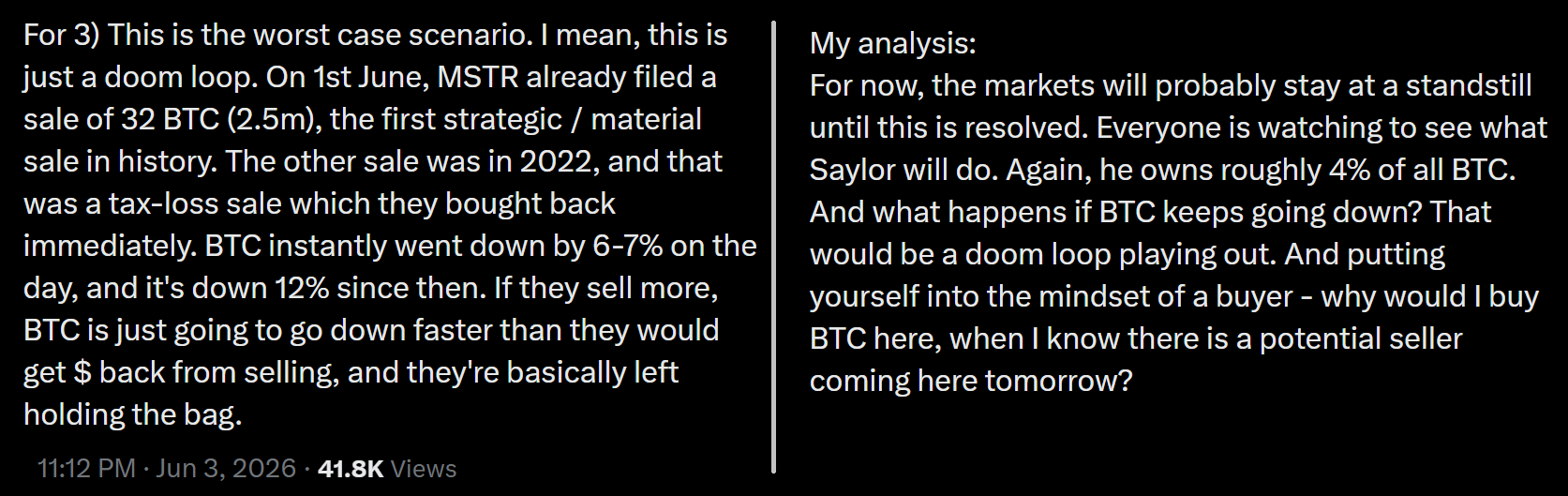
Source: X/
According to X user zeroxkyle, author of the “Grand Line” newsletter, an eventual Bitcoin sale from Strategy would only bring its price down faster, worsening liquidity conditions. The analysis refers to a “doom loop” causing buyers to withhold from adding positions due to a constant fear of a large seller entering the market.
It is impossible to predict what would ease investors' tension, as Strategy is in no danger of an imminent forced sale. The preferred stock dividends can be paused at will, although they merely accumulate for later on. Still, as long as STRC continues to trade below $100 and spot exchange-traded funds (ETFs) remain a net seller, odds for a Bitcoin rally above $70,000 are slim.
Disclaimer: The content of this article solely reflects the author's opinion and does not represent the platform in any capacity. This article is not intended to serve as a reference for making investment decisions.
You may also like
CDS Soar Collectively, "SpaceX and Others" Still Borrowing Furiously! How Long Can the AI Debt Frenzy Last?
The wave of AI infrastructure debt is reshaping the global credit landscape at an unprecedented pace, with the technology industry's debt reaching $500 billion in the first nine months of this year. However, frequent alarms have been raised in the CDS market, US Treasury yields have climbed to 5.3%, the highest in over twenty years, and Dalio pointed out that this is a "classic bubble that will be burst by interest rates."
Is a major reversal in stock-bond allocation approaching? Bank of America issues rare signal: Bonds compete with stocks for capital for the first time in decades, S&P 500's return over the next ten years may be less than 5%
Savita Subramanian, Head of US Equity and Quantitative Strategy at Bank of America, said in an interview on Wednesday that the bond market is becoming attractive again and has, for the first time in decades, become a real competitor to the stock market.

Stop Using the Consumer Cycle to Analyze Micron (MU.US)! AI is Redefining NAND Logic, Enterprise SSDs Have Taken Over Pricing Power
Eudaemon Research previously assessed that within Micron's business structure, DRAM is more resilient than NAND, and that NAND prices and demand would return to normal faster. However, Micron's latest Q4 financial data has led them to revise this view: NAND is no longer a homogeneous market, and the supply-demand and pricing dynamics of consumer-grade NAND and enterprise-level data center SSDs are clearly diverging.
Micron's target price is significantly raised by investment banks, with a maximum of 3,000 USD
DA Davidson has raised Micron's target price to $3,000, implying a 176% upside from the current share price. The core logic is that the AI-driven memory supercycle will continue until 2028, with the supply-demand gap widening further. The key variable lies in the shift of demand—buyers are transitioning from smaller, high-default-risk clients to tech giants such as Amazon, Microsoft, and Google. Micron has already secured $150 billion in remaining contractual obligations.
Crypto prices
More


