
Market Shock! Broadcom Plunges, Sparking AI Bubble Doubts; US Stock Futures Dive, Middle East Conflict Adds Pressure

On Thursday, June 4, global stock markets faced a second consecutive day of losses. The AI rally showed signs of "malfunction" after Broadcom released disappointing earnings guidance, raising market doubts about whether the recent surge in tech stocks has gone too far.
Meanwhile, renewed fighting between the US and Iran weighed on market sentiment. However, oil prices retreated after Israel and Lebanon agreed to a ceasefire.
The European benchmark stock index fell 0.1%. Software firms helped the tech sector offset some of the pressure from weaker hardware stocks, with banks, retail-related companies, and software stocks gaining, as well as travel and leisure stocks rising.
Software group Capgemini rose 3.4%, pushing France's CAC 40 index up 0.3%. Germany's DAX rose 0.3%, but sector trading remained highly volatile. London's FTSE 100 opened lower before inching up 0.1%. Bank stocks also helped Italy's FTSE MIB and Spain's IBEX 35 indices increase by 0.2% and 0.7% respectively. The Netherlands' AEX index, which is heavily weighted in semiconductors, dropped 0.3%.
Broadcom Plunge Sparks AI Bubble Concerns
S&P 500 futures dropped 0.4%, and Nasdaq 100 futures fell 1.2%. Previously, both indexes ended their nine-day winning streaks in the last session. The Dow Jones Industrial Average futures, however, rose 0.2%.
Broadcom added about $150 billion in market value this week, but because its quarterly artificial intelligence semiconductor revenue guidance missed market expectations, the stock plunged 13% in US pre-market trading.
The decline spread to other tech areas. Cybersecurity company CrowdStrike Holdings Inc. dropped 11%, despite raising its revenue forecast.
Broadcom not only reported revenue below expectations for the second quarter but also kept its long-term sales outlook unchanged, disappointing traders. They believe this rare signal may indicate that the growth momentum for a major AI chip maker may be slowing.
James Athey, fund manager at Marlborough, said: "Following Broadcom, the market showed some softness, which suggests that after a very strong run higher, we need time to digest and consolidate."
He added: "This isn't about hope or expectations, but it sparked the view that chip demand will not keep expanding exponentially forever into the future."
The tech sector also dragged down Asian markets, with South Korea's Kospi falling 1.8%. Japan's Nikkei 225, Hong Kong stocks, and Taiwan stocks all closed down by 1.4% to 1.7%.
Markets Wary of Overextended Tech Stocks
Concerns around AI-driven stocks may impact the previously record rally in equities, which continued even as markets had shrugged off the biggest supply disruptions in oil history.
Although Brent crude is heading for the first daily drop this week—down 1.5% to around $96.30/barrel—investors still showed risk-off sentiment.
Wolf von Rotberg, equity strategist at J Safra Sarasin, said, "Valuations in certain market segments look somewhat bubbly, where they've seen the strongest gains in recent weeks."
He said: "It's not impossible for market leadership to shift now, with sectors less powerful than tech stocks taking over."
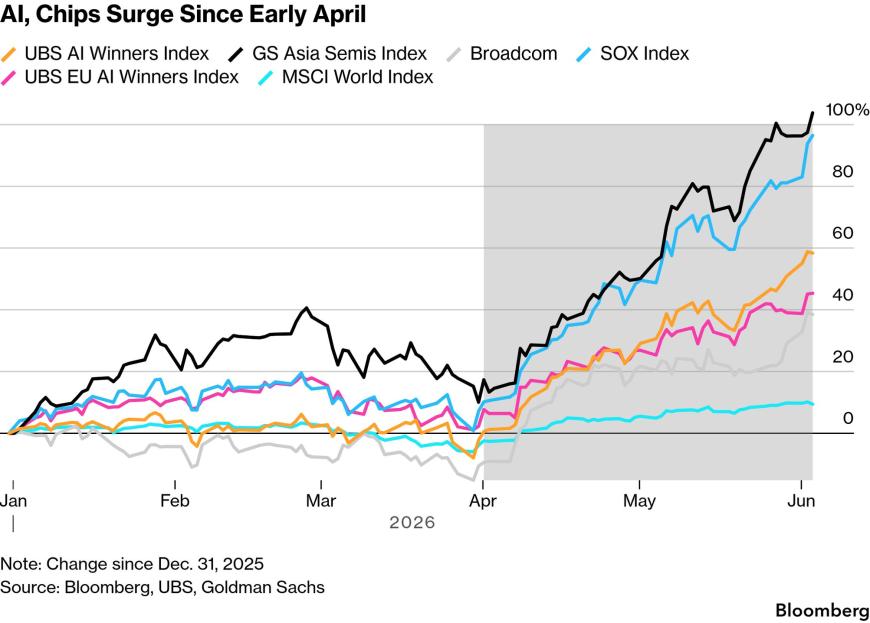
(Since early April, AI and chip stocks have surged. Source: Bloomberg, UBS, Goldman Sachs)
Israel-Lebanon Ceasefire Drives Oil Prices Down
Although equities are under pressure, oil and bonds found some breathing room. After Israel and Lebanon agreed to a ceasefire, Brent crude fell nearly 1% to $97 a barrel.
The truce agreement requires Hezbollah militias allied with Iran to completely halt fire.
Additionally, US commercial crude inventories dropped by 8 million barrels last week due to strong export demand; the Strategic Petroleum Reserve saw an additional release of 8 million barrels.
Analysts noted that global inventories provide a buffer, and may keep tightening in Q3, bringing upside risk to oil prices.
Meanwhile, although Washington announced a ceasefire between Israel and Lebanon, fighting continues inside Lebanon. The Lebanon issue may remain a key sticking point in ending the Middle East war talks, while Iran said negotiations on a temporary agreement have seen no progress recently.
Iranian Foreign Minister Abbas Araghchi wrote that talks with the US "have made no substantive progress," and warned that "any hostile action will be met with an immediate and decisive response."
Bahrain announced it intercepted three missiles and several drones; Kuwait temporarily halted air traffic after an attack.
Von Rotberg said: "For global equity markets to rise significantly from current levels, the Straits of Hormuz would need to be resolved quickly, but that seems unlikely."
He added: "A lot of optimism seems to be priced in again, which limits the short-term upside for global equities."
The US House of Representatives, controlled by the Republican Party, on Wednesday approved a war powers resolution to prevent Trump from escalating conflict with Iran.
However, the measure is largely symbolic, as it must pass the Senate, and even to override a likely presidential veto, two-thirds majorities in both chambers would be required.
Middle East Tensions Continue to Dominate Global Bond Market
US Treasuries stabilized after a pullback on Wednesday, with the 10-year yield down 1 basis point to 4.48%.
Germany's 10-year bund yield fell 1.5 basis points to 3.02%. Markets expect the European Central Bank to raise interest rates next week. According to LSEG data, markets have fully priced in a 25 basis point hike by the ECB at its June 11 policy meeting.
ECB President Christine Lagarde will speak on Thursday, but KBC Bank analysts said rules prohibit her from discussing monetary policy. Meanwhile, a total of €16.75 billion to €20.25 billion in Spanish and French government bonds are set to be issued Thursday for investors to digest.
Jens Naervig Pedersen of Danske Bank wrote in a report, "The Middle East war continues to dominate the global bond market," with little room for easing in the short term.
Dollar Steady, Yen Nears 160 Intervention Level
The dollar was little changed. The dollar index, which measures the greenback against six currencies, remained stable near a two-month high at 99.45.
Previously, the US's ISM services PMI released Wednesday topped expectations. The data showed that, with the Iran war prompting concerns about supply shortages and price increases, companies rushed orders and rebuilt inventories.
The yen rose slightly to 159.9 per dollar, giving it a small buffer from the key 160 level. The 160 level is widely viewed as the trigger for Bank of Japan forex intervention.
Japan's Chief Cabinet Secretary Yoshimasa Hayashi said in Tokyo he expects the Bank of Japan to coordinate with the government. This comes after BOJ Governor Kazuo Ueda gave new hints at a possible rate hike this month.
Bitcoin Falls to Four-Month Low
Bitcoin at one point touched a four-month low and is heading for its longest losing streak since August last year.
Swissquote Senior Analyst Ipek Ozkardeskaya said: "A big issue is that as Bitcoin fell below its estimated mining cost range—$60,000 to $70,000—the last obvious valuation anchor is disappearing."
Analysts at data-tracking platform Material Indicators said by email: "The first major area I'm watching is just above $60,000, because many key factors begin to converge here. We're seeing local lows around $59,900. The 200-week moving average is currently also in about the same area."
They added: "That doesn't guarantee support will hold. It just tells us that this is where the market must choose its direction."
Gold Inches Higher
Gold prices edged higher. In early US trading, New York gold futures rose 0.5% to $4,488.40, supported by a weaker dollar and falling oil prices.
Saxo Bank analysts said: "Overall, gold remains in a range-bound pattern. Steady central bank demand is offset by outflows from gold ETFs and short-term momentum traders betting on deeper corrections in gold prices."
Disclaimer: The content of this article solely reflects the author's opinion and does not represent the platform in any capacity. This article is not intended to serve as a reference for making investment decisions.
You may also like
Is a major reversal in stock-bond allocation approaching? Bank of America issues rare signal: Bonds compete with stocks for capital for the first time in decades, S&P 500's return over the next ten years may be less than 5%
Savita Subramanian, Head of US Equity and Quantitative Strategy at Bank of America, said in an interview on Wednesday that the bond market is becoming attractive again and has, for the first time in decades, become a real competitor to the stock market.

Stop Using the Consumer Cycle to Analyze Micron (MU.US)! AI is Redefining NAND Logic, Enterprise SSDs Have Taken Over Pricing Power
Eudaemon Research previously assessed that within Micron's business structure, DRAM is more resilient than NAND, and that NAND prices and demand would return to normal faster. However, Micron's latest Q4 financial data has led them to revise this view: NAND is no longer a homogeneous market, and the supply-demand and pricing dynamics of consumer-grade NAND and enterprise-level data center SSDs are clearly diverging.
Micron's target price is significantly raised by investment banks, with a maximum of 3,000 USD
DA Davidson has raised Micron's target price to $3,000, implying a 176% upside from the current share price. The core logic is that the AI-driven memory supercycle will continue until 2028, with the supply-demand gap widening further. The key variable lies in the shift of demand—buyers are transitioning from smaller, high-default-risk clients to tech giants such as Amazon, Microsoft, and Google. Micron has already secured $150 billion in remaining contractual obligations.
Oil prices continue to surge, triggering inflation concerns; global stock markets under pressure, Korean stocks close down 2.6%, US Treasury yields rise
Brent crude oil rose about 2.5% on Thursday, surpassing the $102 per barrel mark. Driven by this surge, the U.S. 10-year Treasury yield climbed 3 basis points to 5.31%, approaching its highest level since 2002. Asian stock markets followed the downward trend of U.S. stocks on Wednesday, with an overall decline of 1.2%. Japan's Nikkei 225 closed down 1.4%, and South Korea's Seoul Composite Index plunged 2.6%.
Crypto prices
More


