
BNP Paribas warns inflation threat could trigger three Fed hikes

BNP Paribas has forecast three Federal Reserve rate hikes beginning in December, citing stronger-than-expected U.S. employment data and rising inflation pressures that the bank links in part to the ongoing U.S.-Iran conflict.
- BNP Paribas expects the Fed to deliver three rate hikes starting in December as inflation risks rise.
- Strong U.S. jobs data boosted market expectations for tighter monetary policy.
- Polymarket and CME FedWatch data show traders increasingly pricing in the possibility of higher rates.
According to a Markets 360 analysis from BNP Paribas, the bank has abandoned its previous expectation for stable policy and now expects the Fed to reverse the three interest rate cuts delivered in 2025 through a series of hikes at consecutive Federal Open Market Committee meetings starting at the end of this year.
The bank said policymakers may need to remove some monetary stimulus as inflation risks intensify while labor market conditions remain firm. BNP Paribas also projected that the unemployment rate could gradually fall to 4% by year-end, a level that would give the central bank more room to focus on price pressures.
Fresh labor market data released this week appears to support the bank’s view that the economy remains resilient. U.S. nonfarm payrolls increased by 172,000 last month, far exceeding economists’ forecasts of 85,000. The unemployment rate remained unchanged at 4.3%.
Markets are increasingly pricing in higher rates
Following the jobs report, prediction markets and interest-rate traders moved toward a more hawkish outlook.
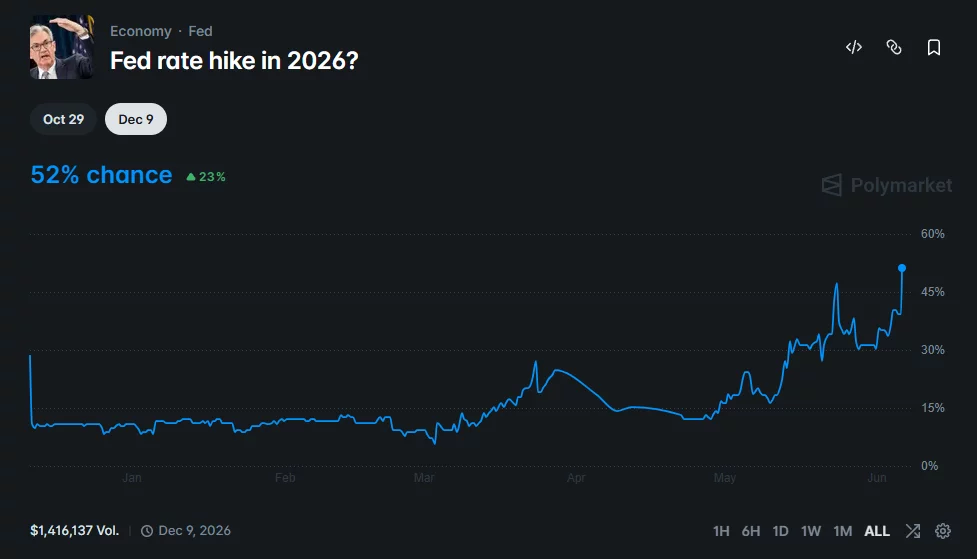
Data from Polymarket now shows a 52% probability that the Federal Reserve will raise rates before the end of the year. The odds reached their highest level so far after the stronger-than-expected payroll figures were published.
 Source:
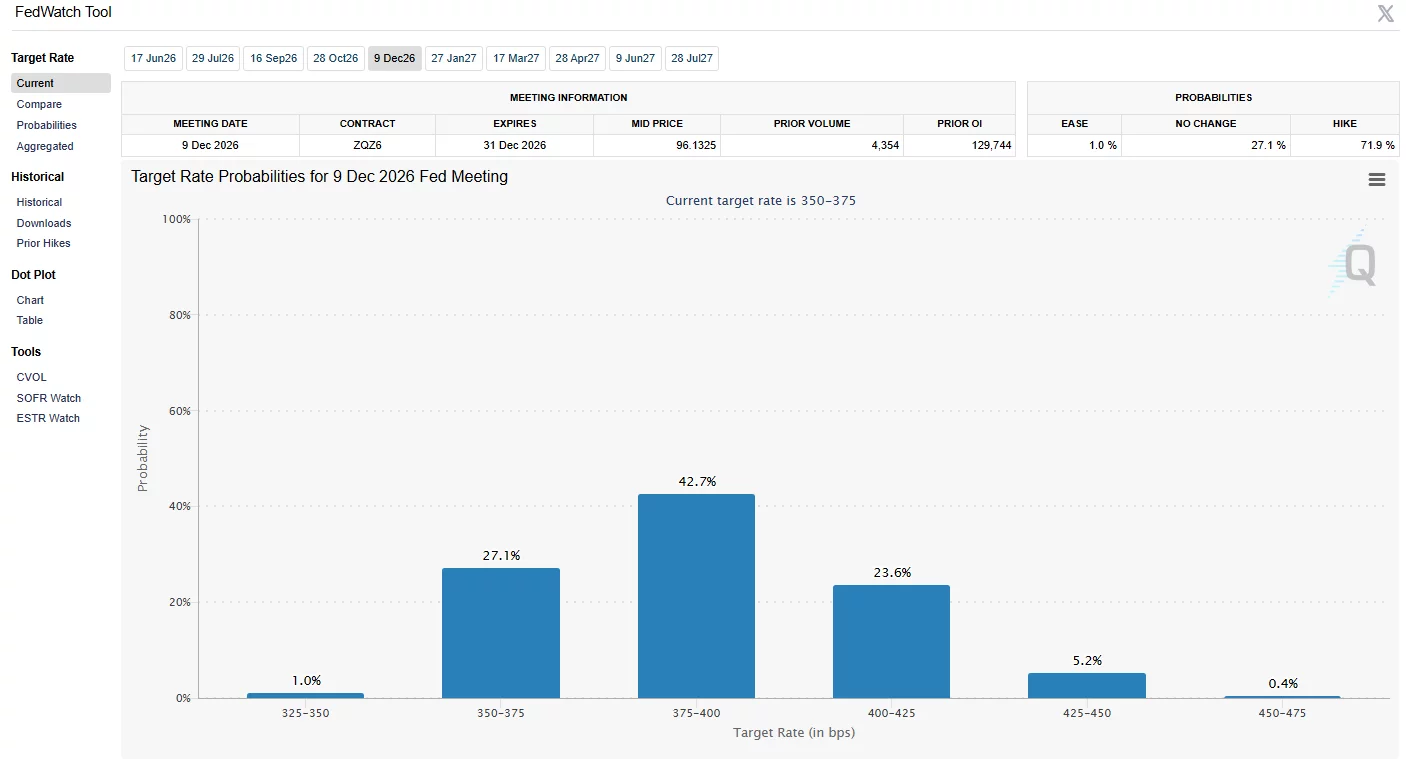
At the same time, CME FedWatch data indicates a 42.7% chance that rates will be higher by December this year. Futures traders continue to expect policymakers to leave rates unchanged for most of the year, while assigning only a limited probability to additional cuts.
 Source:
Those expectations have emerged as inflation remains above the Federal Reserve’s long-term target and geopolitical tensions raise concerns about fresh price increases.
Fed officials and former policymakers remain divided
While BNP Paribas expects tighter monetary policy, some current Federal Reserve officials have continued to argue for patience.
Recent remarks from Mary Daly highlighted a more cautious approach. Daly said restoring price stability remains essential but warned that the Fed cannot achieve that objective by damaging the economy.
Daly has also argued in previous speeches that policymakers are in a position to wait for more data before making major policy changes.
Her stance contrasts with concerns raised by former New York Fed President Bill Dudley, who has repeatedly warned that the central bank risks undermining its credibility if inflation remains above its 2% target for too long.
In recent commentary and interviews, Dudley argued that inflation has exceeded the Fed’s objective for more than five years, yet policymakers have increasingly discussed rate cuts. He has also maintained that the neutral interest rate, often referred to as r*, is likely higher than officials currently assume, suggesting monetary policy may not be as restrictive as it appears.
According to Dudley, the bigger danger lies in inflation expectations becoming entrenched. He has cautioned that households and financial markets could begin treating inflation in the 3% to 5% range as normal if price growth stays elevated for an extended period. In his view, bringing inflation back to target under those conditions could eventually require much more aggressive action from the Federal Reserve.
Disclaimer: The content of this article solely reflects the author's opinion and does not represent the platform in any capacity. This article is not intended to serve as a reference for making investment decisions.
You may also like
Is a major reversal in stock-bond allocation approaching? Bank of America issues rare signal: Bonds compete with stocks for capital for the first time in decades, S&P 500's return over the next ten years may be less than 5%
Savita Subramanian, Head of US Equity and Quantitative Strategy at Bank of America, said in an interview on Wednesday that the bond market is becoming attractive again and has, for the first time in decades, become a real competitor to the stock market.

Stop Using the Consumer Cycle to Analyze Micron (MU.US)! AI is Redefining NAND Logic, Enterprise SSDs Have Taken Over Pricing Power
Eudaemon Research previously assessed that within Micron's business structure, DRAM is more resilient than NAND, and that NAND prices and demand would return to normal faster. However, Micron's latest Q4 financial data has led them to revise this view: NAND is no longer a homogeneous market, and the supply-demand and pricing dynamics of consumer-grade NAND and enterprise-level data center SSDs are clearly diverging.
Micron's target price is significantly raised by investment banks, with a maximum of 3,000 USD
DA Davidson has raised Micron's target price to $3,000, implying a 176% upside from the current share price. The core logic is that the AI-driven memory supercycle will continue until 2028, with the supply-demand gap widening further. The key variable lies in the shift of demand—buyers are transitioning from smaller, high-default-risk clients to tech giants such as Amazon, Microsoft, and Google. Micron has already secured $150 billion in remaining contractual obligations.
Oil prices continue to surge, triggering inflation concerns; global stock markets under pressure, Korean stocks close down 2.6%, US Treasury yields rise
Brent crude oil rose about 2.5% on Thursday, surpassing the $102 per barrel mark. Driven by this surge, the U.S. 10-year Treasury yield climbed 3 basis points to 5.31%, approaching its highest level since 2002. Asian stock markets followed the downward trend of U.S. stocks on Wednesday, with an overall decline of 1.2%. Japan's Nikkei 225 closed down 1.4%, and South Korea's Seoul Composite Index plunged 2.6%.
Crypto prices
More


