
Bitcoin Critic Peter Schiff Predicts USDT Will Eclipse BTC

By:Newsbtc
Bitget offers one-stop trading for cryptocurrencies, stocks, and gold. Trade now!
A welcome pack worth 6200 USDT for new users! Sign up now!
Bitcoin dropped to around $61,500 in recent days, its weakest level in roughly four months, and Peter Schiff wasted no time connecting that slide to a broader argument he has been making about stablecoins.

A Stablecoin On The Move
Tether’s USDT has already climbed to a market capitalization of nearly $188 billion, closing the gap with Ethereum to just under $26 billion. Schiff, the economist and longtime Bitcoin critic, says the numbers point to an inevitable outcome.
“The market cap of Tether will soon surpass the market cap of Ethereum,” Schiff wrote on X. “It will eventually surpass the market cap of Bitcoin, too. The only question is how long it will take.”
var rnd = window.rnd || Math.floor(Math.random()*10e6); var pid607465 = window.pid607465 || rnd; var plc607465 = window.plc607465 || 0; var abkw = window.abkw || ''; var absrc = 'https://servedbyadbutler.com/adserve/;ID=172179;size=0x0;setID=607465;type=js;sw='+screen.width+';sh='+screen.height+';spr='+window.devicePixelRatio+';kw='+abkw+';pid='+pid607465+';place='+(plc607465++)+';rnd='+rnd+';click=CLICK_MACRO_PLACEHOLDER'; document.write('
');
if (!window.AdButler){(function(){var s = document.createElement("script"); s.async = true; s.type = "text/javascript";s.src = "https://servedbyadbutler.com/app.js";var n = document.getElementsByTagName("script")[0]; n.parentNode.insertBefore(s, n);}());}
var AdButler = AdButler || {}; AdButler.ads = AdButler.ads || []; var abkw = window.abkw || ""; var plc366606 = window.plc366606 || 0; (function(){ var divs = document.querySelectorAll(".plc366606:not([id])"); var div = divs[divs.length-1]; div.id = "placement_366606_"+plc366606; AdButler.ads.push({handler: function(opt){ AdButler.register(172179, 366606, [728,90], "placement_366606_"+opt.place, opt); }, opt: { place: plc366606++, keywords: abkw, domain: "servedbyadbutler.com", click:"CLICK_MACRO_PLACEHOLDER" }}); })();
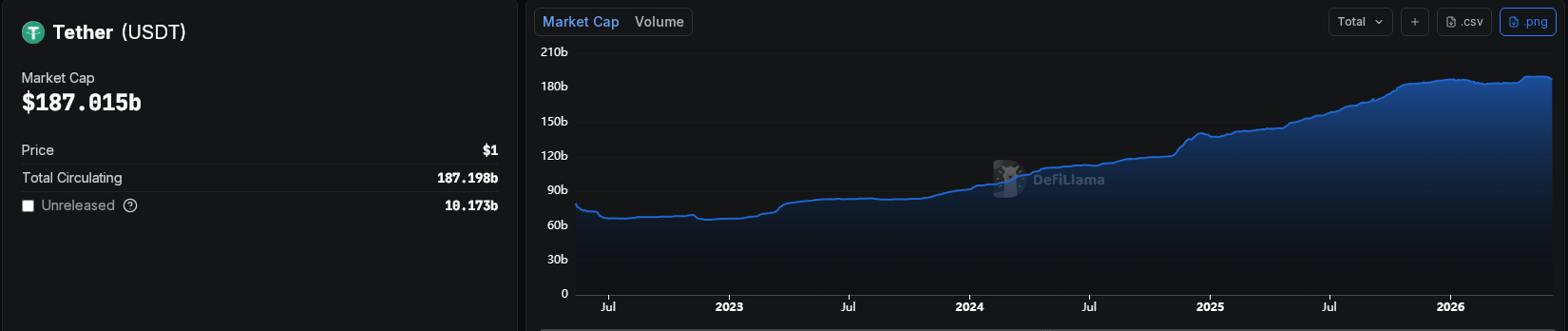 Source:
USDT has become a dominant tool for moving money across crypto markets, and its reach now extends into payments, remittances, and digital dollar transfers — a trend he says supports his case.
USDT holds a one-dollar peg, setting it apart from Bitcoin and Ethereum, and that stability makes it the go-to choice for users who want to move money without taking on price risk.
The market cap of Tether will soon surpass the market cap of Ethereum. It will eventually surpass the market cap of Bitcoin too. The only question is how long it will take.
— Peter Schiff (@PeterSchiff) June 4, 2026
Not His First Warning
Schiff has been sounding alarms about Bitcoin for years. His latest comments include a prediction that BTC could eventually fall below $20,000, which would represent a drop of roughly 80% from its October 2025 peak near $126,200.
var rnd = window.rnd || Math.floor(Math.random()*10e6); var pid607472 = window.pid607472 || rnd; var plc607472 = window.plc607472 || 0; var abkw = window.abkw || ''; var absrc = 'https://servedbyadbutler.com/adserve/;ID=172179;size=0x0;setID=607472;type=js;sw='+screen.width+';sh='+screen.height+';spr='+window.devicePixelRatio+';kw='+abkw+';pid='+pid607472+';place='+(plc607472++)+';rnd='+rnd+';click=CLICK_MACRO_PLACEHOLDER'; document.write('
');
if (!window.AdButler){(function(){var s = document.createElement("script"); s.async = true; s.type = "text/javascript";s.src = "https://servedbyadbutler.com/app.js";var n = document.getElementsByTagName("script")[0]; n.parentNode.insertBefore(s, n);}());}
var AdButler = AdButler || {}; AdButler.ads = AdButler.ads || []; var abkw = window.abkw || ""; var plc452518 = window.plc452518 || 0; (function(){ var divs = document.querySelectorAll(".plc452518:not([id])"); var div = divs[divs.length-1]; div.id = "placement_452518_"+plc452518; AdButler.ads.push({handler: function(opt){ AdButler.register(172179, 452518, [728,90], "placement_452518_"+opt.place, opt); }, opt: { place: plc452518++, keywords: abkw, domain: "servedbyadbutler.com", click:"CLICK_MACRO_PLACEHOLDER" }}); })();
He has also pointed to weakness in tech stocks as a pressure point for Bitcoin, noting that the crypto asset has relied on the broader tech rally for support.
“It looks like the correction in tech stocks has finally begun,” Schiff said. “As tech stocks sell off, Bitcoin should crash. Gold will likely head in the opposite direction.”
BTCUSD now trading at $62,410. Chart:
Bitcoin recently suffered a sharp hourly decline of more than $2,000, briefly touching $61,460, as selling pressure spread across the market and triggered over $1 billion in leveraged liquidations.
USDT’s Growing Reach
Reports indicate Ethereum’s position as the second-largest crypto asset is now under pressure from a stablecoin rather than another blockchain competitor.
var rnd = window.rnd || Math.floor(Math.random()*10e6); var pid607473 = window.pid607473 || rnd; var plc607473 = window.plc607473 || 0; var abkw = window.abkw || ''; var absrc = 'https://servedbyadbutler.com/adserve/;ID=172179;size=0x0;setID=607473;type=js;sw='+screen.width+';sh='+screen.height+';spr='+window.devicePixelRatio+';kw='+abkw+';pid='+pid607473+';place='+(plc607473++)+';rnd='+rnd+';click=CLICK_MACRO_PLACEHOLDER'; document.write('
');
if (!window.AdButler){(function(){var s = document.createElement("script"); s.async = true; s.type = "text/javascript";s.src = 'https://servedbyadbutler.com/app.js';var n = document.getElementsByTagName("script")[0]; n.parentNode.insertBefore(s, n);}());}
var AdButler = AdButler || {}; AdButler.ads = AdButler.ads || []; var abkw = window.abkw || ''; var plc452519 = window.plc452519 || 0; (function(){ var divs = document.querySelectorAll(".plc452519:not([id])"); var div = divs[divs.length-1]; div.id = "placement_452519_"+plc452519; AdButler.ads.push({handler: function(opt){ AdButler.register(172179, 452519, [728,90], 'placement_452519_'+opt.place, opt); }, opt: { place: plc452519++, keywords: abkw, domain: 'servedbyadbutler.com', click:'CLICK_MACRO_PLACEHOLDER' }}); })();
At current figures, USDT would need to grow by roughly 15% to pull ahead of Ethereum, while matching Bitcoin’s $1.28 trillion market cap would require a far larger expansion of nearly seven times its present size.

Bitmine Seeks $300M Raise To Accelerate Ethereum Accumulation Strategy
Schiff’s prediction has drawn attention not just for its boldness but for its timing, arriving as stablecoin adoption continues rising and crypto markets face renewed turbulence.
Whether the prediction holds up remains an open question, though the narrowing gap between USDT and Ethereum suggests the first part of his forecast may not be far off.
Featured image from Unsplash, chart from TradingView
0
0
Disclaimer: The content of this article solely reflects the author's opinion and does not represent the platform in any capacity. This article is not intended to serve as a reference for making investment decisions.
Understand the market, then trade.
Bitget offers one-stop trading for cryptocurrencies, stocks, and gold.
Trade now!
You may also like
How to view the current AI bubble? Industry leaders are fiercely debating
Novogratz said, "The bubble is not spectacular enough"; Dalio warned, "It's very close to bursting"; Taleb pointed out that the real risk lies in the bond market. Goldman Sachs data shows that AI stocks now account for 42% of the S&P 500's market capitalization, surpassing the peak of the 1999 tech bubble. The focus of the debate has evolved into "how to make money before it bursts."
华尔街见闻•2026/10/08 06:02
24 Hour Crypto Recap: Here’s What Happened in the Market
Coinedition•2026/10/08 05:33
Peter Brandt Favors Monero Over XRP Despite Bullish Price Targets
CryptoNewsNet•2026/10/08 05:00
What does Meta Muse mean for GPU and CPU?
Unlike chatbots with a high idle rate, the “always online” nature of intelligent agents like Meta Muse leads to a dramatic increase in computing power consumption. Citi predicts that this trend will shift the CPU-GPU ratio from 1:8 during the training phase to 1:1, driving the CPU market to reach $300 billion by 2030. Meanwhile, just 100 million daily active Muse users could generate up to $19 billion in GPU revenue for Nvidia.
华尔街见闻•2026/10/08 04:06

Crypto prices
More
Bitcoin
BTC
$82,742.45
-1.79%

Ethereum
ETH
$2,563.68
-2.13%

Tether USDt
USDT
$0.9993
-0.05%

BNB
BNB
$770.37
+0.23%

XRP
XRP
$1.4
-4.71%

USDC
USDC
$0.9998
-0.01%

Solana
SOL
$115.16
-3.06%

TRON
TRX
$0.3348
+0.48%

Hyperliquid
HYPE
$87.1
-4.32%

Zcash
ZEC
$1,239.6
-6.19%
How to buy BTC
Bitget lists BTC – Buy or sell BTC quickly on Bitget!
Trade now
Become a trader now?A welcome pack worth 6200 USDT for new users!
Sign up now