
Analyst Who Predicted the Bitcoin Crash Says Price Could Reach $40,000, Here’s When

By:Newsbtc
Bitget offers one-stop trading for cryptocurrencies, stocks, and gold. Trade now!
A welcome pack worth 6200 USDT for new users! Sign up now!
The Bitcoin price recovery back in May 2026 triggered a renewed wave of bullish optimism. But despite the rising prices, there are some who did not give in to the bullish wave, picking a more conservative stance on the cryptocurrency. With the new month, those who refused to flip bullish look to have come out on top as the Bitcoin price has reversed. However, some analysts are predicting that this might only be the start of the decline.
Bitcoin Price Could Be Getting Ready To Fall To New Cycle Lows
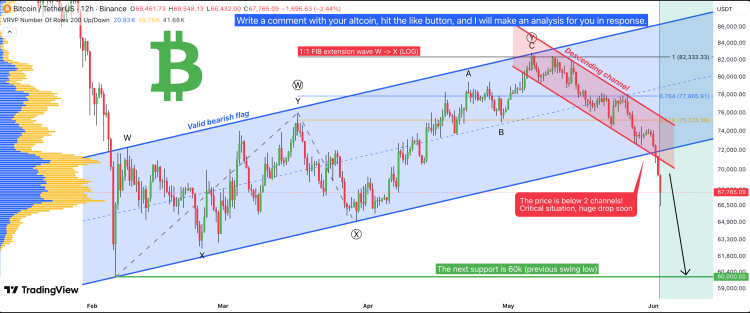
According to crypto analyst Xanrox, the Bitcoin price crash was expected, given that the cryptocurrency has entered one of the most brutal bear markets in recent history. One very bearish development is the fact that the Bitcoin price has now fallen below two major channels.

These channels include a descending channel, which was broken with the fall below $71,000. Then, the other broken channel is an ascending channel, broken at almost the same time as the descending channel. The result of these two channels being broken, the analyst explains, is a double breakdown.
var rnd = window.rnd || Math.floor(Math.random()*10e6); var pid607465 = window.pid607465 || rnd; var plc607465 = window.plc607465 || 0; var abkw = window.abkw || ''; var absrc = 'https://servedbyadbutler.com/adserve/;ID=172179;size=0x0;setID=607465;type=js;sw='+screen.width+';sh='+screen.height+';spr='+window.devicePixelRatio+';kw='+abkw+';pid='+pid607465+';place='+(plc607465++)+';rnd='+rnd+';click=CLICK_MACRO_PLACEHOLDER'; document.write('
');
if (!window.AdButler){(function(){var s = document.createElement("script"); s.async = true; s.type = "text/javascript";s.src = "https://servedbyadbutler.com/app.js";var n = document.getElementsByTagName("script")[0]; n.parentNode.insertBefore(s, n);}());}
var AdButler = AdButler || {}; AdButler.ads = AdButler.ads || []; var abkw = window.abkw || ""; var plc366606 = window.plc366606 || 0; (function(){ var divs = document.querySelectorAll(".plc366606:not([id])"); var div = divs[divs.length-1]; div.id = "placement_366606_"+plc366606; AdButler.ads.push({handler: function(opt){ AdButler.register(172179, 366606, [728,90], "placement_366606_"+opt.place, opt); }, opt: { place: plc366606++, keywords: abkw, domain: "servedbyadbutler.com", click:"CLICK_MACRO_PLACEHOLDER" }}); })();
The thing about double breakdowns is that they are extremely bearish and often suggest that the crash is just starting. With the Bitcoin crash already in motion, the crypto analyst expects that the price will continue to go lower.
Despite there being significant support around the $60,000 level, which has served as the psychological support this cycle, the analyst does not believe this level will hold. Instead, they suggest holding off buying as the price is expected to drop to $48,000, with a strong possibility of a crash to the $40,000-$30,000 levels.
 Source: TradingView
What Investors Should Watch Out For
Presently, there is a major outflow happening in the crypto market, and Bitcoin, being the leading cryptocurrency, has taken the highest hit. The bear market has also pushed a significant number of users out as they move toward cash in a market that seems to offer nothing but losses.
var rnd = window.rnd || Math.floor(Math.random()*10e6); var pid607472 = window.pid607472 || rnd; var plc607472 = window.plc607472 || 0; var abkw = window.abkw || ''; var absrc = 'https://servedbyadbutler.com/adserve/;ID=172179;size=0x0;setID=607472;type=js;sw='+screen.width+';sh='+screen.height+';spr='+window.devicePixelRatio+';kw='+abkw+';pid='+pid607472+';place='+(plc607472++)+';rnd='+rnd+';click=CLICK_MACRO_PLACEHOLDER'; document.write('
');
if (!window.AdButler){(function(){var s = document.createElement("script"); s.async = true; s.type = "text/javascript";s.src = "https://servedbyadbutler.com/app.js";var n = document.getElementsByTagName("script")[0]; n.parentNode.insertBefore(s, n);}());}
var AdButler = AdButler || {}; AdButler.ads = AdButler.ads || []; var abkw = window.abkw || ""; var plc452518 = window.plc452518 || 0; (function(){ var divs = document.querySelectorAll(".plc452518:not([id])"); var div = divs[divs.length-1]; div.id = "placement_452518_"+plc452518; AdButler.ads.push({handler: function(opt){ AdButler.register(172179, 452518, [728,90], "placement_452518_"+opt.place, opt); }, opt: { place: plc452518++, keywords: abkw, domain: "servedbyadbutler.com", click:"CLICK_MACRO_PLACEHOLDER" }}); })();
Pundit Shares Why Most People Will Miss The XRP Run
Xanrox also suggests that the banks are now controlling the Bitcoin price. According to the post, the banks could push the price down 20% in a single day once they start selling on futures. This would put major stress on investors as retail traders are liquidated en masse.
In this case, losses were expected to be amplified as the market made its final downward move. Nevertheless, there is the possibility that bulls will put up a major fight at $60,000, since it is the cycle’s swing low.
BTC price falls toward $60,000 | Source:
BTCUSD on Tradingview.com
0
0
Disclaimer: The content of this article solely reflects the author's opinion and does not represent the platform in any capacity. This article is not intended to serve as a reference for making investment decisions.
Understand the market, then trade.
Bitget offers one-stop trading for cryptocurrencies, stocks, and gold.
Trade now!
You may also like
Micron's target price is significantly raised by investment banks, with a maximum of 3,000 USD
DA Davidson has raised Micron's target price to $3,000, implying a 176% upside from the current share price. The core logic is that the AI-driven memory supercycle will continue until 2028, with the supply-demand gap widening further. The key variable lies in the shift of demand—buyers are transitioning from smaller, high-default-risk clients to tech giants such as Amazon, Microsoft, and Google. Micron has already secured $150 billion in remaining contractual obligations.
华尔街见闻•2026/10/08 07:38
Oil prices continue to surge, triggering inflation concerns; global stock markets under pressure, Korean stocks close down 2.6%, US Treasury yields rise
Brent crude oil rose about 2.5% on Thursday, surpassing the $102 per barrel mark. Driven by this surge, the U.S. 10-year Treasury yield climbed 3 basis points to 5.31%, approaching its highest level since 2002. Asian stock markets followed the downward trend of U.S. stocks on Wednesday, with an overall decline of 1.2%. Japan's Nikkei 225 closed down 1.4%, and South Korea's Seoul Composite Index plunged 2.6%.
华尔街见闻•2026/10/08 07:37
Samsung Partners With Solana to Launch Crypto Stablecoin Payments for 82 Million Americans via Samsung Wallet
Cryptonewsland•2026/10/08 07:27
JPMorgan CEO Dimon Issues Another Warning on the Bond Market: Corporate Borrowers Will Start to Face Pressure
The global competition for capital may begin to squeeze corporate borrowers.
智通财经•2026/10/08 07:13
Crypto prices
More
Bitcoin
BTC
$82,945.27
-1.38%

Ethereum
ETH
$2,567.88
-1.82%

Tether USDt
USDT
$0.9993
-0.03%

BNB
BNB
$769.91
-0.08%

XRP
XRP
$1.41
-4.39%

USDC
USDC
$0.9998
-0.01%

Solana
SOL
$115.03
-3.08%

TRON
TRX
$0.3347
+0.50%

Hyperliquid
HYPE
$87.32
-3.84%

Zcash
ZEC
$1,240.74
-6.16%
How to buy BTC
Bitget lists BTC – Buy or sell BTC quickly on Bitget!
Trade now
Become a trader now?A welcome pack worth 6200 USDT for new users!
Sign up now