
XRP’s Network Traffic Plummets 91.5% as Panic-Stricken Traders Target the $0.65 Support Line

XRP’s (XRP-USD) network traffic plummeted 91.5% following a sharp contraction from its previous speculative high. This has led panic-stricken traders to target the critical $0.65 support line.
Introducing TipRanks MCP for Agents
- Designed for personal research, portfolio monitoring, and AI-assisted investment workflows.
New blockchain data reveals that total XRP network transaction fees have completely evaporated from their previous peaks. This sudden loss of utility leaves the XRP token highly exposed to heavy downward pressure, forcing market participants to watch a lower XRP pricing floor to see if the asset can stabilize.
Fee Collapses Trigger Retail XRP Capitulation
Blockchain analysts at Glassnode discovered that the average total fees paid on the XRP network fell from a peak of 5,900 XRP down to a mere 500 XRP. This steep drop serves as clear proof that transaction demand on the XRP ledger has vanished. At the same time, the XRP network’s realized profit-to-loss ratio hit a rock-bottom 0.38. Through these rough market conditions, XRP market participants are locking in nearly three dollars of losses for every single dollar of profit they make. This harsh reversal shows that a massive wave of investors are dumping their XRP tokens far below their original purchase price.
Large Whales Maintain XRP Holding Strategies
While smaller retail traders panic-sell their assets, large-scale XRP holders are taking a completely different path. Blockchain metrics track a steady decline in massive XRP token transfers moving onto the Binance exchange platform.
In previous market crashes, wealthy XRP whales historically rushed to move massive chunks of tokens onto centralized trading venues to dump them. The current data reveals that inflows from these giant XRP accounts dropped between 15% and 20% over the past few months. Through this quiet behavior, major XRP insiders are indicating that the recent downward price pressure is coming from forced futures market liquidations rather than aggressive selling on their part.
Technical Charts Pinpoint Key XRP Floor Levels
The long-term weekly XRP price charts show a very important price area situated between the $1.00 and $0.65 XRP lines. A massive pricing gap left behind from last year’s explosive XRP rally is drawing the asset downward after the XRP token broke through key support at $1.40.
Moreover, heavy XRP trading volume nodes and a vital five-year upward XRP trendline are both heading toward a collision point right around the $0.60 to $0.65 XRP range. While some aggressive market analysts still project wild long-term XRP targets as high as $15, the immediate survival of the token depends entirely on whether this lower XRP boundary can hold back the bears.
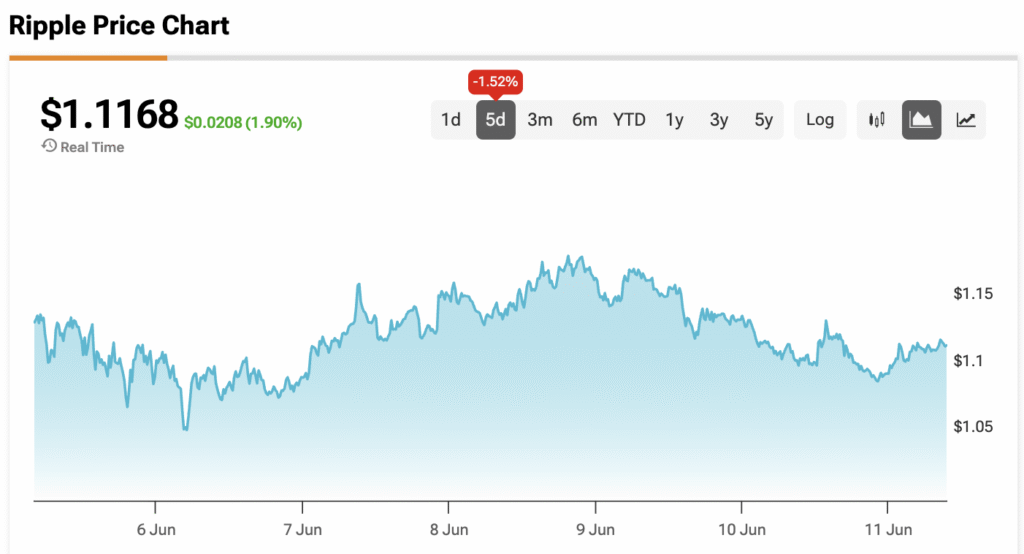
At the time of writing, XRP’s price is sitting at $1.1168.
Copyright © 2026, TipRanks. All rights reserved.
Disclaimer: The content of this article solely reflects the author's opinion and does not represent the platform in any capacity. This article is not intended to serve as a reference for making investment decisions.
You may also like
Federal Reserve meeting minutes: All 19 policymakers support a rate hike in September, but reasons vary; most expect further hikes this year, suggesting no urgency in October.
Most officials view a September interest rate hike as an "insurance" measure against stubborn inflation; a minority see it as a necessary step to curb inflation. Overall, there is no indication of a desire to push for consecutive rate hikes. The "New Fed News Agency" emphasized the minutes: "Most participants believe that it may be appropriate to raise interest rates again before the end of the year." Nearly all officials believe inflation remains elevated and the labor market is close to full employment. Many noted that, despite the rise in long-term U.S. Treasury yields, financial conditions are still conducive to economic growth. Some officials believe that AI will boost investment and productivity, but may also contribute to inflation. The minutes revealed that the U.S.-Japan joint intervention in July to support the yen was a U.S. Treasury action, with no Federal Reserve funds used.
Solana Consolidates After Sharp Expansion
FLOKI Recovery Tests Key Resistance
100 Million Barrels Shrinkage? Reports Say EU Believes Oil Reserve Release Plan Mainly Fulfills Previous Commitments, Not New Quotas
Last Friday, G7 member countries agreed to release up to 100 million barrels of crude oil and diesel reserves. The IEA had announced a plan to release 400 million barrels in March, and as of last Friday, about 75 million barrels had yet to be released. Most EU member states believe that this action is simply fulfilling previous commitments rather than adding new releases. Regarding the earlier-than-scheduled release of diesel stocks emphasized in last week's G7 agreement, EU member states consider it feasible, but on a limited scale.
Crypto prices
More


