
Why The Bitcoin Price Could Mark A Generational Bottom And Rise Over 200%

By:Newsbtc
Bitget offers one-stop trading for cryptocurrencies, stocks, and gold. Trade now!
A welcome pack worth 6200 USDT for new users! Sign up now!
Bitcoin’s investor sentiment is in ruins, but buried inside the wreckage, a technical signal that has appeared only at the most consequential turning points in Bitcoin’s history has just fired again. This technical argument, which is built around Bitcoin’s Relative Strength Index, is because the indicator has fallen to its lowest daily reading in four years, a level last seen near the 2022 bottom before BTC began its climb from $15,500 to $70,000.
Bitcoin’s RSI Is Back In A Rare Bottom Zone
The Relative Strength Index is among the most used momentum indicators, measuring the speed and magnitude of price movements on a scale from 0 to 100. Readings below 30 indicate oversold conditions. At its lowest point during the recent selloff over the weekend, the daily RSI fell to as low as 21.8, and the reading is still around the mid-20s at the time of writing.
That places this reading among the lowest on record for the daily timeframe, and that is why a crypto analyst that goes by the name Crypto Tice on the social media platform believes the Bitcoin price action may be looking at something much bigger than a normal oversold bounce.
var rnd = window.rnd || Math.floor(Math.random()*10e6); var pid607465 = window.pid607465 || rnd; var plc607465 = window.plc607465 || 0; var abkw = window.abkw || ''; var absrc = 'https://servedbyadbutler.com/adserve/;ID=172179;size=0x0;setID=607465;type=js;sw='+screen.width+';sh='+screen.height+';spr='+window.devicePixelRatio+';kw='+abkw+';pid='+pid607465+';place='+(plc607465++)+';rnd='+rnd+';click=CLICK_MACRO_PLACEHOLDER'; document.write('
');
if (!window.AdButler){(function(){var s = document.createElement("script"); s.async = true; s.type = "text/javascript";s.src = "https://servedbyadbutler.com/app.js";var n = document.getElementsByTagName("script")[0]; n.parentNode.insertBefore(s, n);}());}
var AdButler = AdButler || {}; AdButler.ads = AdButler.ads || []; var abkw = window.abkw || ""; var plc366606 = window.plc366606 || 0; (function(){ var divs = document.querySelectorAll(".plc366606:not([id])"); var div = divs[divs.length-1]; div.id = "placement_366606_"+plc366606; AdButler.ads.push({handler: function(opt){ AdButler.register(172179, 366606, [728,90], "placement_366606_"+opt.place, opt); }, opt: { place: plc366606++, keywords: abkw, domain: "servedbyadbutler.com", click:"CLICK_MACRO_PLACEHOLDER" }}); })();
As shown in the chart below, the red and orange zones line up with some of Bitcoin’s most painful periods, including the 2011 bottom, the 2015 bear-market low, the 2018-2019 correction, the 2022 collapse, and now the 2026 slow correction. In each case, the bottom appeared when the Bitcoin price had already endured a major decline, and that is the same setup happening right now.
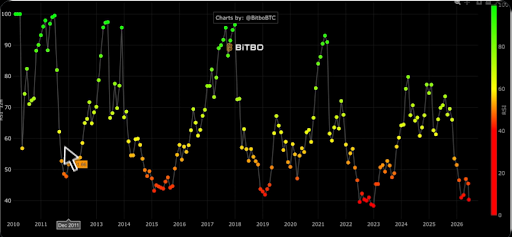
Bitcoin Price Chart. Source: @CryptoTice_ On X
var rnd = window.rnd || Math.floor(Math.random()*10e6); var pid607472 = window.pid607472 || rnd; var plc607472 = window.plc607472 || 0; var abkw = window.abkw || ''; var absrc = 'https://servedbyadbutler.com/adserve/;ID=172179;size=0x0;setID=607472;type=js;sw='+screen.width+';sh='+screen.height+';spr='+window.devicePixelRatio+';kw='+abkw+';pid='+pid607472+';place='+(plc607472++)+';rnd='+rnd+';click=CLICK_MACRO_PLACEHOLDER'; document.write('
');
if (!window.AdButler){(function(){var s = document.createElement("script"); s.async = true; s.type = "text/javascript";s.src = "https://servedbyadbutler.com/app.js";var n = document.getElementsByTagName("script")[0]; n.parentNode.insertBefore(s, n);}());}
var AdButler = AdButler || {}; AdButler.ads = AdButler.ads || []; var abkw = window.abkw || ""; var plc452518 = window.plc452518 || 0; (function(){ var divs = document.querySelectorAll(".plc452518:not([id])"); var div = divs[divs.length-1]; div.id = "placement_452518_"+plc452518; AdButler.ads.push({handler: function(opt){ AdButler.register(172179, 452518, [728,90], "placement_452518_"+opt.place, opt); }, opt: { place: plc452518++, keywords: abkw, domain: "servedbyadbutler.com", click:"CLICK_MACRO_PLACEHOLDER" }}); })();
Why A 200% Target Is Possible For Bitcoin
Bitcoin fell below $60,000 for the first time since 2024 and is currently down by about 50% from its October 2025 peak above $126,000. The leading cryptocurrency is now trading between $61,000 and $63,000.
Interestingly, the main comparison of where Bitcoin goes from here is the 2022 bottom. Back then, Bitcoin’s RSI reached deeply oversold levels as the price collapsed to around $15,500, but the low eventually became the base for a rally to $70,000 in 2024. That move represented a gain of more than 350% from the cycle bottom, and it eventually rolled on to its all-time high in October 2025.

Dogecoin Is One Step Away From The Same Pattern That Triggered 2021’s 29,000% Rally, What Next?
If Bitcoin were to form a similar bottom around the current $60,000 zone, a 200% rally would place the price at a target of $180,000. A move matching the full 2022-to-2024 recovery would imply even higher levels above $200,000. The present market also has a different background from 2022. Bitcoin now has spot ETFs, deeper institutional involvement, and large corporate holders that are influencing sentiment.
var rnd = window.rnd || Math.floor(Math.random()*10e6); var pid607473 = window.pid607473 || rnd; var plc607473 = window.plc607473 || 0; var abkw = window.abkw || ''; var absrc = 'https://servedbyadbutler.com/adserve/;ID=172179;size=0x0;setID=607473;type=js;sw='+screen.width+';sh='+screen.height+';spr='+window.devicePixelRatio+';kw='+abkw+';pid='+pid607473+';place='+(plc607473++)+';rnd='+rnd+';click=CLICK_MACRO_PLACEHOLDER'; document.write('
');
if (!window.AdButler){(function(){var s = document.createElement("script"); s.async = true; s.type = "text/javascript";s.src = 'https://servedbyadbutler.com/app.js';var n = document.getElementsByTagName("script")[0]; n.parentNode.insertBefore(s, n);}());}
var AdButler = AdButler || {}; AdButler.ads = AdButler.ads || []; var abkw = window.abkw || ''; var plc452519 = window.plc452519 || 0; (function(){ var divs = document.querySelectorAll(".plc452519:not([id])"); var div = divs[divs.length-1]; div.id = "placement_452519_"+plc452519; AdButler.ads.push({handler: function(opt){ AdButler.register(172179, 452519, [728,90], 'placement_452519_'+opt.place, opt); }, opt: { place: plc452519++, keywords: abkw, domain: 'servedbyadbutler.com', click:'CLICK_MACRO_PLACEHOLDER' }}); })();
Speaking of ETFs, Spot Bitcoin ETFs have resumed their streak of outflows, which complicates any bottom prediction right now. The technical signal from the RSI is strong, but the Bitcoin price needs demand to turn the signal into a sustained rally.
BTC price struggles with bears | Source:
BTCUSD on Tradingview.com
0
0
Disclaimer: The content of this article solely reflects the author's opinion and does not represent the platform in any capacity. This article is not intended to serve as a reference for making investment decisions.
Understand the market, then trade.
Bitget offers one-stop trading for cryptocurrencies, stocks, and gold.
Trade now!
You may also like
Federal Reserve meeting minutes: All 19 policymakers support a rate hike in September, but reasons vary; most expect further hikes this year, suggesting no urgency in October.
Most officials view a September interest rate hike as an "insurance" measure against stubborn inflation; a minority see it as a necessary step to curb inflation. Overall, there is no indication of a desire to push for consecutive rate hikes. The "New Fed News Agency" emphasized the minutes: "Most participants believe that it may be appropriate to raise interest rates again before the end of the year." Nearly all officials believe inflation remains elevated and the labor market is close to full employment. Many noted that, despite the rise in long-term U.S. Treasury yields, financial conditions are still conducive to economic growth. Some officials believe that AI will boost investment and productivity, but may also contribute to inflation. The minutes revealed that the U.S.-Japan joint intervention in July to support the yen was a U.S. Treasury action, with no Federal Reserve funds used.
华尔街见闻•2026/10/07 20:07
Solana Consolidates After Sharp Expansion
Cryptonewsland•2026/10/07 19:33
FLOKI Recovery Tests Key Resistance
Cryptonewsland•2026/10/07 18:51
100 Million Barrels Shrinkage? Reports Say EU Believes Oil Reserve Release Plan Mainly Fulfills Previous Commitments, Not New Quotas
Last Friday, G7 member countries agreed to release up to 100 million barrels of crude oil and diesel reserves. The IEA had announced a plan to release 400 million barrels in March, and as of last Friday, about 75 million barrels had yet to be released. Most EU member states believe that this action is simply fulfilling previous commitments rather than adding new releases. Regarding the earlier-than-scheduled release of diesel stocks emphasized in last week's G7 agreement, EU member states consider it feasible, but on a limited scale.
华尔街见闻•2026/10/07 18:41
Crypto prices
More
Bitcoin
BTC
$83,275.43
-2.70%

Ethereum
ETH
$2,568.31
-4.79%

Tether USDt
USDT
$0.9994
-0.06%

BNB
BNB
$770.02
-1.22%

XRP
XRP
$1.42
-5.56%

USDC
USDC
$0.9998
-0.02%

Solana
SOL
$115.9
-4.12%

TRON
TRX
$0.3352
-0.15%

Hyperliquid
HYPE
$87.81
-4.38%

Zcash
ZEC
$1,318.63
-1.61%
How to buy BTC
Bitget lists BTC – Buy or sell BTC quickly on Bitget!
Trade now
Become a trader now?A welcome pack worth 6200 USDT for new users!
Sign up now