
Ethereum Nears 200 Million Non-Empty Wallets Despite Market Uncertainty

Despite persistent market uncertainty and bearish sentiment across parts of the cryptocurrency sector, Ethereum is approaching a significant adoption milestone, with the number of non-empty wallets nearing 200 million. While price fluctuations often dominate investor attention, the steady growth in wallet activity suggests that participation in the ETH ecosystem continues to expand.
How Ethereum’s Expanding User Network Signals Resilience
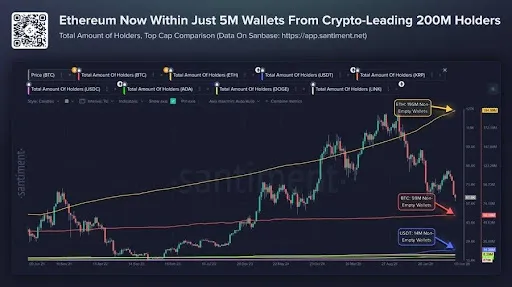
Ethereum is rapidly approaching a major adoption milestone, with the network now approaching 200 million non-empty wallets despite high Fear, Uncertainty, and Doubt (FUD). Santiment Intelligence on X pointed out that the ETH network continues to grow exponentially compared to other top market capitalizations, while facing some of the most negative sentiment in crypto.

The network now boasts approximately 195 million non-empty wallets, significantly outpacing Bitcoin’s roughly 59 million. This represents a lead of more than 230%, a gap that has continued to grow across multiple market cycles. While social media narratives focus on ETH’s recent price underperformance, user adoption continues to move in the opposite direction.
 Source:
ETH now sits just 5 million wallets away from the 200 million milestone. Much of the growth is driven by ETH dominance in Decentralized Finance (DeFi), staking, and broader on-chain activity, where users are not just holding assets but actively participating in the network. Despite the recent crowd sentiment indicators falling into extreme fear territory, ETH’s rising wallet growth suggests that long-term adoption continues to accelerate beneath the surface.
Why Ethereum’s Consolidation May Be A Sign Of Market Maturity
Ethereum’s current market structure may be less a sign of weakness and more a reflection of a natural consolidation process. According to Materkel, ETH remains one of the fastest assets in history to reach a $500 million valuation, even if Anthropic might overtake it depending on when it goes public.

Rather than signalling weakness, this appears to be an extremely healthy consolidation that happens after an asset has experienced a meteoric rise. Materkel argues that a large portion of BitMine’s ETH is most likely coming from long-term holders who invested at sub-$100 levels. Over the past five years, with ETH trading between $1,000 and $5,000, many of these investors have had ample opportunity to realize substantial gains.
Though some of these investors may have lost conviction, they are also sitting on outsized profits for more than 5 years. It’s only natural that they would sell a bit at some point. Historically, many of the world’s most successful assets have experienced lengthy consolidation phases after periods of explosive growth in the stock market. These consolidation periods often lasted 5, 10, or even 20 years, and are frequently accompanied by widespread skepticism before eventually giving way to powerful new expansion phases.
Disclaimer: The content of this article solely reflects the author's opinion and does not represent the platform in any capacity. This article is not intended to serve as a reference for making investment decisions.
You may also like
Federal Reserve meeting minutes: All 19 policymakers support a rate hike in September, but reasons vary; most expect further hikes this year, suggesting no urgency in October.
Most officials view a September interest rate hike as an "insurance" measure against stubborn inflation; a minority see it as a necessary step to curb inflation. Overall, there is no indication of a desire to push for consecutive rate hikes. The "New Fed News Agency" emphasized the minutes: "Most participants believe that it may be appropriate to raise interest rates again before the end of the year." Nearly all officials believe inflation remains elevated and the labor market is close to full employment. Many noted that, despite the rise in long-term U.S. Treasury yields, financial conditions are still conducive to economic growth. Some officials believe that AI will boost investment and productivity, but may also contribute to inflation. The minutes revealed that the U.S.-Japan joint intervention in July to support the yen was a U.S. Treasury action, with no Federal Reserve funds used.
Solana Consolidates After Sharp Expansion
FLOKI Recovery Tests Key Resistance
100 Million Barrels Shrinkage? Reports Say EU Believes Oil Reserve Release Plan Mainly Fulfills Previous Commitments, Not New Quotas
Last Friday, G7 member countries agreed to release up to 100 million barrels of crude oil and diesel reserves. The IEA had announced a plan to release 400 million barrels in March, and as of last Friday, about 75 million barrels had yet to be released. Most EU member states believe that this action is simply fulfilling previous commitments rather than adding new releases. Regarding the earlier-than-scheduled release of diesel stocks emphasized in last week's G7 agreement, EU member states consider it feasible, but on a limited scale.
Crypto prices
More


