
StanChart looks for 3 signs of BTC bottom, including Strategy’s Monday news

Standard Chartered analyst Geoff Kendrick on Friday told clients that he believes crypto asset prices have seen the low in the current cycle and he is looking for confirmation in three indicators: Strategy’s reporting that it bought more Bitcoin last week; crypto exchange-traded funds (ETF) saw positive inflows on Friday; and, oil prices continue to break lower.
“We have now seen the low in crypto asset prices for the cycle. That would be USD59k for BTC (53% down from USD126k high),” Kendrick said in a brief note to clients on Friday. The biggest crypto was last trading on Sunday at about $63,704, according to CoinMarketCap data.
Depending on how investors read Strategy chief Michael Saylor’s near-weekly tweet issued earlier on Sunday, The first sign that Kendrick is watching for may have come.
“Still adding dots,” was Saylor’s message that accompanied the now-familiar dot, or bubble, chart that the Strategy executive frequently includes in his social media posts teasing forthcoming BTC purchases.
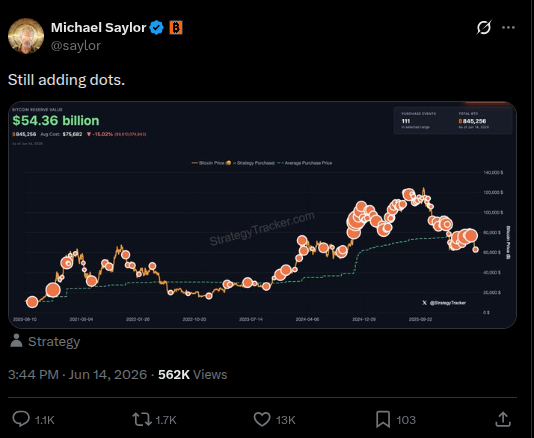
Michael Saylor's tweet on Sunday had more than a half a million views by mid-afternoon, ET. Source: Michael Saylor on X.com
As for the other indicators of a BTC bottom that StanChart’s global head of digital assets research cited, Bitcoin ETFs on Friday posted one-day net inflow of $85.84 million, with investors moving money into five of the funds while eight of the US-traded BTC ETFs had no net change, according to data tracked by SoSoValue.com. Crude oil futures fell on Friday for the second straight day, according to Yahoo Finance data.
Kendrick closed his note with: “Winter is over. Welcome back to crypto Spring.“
Related: Bitcoin sales are necessary for Strategy's digital credit business, Saylor says
Surprise Bitcoin sale defended as “necessary“ defense of digital credit
Strategy disclosed its first reported Bitcoin sale since 2022 in a June 1 filing with the US Securities and Exchange Commission, offloading 32 BTC in a move that appeared at odds with Saylor's long-running “never sell your Bitcoin“ mantra. He defended that sale, saying the ability to sell the asset is necessary to continue issuing “digital credit.“
“If the company's policy is that we won't sell the Bitcoin, then the credit won't have value and the equity won't have value,” he told Cointelegraph at the BTC Prague conference.

Cointelegraph’s Ciaran Lyons (left) and Strategy founder Michael Saylor (right) at BTC Prague. Source: Cointelegraph
Saylor said that Bitcoin treasury companies must retain the ability to sell holdings when necessary to support dividend-paying securities and other BTC-backed credit products.
Magazine: Bitcoin, the ‘canary in the coal mine,’ XRP transaction demand falls 91.5%: Market Moves
Disclaimer: The content of this article solely reflects the author's opinion and does not represent the platform in any capacity. This article is not intended to serve as a reference for making investment decisions.
You may also like
Federal Reserve meeting minutes: All 19 policymakers support a rate hike in September, but reasons vary; most expect further hikes this year, suggesting no urgency in October.
Most officials view a September interest rate hike as an "insurance" measure against stubborn inflation; a minority see it as a necessary step to curb inflation. Overall, there is no indication of a desire to push for consecutive rate hikes. The "New Fed News Agency" emphasized the minutes: "Most participants believe that it may be appropriate to raise interest rates again before the end of the year." Nearly all officials believe inflation remains elevated and the labor market is close to full employment. Many noted that, despite the rise in long-term U.S. Treasury yields, financial conditions are still conducive to economic growth. Some officials believe that AI will boost investment and productivity, but may also contribute to inflation. The minutes revealed that the U.S.-Japan joint intervention in July to support the yen was a U.S. Treasury action, with no Federal Reserve funds used.
Solana Consolidates After Sharp Expansion
FLOKI Recovery Tests Key Resistance
100 Million Barrels Shrinkage? Reports Say EU Believes Oil Reserve Release Plan Mainly Fulfills Previous Commitments, Not New Quotas
Last Friday, G7 member countries agreed to release up to 100 million barrels of crude oil and diesel reserves. The IEA had announced a plan to release 400 million barrels in March, and as of last Friday, about 75 million barrels had yet to be released. Most EU member states believe that this action is simply fulfilling previous commitments rather than adding new releases. Regarding the earlier-than-scheduled release of diesel stocks emphasized in last week's G7 agreement, EU member states consider it feasible, but on a limited scale.
Crypto prices
More


