
Ready USDC card halts non-EEA service after issuer change, users report

Ready, a self-custodial crypto wallet and payments company, has reportedly restricted card access for users outside the European Economic Area, according to multiple user reports.
Ready has restricted USDC card functionality for users outside the European Economic Area following a change in its card provider, according to notices shared by users on social media.
Several users shared screenshots of an in-app notice from Ready stating: “Your Ready Card will be deactivated within the next hour,” citing changes affecting users “primarily outside the EEA.”
The reported changes left some users questioning how quickly access to crypto-linked payment cards can be restricted when providers change.
Users question speed of restriction and communication
Several users criticized the short notice period before the changes took effect, saying they lost access to the card within hours.
One user, who uses the X handle TapSatoshi, said in a post that they were frustrated with the company’s product roadmap, citing delayed features such as Apple Pay support and prioritizing the addition of a “Rewards” section.
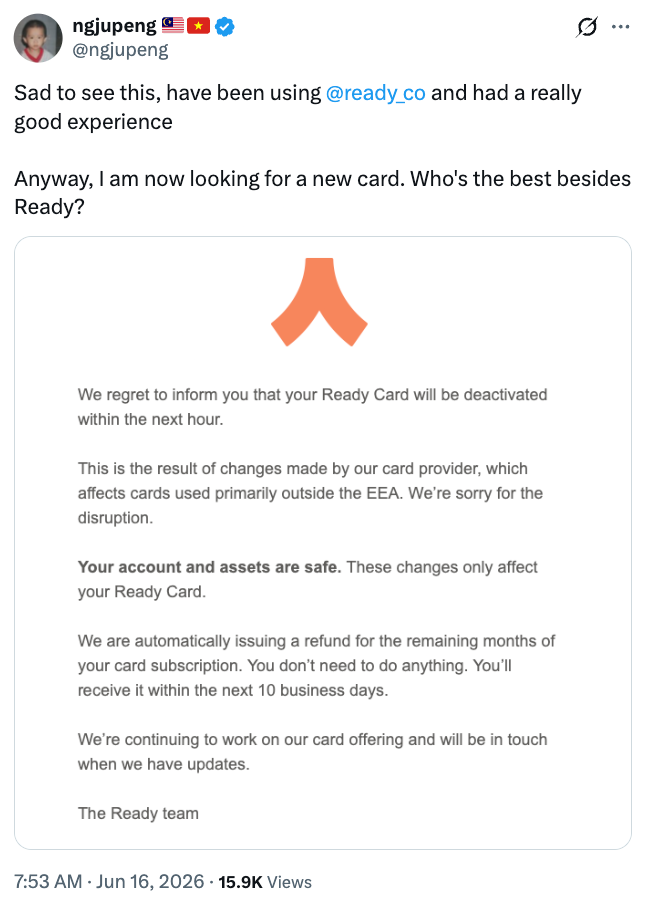
Screenshots of Ready’s message also stated that users would receive automatic refunds for any remaining subscription period within 10 business days.
It remains unclear which company will serve as the new card provider for the Ready Card or what prompted the change. The previous issuer-side partner linked to the program was Kulipa, according to publicly available documentation.
Related: BitGo courts crypto firms awaiting MiCA approval amid Binance licensing concerns
Cointelegraph contacted Ready for comment regarding the issue but did not receive a response by publication time.
USDC at the center of the Ready Card
Formerly known as Argent, Ready is a wallet built for the Starknet ecosystem, an Ethereum layer-2 scaling network using zero-knowledge rollups.
While Ready’s wallet supports multiple crypto assets, including Bitcoin (BTC) and Ether (ETH), the Ready Card is primarily built around USDC, which users spend directly from their wallet balance at checkout.

Source: Ready
According to Ready documentation, the system checks a user’s USDC balance in real time when a purchase is made and processes the transaction through Mastercard’s payment network, converting crypto into fiat at the point of sale. The card issuer acts as the bridge between the self-custodial wallet and traditional payment rails.
This structure allows users to retain full control of their assets in the wallet, while the card only provides a spending layer on top of those funds. If card access is restricted, users can still hold and transfer USDC onchain without interruption.
Magazine: The end of anon? AI could unmask crypto’s hidden identities
Disclaimer: The content of this article solely reflects the author's opinion and does not represent the platform in any capacity. This article is not intended to serve as a reference for making investment decisions.
You may also like
Beaver Creek: Mining’s next generation takes the wheel
NASDAQ TRADE HALT CONTINUES <UCFIW.O> REASON NOT AVAILABLE AT 12:51 PM
NASDAQ TRADE HALT CONTINUES REASON NOT AVAILABLE AT 12:51 PM
Exchange-Traded Funds, Equity Futures Higher Pre-Bell Tuesday Amid Lower Oil Prices
09:12 AM EDT, 10/06/2026 (MT Newswires) -- The broad market exchange-traded fund SPDR S&P 500 ETF Trust (SPY) was up 0.5% and the actively traded Invesco QQQ Trust (QQQ) was 0.6% higher in Tuesday's premarket activity amid lower oil prices and optimism around tech stocks. US stock futures were also higher, with S&P 500 Index futures up 0.5%, Dow Jones Industrial Average futures advancing 0.7%, and Nasdaq futures gaining 0.7% before the start of regular trading. The US international trade deficit widened to $105.57 billion in August from a $92.83 billion gap in July, compared with a $102.1 billion gap expected in a survey compiled by Bloomberg as of 7:35 am ET. In premarket activity, bitcoin was up by 0.7%. Among cryptocurrency ETFs, the cryptocurrency fund ProShares Bitcoin Strategy ETF (BITO) was 1% higher, Ether ETF (EETH) advanced 1.6%, and Bitcoin & Ether Market Cap Weight ETF (BETH) was flat. Power Play: Health Care The State Street Health Care Select Sector SPDR ETF (XLV) advanced 0.3%, while the Vanguard Health Care Index Fund (VHT) and the iShares US Healthcare ETF (IYH) were inactive. The iShares Biotechnology ETF (IBB) was 0.7% higher. Option Care Health (OPCH) shares were up 21% pre-bell Tuesday after McKesson (MCK) and CD&R agreed to buy the company for roughly $5.80 billion. Winners and Losers: Technology The State Street Technology Select Sector SPDR ETF (XLK) gained 0.7%, the iShares US Technology ETF (IYW) was 0.5% higher, and the iShares Expanded Tech Sector ETF (IGM) was inactive. Among semiconductor ETFs, the State Street SPDR S&P Semiconductor ETF (XSD) was inactive, while the iShares Semiconductor ETF (SOXX) rose by 0.5%. Xanadu Quantum Technologies (XNDU) shares were up 7% in premarket activity after the company entered a multiyear deal with GlobalFoundries (GFS). GlobalFoundries was 1.4% higher. Financial The State Street Financial Select Sector SPDR ETF (XLF) advanced 0.3%. Direxion Daily Financial Bull 3X Shares (FAS) was up 0.9%, while its bearish counterpart, Direxion Daily Financial Be
Iran Tries to Oust Diplomat Who Met Trump Envoys: Will It Reverse Oil Price Slide?
Crypto prices
More


