
Strategy director dumps $9M in shares as STRC rout hits MSTR stock

A Strategy director has sold nearly $9 million worth of company shares over the past three months as pressure on the firm’s preferred stock offerings and concerns over future dividend funding continue to weigh on MSTR.
- Strategy director Jarrod Patten has sold nearly $9 million worth of MSTR shares over the past three months.
- QCP estimates Strategy has about 7.5 months of liquidity to support preferred stock dividend payments.
- Bernstein maintained its $450 MSTR price target despite the stock falling roughly 31% over the past month.
According to a recent filing with the U.S. Securities and Exchange Commission, Strategy director Jarrod Patten exercised options to acquire 1,500 Class A shares at a strike price of $18.236 and immediately sold them on the open market at roughly $134 per share, generating a profit of around $200K.
The transaction adds to a steady pattern of insider selling. SEC filings show Patten has disposed of 55,750 MSTR shares during the last three months, with total proceeds approaching $9 million. His latest sale comes as Strategy stock remains under pressure following a sharp decline in both Bitcoin and the company’s preferred securities.
Following the transaction, Patten still holds 28,406 Class A shares, positions across several Series A perpetual preferred stock offerings, and 44,250 unexercised director stock options.
Dividend concerns have moved into focus
Attention has increasingly shifted toward Strategy’s ability to support dividend obligations tied to its preferred stock products.
According to market maker QCP, Strategy’s current liquidity position can fund dividend payments for roughly seven and a half months.
As crypto.news reported, QCP said the company could eventually face a decision between raising additional capital, diluting shareholders further, or selling Bitcoin if alternative funding sources become less attractive.
The concern emerged shortly after Strategy completed several balance-sheet transactions. QCP noted that the company repurchased nearly $1.5 billion of convertible notes due in 2029 while raising approximately $200 million through MSTR stock sales. Part of those proceeds was later used to acquire another $100 million worth of Bitcoin.
Investor attention has also centered on Strategy’s preferred securities. STRC, the company’s Stretch preferred stock, recently fell to a record low of $89, leaving it about 11% below its intended $100 value and increasing scrutiny of the firm’s capital structure.
Earlier this month, Strategy disclosed the sale of 32 BTC valued at approximately $2.5 million to fund STRC dividend payments. The transaction marked the first known Bitcoin sale by the company after years of maintaining a strict accumulation strategy.
Analyst targets remain unchanged despite weakness
Selling activity by company insiders has continued throughout 2026. Earlier filings showed Chief Executive Officer Phong Le, Chief Financial Officer Andrew Kang, and former Executive Vice President Wei-Ming Shao collectively sold millions of dollars’ worth of MSTR shares in March. Kang and Patten reduced their holdings as the stock weakened despite record highs in major U.S. equity indexes.
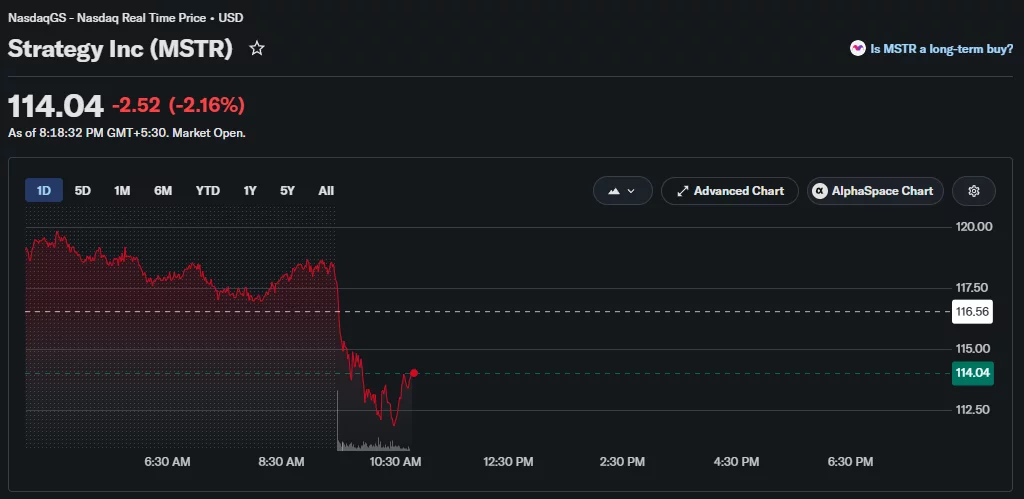
MSTR closed 5.09% lower at $116.56 on Wednesday as risk assets weakened after the Federal Reserve kept interest rates unchanged at 3.50% to 3.75% while signaling potential tightening risks for 2026. The stock extended its decline on Thursday, falling another 2.1% to $114.04. With those losses, MSTR is now down roughly 31% over the past month.
 Source:
Meanwhile, Bitcoin traded near $63,850 at press time after dropping nearly 2% in the past 24 hours.
Despite the recent decline, analysts at TD Cowen, Citigroup, Bernstein, and BTIG have maintained their existing bullish ratings on MSTR shares. Bernstein analysts reiterated a buy rating and kept a 12-month price target of $450, while TD Cowen targets $350, Citigroup holds at $260, and BTIG maintains a target of $250.
Disclaimer: The content of this article solely reflects the author's opinion and does not represent the platform in any capacity. This article is not intended to serve as a reference for making investment decisions.
You may also like
XRP News Today : Ripple Expands Prime Brokerage Services for Brevan Howard
ROI - For the Trump-led Treasury, the "tail" of the auction is the most difficult part: McKeever
The views expressed in this article are solely those of the author, Reuters columnist Jamie McGeever. Reuters, Orlando, Florida, October 6 – U.S. Treasury auctions are typically dull, predictable, and not newsworthy. But these are not ordinary times, and the Trump administration now faces the risk of sluggish U.S. debt sales making headlines. The U.S. Treasury plans to issue nearly $120 billion in Treasuries this week, the first non-bill bond sales in two weeks: $58 billion in three-year notes on Tuesday, $39 billion in ten-year notes on Wednesday, and $22 billion in thirty-year bonds on Thursday. These auctions would usually be insignificant events, but due to the exceptionally weak performance of auctions from September 22 to 24—especially the five-year note auction on September 23, which triggered the largest spike in bond yields since April last year—they are attracting growing attention. Since then, yields have not only failed to retreat but have surged across most tenors to multi-decade highs. It's worth noting that the possibility of a U.S. Treasury auction "failing" is almost zero. Primary dealers—currently 26 Wall Street banks and institutions authorized by the New York Fed as market makers for Treasuries—are always involved. They effectively underwrite the sales, ensuring the smooth operation of the $30 trillion U.S. Treasury market, the most liquid market in the world. This, in turn, allows the entire global financial system to function, given that trillions of dollars in global debt, assets, and market derivatives are benchmarked against U.S. Treasuries. Treasuries are also the primary collateral for lubricating the financial “pipes” of the U.S. and global markets, including repo agreements, interbank loans, and financing. In short, as long as U.S. Treasuries remain the pillar of the global financial system, there will always be buyers at Treasury auctions. The question, as always, is at what price these bonds will be sold. Currently, borrowing costs in the secondary market are at their highest levels since the mid-2000s, so it's reasonable to expect that the Treasury will pay relatively high rates in the primary market as well. But as recent auctions have shown, negative surprises remain possible. "Too big to be absorbed by the market"? The $70 billion five-year auction on September 23 was among the most worrisome in years. Demand, as measured by the bid-to-cover ratio, was at a nine-year low. The Treasury ended up selling the notes at a yield of 5.033%, more than 3 basis points above the market yield at the close of bidding. Three basis points might not sound like much, but it's exceptional for a five-year note auction. This is the largest so-called "tail" since June 2022. According to JPMorgan analysts, the last time a five-year auction had a three-basis-point tail was back in 2011—amid the brewing debt ceiling crisis that eventually led to a U.S. credit rating downgrade in August that year. Currently, concerns over the U.S.'s daunting fiscal outlook are driving up long-term borrowing costs. As a result, markets generally expect the Trump administration to gradually shift the Treasury’s massive funding needs toward the lower-yield (and therefore lower-cost) short- and medium-term segments of the curve. That's why the five-year note auction two weeks ago sparked such concern. A three-basis-point tail is common in long bond auctions, but not in the "belly" of the yield curve. If the Treasury is forced to pay a higher premium to issue these bonds, then Houston, we have a problem. A large auction tail can be caused by many factors, including market volatility on the day of the auction or more concerning, fundamental issues that may erode demand over time. The two are often hard to distinguish because they are not mutually exclusive. On a brighter note, this unease has not yet spread to the short end of the yield curve. At least, not yet. Three-year and ten-year Treasury yields are up about 50 basis points from the last auction a month ago, hovering around 4.96% and 5.32%, respectively. The thirty-year yield is up roughly 35 basis points to 5.65%. These levels should be high enough to attract strong demand and ensure smooth sales, right? Maybe. But if surprises do occur, volatility and uncertainty could spill over across the market. Investors will be watching developments as closely as hawks. (The views in this article are solely those of the author, a Reuters columnist.) Like this column? Check out Reuters' "Unhedged" (ROI), your essential new source for global finance commentary. Follow ROI on LinkedIn and X. You can also listen to the daily "Morning Bid" podcast on Apple, Spotify, or the Reuters app—subscribe for in-depth market and finance news, seven days a week. US 5-year auction has biggest 'tail' since 2022 https://fingfx.thomsonreuters.com/gfx/mkt/dwpkmkzogpm/TAIL.png (For the convenience of non-English speakers, Reuters provides automated translations of its reports
Crypto prices
More


