
Unusual transactions in Iran war prediction markets reach a total of $45 million! Accounts registered for just 2 hours placed over $1 million in accurate bets

While prediction markets are seeing billions of dollars in bets flood in around the Iran war, a series of exceptionally well-timed wagers is drawing intense scrutiny from regulators and politicians.
An investigative analysis by Bloomberg News reveals a pattern of highly profitable, anomalous trading on Polymarket’s on-chain prediction contracts occurring around the time of major policy announcements, making insider trading risk a systemic concern for emerging prediction platforms.
The latest example occurred just days before news broke of a US-Iran peace agreement. A Polymarket wallet created just two hours before its first transaction bought large amounts of "Yes" contracts, and after the agreement was made public, collected about $1.5 million in contract payouts with a net profit of roughly $370,000. When the wallet opened its position, the market estimated there was only a 6% chance the US and Iran would reach a peace deal.
Bloomberg’s analysis shows that for Iran war-related bets on Polymarket, anomalous trades flagged as suspicious have cumulatively reached $45 million, making geopolitical events the platform’s largest source of questionable trades.
Anomalous Bets on the US-Iran Peace Accord
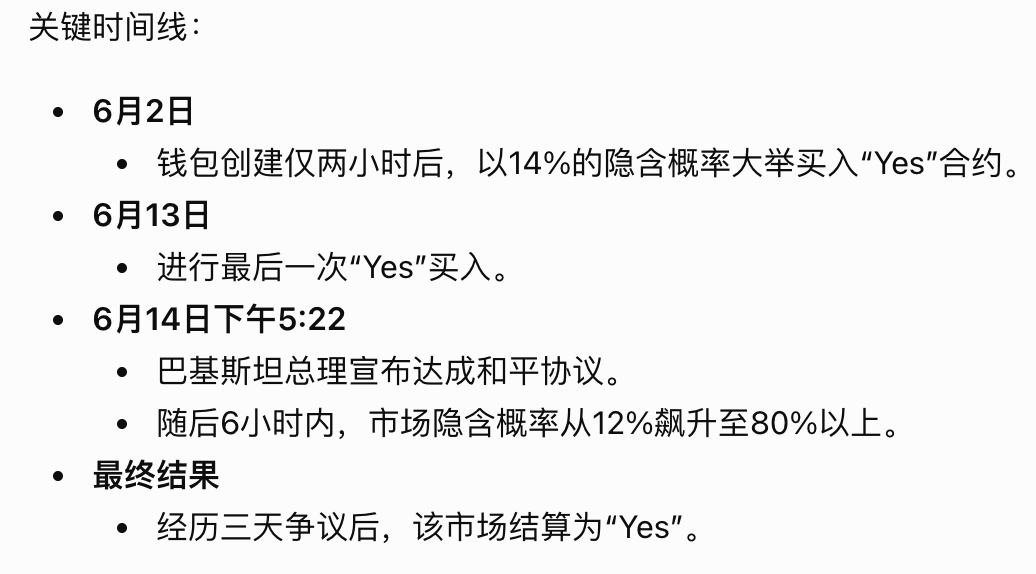
The wallet in question started building its position on June 2, at which point the odds for the "US and Iran to reach a permanent peace agreement by June 15, 2026" market were just 14%. The wallet made its last purchase on June 13, and within six hours after Pakistan’s prime minister announced the peace agreement on June 14 at 5:22 PM, the contract odds jumped from 12% to over 80%. Following three days of deliberation, the market ultimately ruled the contract outcome as "Yes," netting the wallet about $370,000.
This bet may have simply been a shrewd trade. However, the account was created only two hours before its first transaction—a hallmark of the typical patterns identified by analysts in information-driven trading.
Collective Wagers on the Eve of US-Iran Conflict
Earlier clusters of anomalous trades were similarly striking.
Several wallets bought the "Will the US military conduct airstrikes on Iran before February 28" contract at extremely low odds within minutes—just hours before reports of the first US strikes emerged.
Many of these wallets were created only hours or days before placing their bets. In combination, these eight wallets made over $520,000 in a few hours.
Researchers noted that while it's impossible to conclusively determine whether these trades were based on non-public information, these accounts display statistical features highly correlated with informed trading:
Very short wallet lifetime (0 to 1 days); entry at very low odds (roughly $0.12-0.36); abnormally large single-bet amounts (about $40,000 versus an average account’s $40); and markedly high net profits.
Prediction Markets as the New Regulatory Frontier
Such controversies are not unique. Prior to the Iran conflict, well-timed trades immediately before the April 2025 announcement suspending Trump’s reciprocal tariffs had already drawn outside scrutiny; a US Army soldier was also prosecuted for allegedly using classified information to bet on former Venezuelan leader Maduro’s ouster, and accused of using insider data.
The White House has warned staff not to use classified information for betting, and the Senate has prohibited senators and staff from trading in prediction markets.
The fundamental difference between prediction markets and regulated futures markets makes oversight more challenging. Polymarket users trade via anonymous blockchain wallets that cannot be directly linked to brokerage accounts, complicating efforts to identify the real individuals behind suspicious trades.
Meanwhile, the platform’s geopolitical category has already attracted about $5 billion in wagers this year, with a record-breaking $1.5 billion in volume in April alone.
Platforms Strengthen Response, But Challenges Remain
Facing growing skepticism, Polymarket stated it updated its rules earlier this year to explicitly prohibit trading based on stolen confidential information or illegal insider knowledge, and is working with several institutions to identify trading patterns consistent with informed trading, cooperating with law enforcement in investigations.
A company spokesperson said its internal process has so far referred nearly 100 wallets to law enforcement—including those that led to the first and second convictions for prediction market insider trading in the US.
However, circumvention tactics continue to limit regulatory power. Traders can split positions among multiple newly created wallets, making it difficult for analysts to track cumulative exposures, while large bets are more likely to trigger statistical alerts.
As the volume of geopolitical wagers continues to climb and becomes increasingly intertwined with policy decisions, distinguishing between sharp market judgment and the misuse of privileged information remains a major challenge for regulators.
Disclaimer: The content of this article solely reflects the author's opinion and does not represent the platform in any capacity. This article is not intended to serve as a reference for making investment decisions.
You may also like
ROI - For the Trump-led Treasury, the "tail" of the auction is the most difficult part: McKeever
The views expressed in this article are solely those of the author, Reuters columnist Jamie McGeever. Reuters, Orlando, Florida, October 6 – U.S. Treasury auctions are typically dull, predictable, and not newsworthy. But these are not ordinary times, and the Trump administration now faces the risk of sluggish U.S. debt sales making headlines. The U.S. Treasury plans to issue nearly $120 billion in Treasuries this week, the first non-bill bond sales in two weeks: $58 billion in three-year notes on Tuesday, $39 billion in ten-year notes on Wednesday, and $22 billion in thirty-year bonds on Thursday. These auctions would usually be insignificant events, but due to the exceptionally weak performance of auctions from September 22 to 24—especially the five-year note auction on September 23, which triggered the largest spike in bond yields since April last year—they are attracting growing attention. Since then, yields have not only failed to retreat but have surged across most tenors to multi-decade highs. It's worth noting that the possibility of a U.S. Treasury auction "failing" is almost zero. Primary dealers—currently 26 Wall Street banks and institutions authorized by the New York Fed as market makers for Treasuries—are always involved. They effectively underwrite the sales, ensuring the smooth operation of the $30 trillion U.S. Treasury market, the most liquid market in the world. This, in turn, allows the entire global financial system to function, given that trillions of dollars in global debt, assets, and market derivatives are benchmarked against U.S. Treasuries. Treasuries are also the primary collateral for lubricating the financial “pipes” of the U.S. and global markets, including repo agreements, interbank loans, and financing. In short, as long as U.S. Treasuries remain the pillar of the global financial system, there will always be buyers at Treasury auctions. The question, as always, is at what price these bonds will be sold. Currently, borrowing costs in the secondary market are at their highest levels since the mid-2000s, so it's reasonable to expect that the Treasury will pay relatively high rates in the primary market as well. But as recent auctions have shown, negative surprises remain possible. "Too big to be absorbed by the market"? The $70 billion five-year auction on September 23 was among the most worrisome in years. Demand, as measured by the bid-to-cover ratio, was at a nine-year low. The Treasury ended up selling the notes at a yield of 5.033%, more than 3 basis points above the market yield at the close of bidding. Three basis points might not sound like much, but it's exceptional for a five-year note auction. This is the largest so-called "tail" since June 2022. According to JPMorgan analysts, the last time a five-year auction had a three-basis-point tail was back in 2011—amid the brewing debt ceiling crisis that eventually led to a U.S. credit rating downgrade in August that year. Currently, concerns over the U.S.'s daunting fiscal outlook are driving up long-term borrowing costs. As a result, markets generally expect the Trump administration to gradually shift the Treasury’s massive funding needs toward the lower-yield (and therefore lower-cost) short- and medium-term segments of the curve. That's why the five-year note auction two weeks ago sparked such concern. A three-basis-point tail is common in long bond auctions, but not in the "belly" of the yield curve. If the Treasury is forced to pay a higher premium to issue these bonds, then Houston, we have a problem. A large auction tail can be caused by many factors, including market volatility on the day of the auction or more concerning, fundamental issues that may erode demand over time. The two are often hard to distinguish because they are not mutually exclusive. On a brighter note, this unease has not yet spread to the short end of the yield curve. At least, not yet. Three-year and ten-year Treasury yields are up about 50 basis points from the last auction a month ago, hovering around 4.96% and 5.32%, respectively. The thirty-year yield is up roughly 35 basis points to 5.65%. These levels should be high enough to attract strong demand and ensure smooth sales, right? Maybe. But if surprises do occur, volatility and uncertainty could spill over across the market. Investors will be watching developments as closely as hawks. (The views in this article are solely those of the author, a Reuters columnist.) Like this column? Check out Reuters' "Unhedged" (ROI), your essential new source for global finance commentary. Follow ROI on LinkedIn and X. You can also listen to the daily "Morning Bid" podcast on Apple, Spotify, or the Reuters app—subscribe for in-depth market and finance news, seven days a week. US 5-year auction has biggest 'tail' since 2022 https://fingfx.thomsonreuters.com/gfx/mkt/dwpkmkzogpm/TAIL.png (For the convenience of non-English speakers, Reuters provides automated translations of its reports
Money market fund inflows plummet to 158 billion—Is short-term US Treasury liquidity flashing a warning sign?
Money market fund inflows have sharply dropped to $158 billion in the first three quarters of this year, driving Treasury yields higher. Increased volatility at the short end has raised market concerns about tightening short-term financing.
TAO crypto price consolidates – Why $318 is Bittensor’s next big test
Crypto prices
More


