
SpaceX seeks $20B bond deal as Elon Musk faces selloff

SpaceX has explored a bond offering worth as much as $20 billion while its publicly traded shares have fallen more than 9%, trimming Elon Musk’s fortune by roughly $59 billion from recent highs.
- SpaceX is considering a bond sale of up to $20 billion to refinance debt due in 2027.
- SPCX shares fell more than 9% intraday, while Elon Musk’s net worth dropped by $59 billion.
- Major Wall Street banks remain involved in the financing effort despite investor concerns over leverage.
Bloomberg reported, citing people familiar with the matter, that SpaceX and its banking partners are preparing investor discussions for a potential bond sale that could raise up to $20 billion, one of the largest corporate debt offerings in recent years.
The proposed financing would be used primarily to refinance a bridge loan due in September 2027. According to Bloomberg, that loan represents a significant portion of SpaceX’s long-term debt, which stood at approximately $29.1 billion at the end of March.
While the transaction remains under discussion, Bloomberg reported that the final size, structure, and timing could still change depending on market conditions and investor demand. Bank of America, Citigroup, JPMorgan Chase, Goldman Sachs, and Morgan Stanley are expected to lead the process. Those same institutions previously participated in the bridge financing arrangement.
The debt discussions come only days after SpaceX completed a landmark public listing that pushed the company’s valuation above major technology firms and elevated Elon Musk’s wealth to unprecedented levels.
Investors weigh debt plans against recent stock volatility
Following reports of the potential refinancing transaction, SpaceX shares came under selling pressure. SPCX stock fell more than 9% from its previous close of $191.82 to an intraday low of $172.11 on June 18. The stock later recovered part of those losses and finished the session near the $185 level.
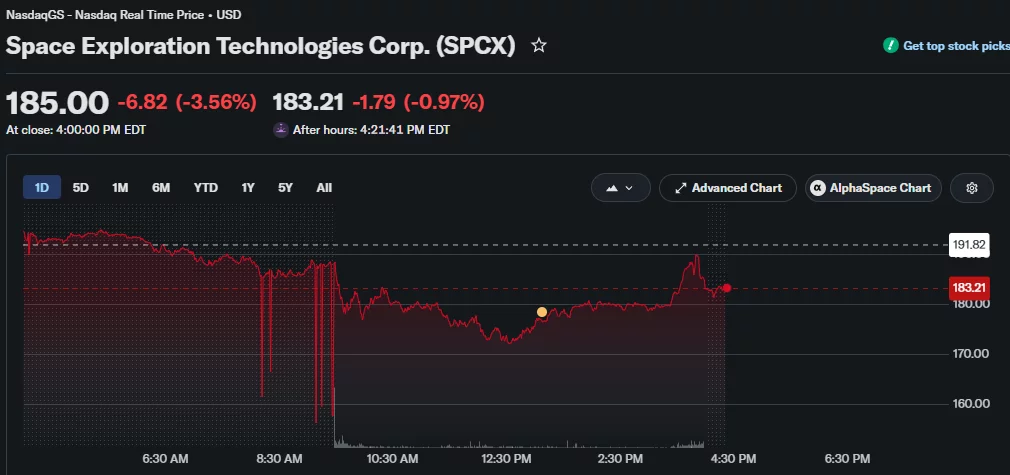
The decline follows a sharp rally that had briefly lifted SpaceX’s valuation close to $3 trillion. As crypto.news previously reported, shares reached an intraday high of about $225.84 on June 16, pushing Musk’s net worth to nearly $1.4 trillion and temporarily placing the value of his holdings above Bitcoin’s market capitalization of roughly $1.31 trillion at the time.
Earlier reporting by crypto.news also noted that SpaceX’s market debut made Musk the world’s first trillionaire. Continued gains after the listing added hundreds of billions of dollars to his paper wealth before the recent pullback reduced those gains.
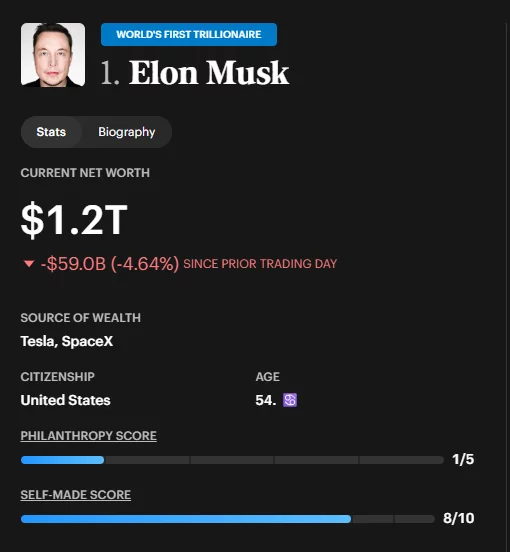
According to data by Forbes, Musk’s net worth has since fallen back to around $1.2 trillion, representing a decline of approximately $59 billion, or 4.6%, over the past trading day.
Banks remain involved despite growing debt burden
Despite the recent pullback, Bloomberg reported that major Wall Street banks remain involved in SpaceX’s financing plans. The institutions expected to arrange the proposed bond offering are the same lenders that previously provided the bridge loan the company now intends to refinance.
Investor interest in SpaceX has remained strong since its public debut. As crypto.news previously reported, some retail investors reportedly took out bank loans to increase their IPO allocations before shares began trading.
Beyond its aerospace operations, the company has also drawn attention for its expansion into artificial intelligence. Recent reports indicated that SpaceX is exploring an acquisition of Anysphere, the developer behind the Cursor AI coding platform.
At the same time, investors are evaluating what a potential $20 billion refinancing transaction could mean for the company’s balance sheet, as large debt deals often bring renewed focus to leverage levels and future funding needs.
Disclaimer: The content of this article solely reflects the author's opinion and does not represent the platform in any capacity. This article is not intended to serve as a reference for making investment decisions.
You may also like
ROI - For the Trump-led Treasury, the "tail" of the auction is the most difficult part: McKeever
The views expressed in this article are solely those of the author, Reuters columnist Jamie McGeever. Reuters, Orlando, Florida, October 6 – U.S. Treasury auctions are typically dull, predictable, and not newsworthy. But these are not ordinary times, and the Trump administration now faces the risk of sluggish U.S. debt sales making headlines. The U.S. Treasury plans to issue nearly $120 billion in Treasuries this week, the first non-bill bond sales in two weeks: $58 billion in three-year notes on Tuesday, $39 billion in ten-year notes on Wednesday, and $22 billion in thirty-year bonds on Thursday. These auctions would usually be insignificant events, but due to the exceptionally weak performance of auctions from September 22 to 24—especially the five-year note auction on September 23, which triggered the largest spike in bond yields since April last year—they are attracting growing attention. Since then, yields have not only failed to retreat but have surged across most tenors to multi-decade highs. It's worth noting that the possibility of a U.S. Treasury auction "failing" is almost zero. Primary dealers—currently 26 Wall Street banks and institutions authorized by the New York Fed as market makers for Treasuries—are always involved. They effectively underwrite the sales, ensuring the smooth operation of the $30 trillion U.S. Treasury market, the most liquid market in the world. This, in turn, allows the entire global financial system to function, given that trillions of dollars in global debt, assets, and market derivatives are benchmarked against U.S. Treasuries. Treasuries are also the primary collateral for lubricating the financial “pipes” of the U.S. and global markets, including repo agreements, interbank loans, and financing. In short, as long as U.S. Treasuries remain the pillar of the global financial system, there will always be buyers at Treasury auctions. The question, as always, is at what price these bonds will be sold. Currently, borrowing costs in the secondary market are at their highest levels since the mid-2000s, so it's reasonable to expect that the Treasury will pay relatively high rates in the primary market as well. But as recent auctions have shown, negative surprises remain possible. "Too big to be absorbed by the market"? The $70 billion five-year auction on September 23 was among the most worrisome in years. Demand, as measured by the bid-to-cover ratio, was at a nine-year low. The Treasury ended up selling the notes at a yield of 5.033%, more than 3 basis points above the market yield at the close of bidding. Three basis points might not sound like much, but it's exceptional for a five-year note auction. This is the largest so-called "tail" since June 2022. According to JPMorgan analysts, the last time a five-year auction had a three-basis-point tail was back in 2011—amid the brewing debt ceiling crisis that eventually led to a U.S. credit rating downgrade in August that year. Currently, concerns over the U.S.'s daunting fiscal outlook are driving up long-term borrowing costs. As a result, markets generally expect the Trump administration to gradually shift the Treasury’s massive funding needs toward the lower-yield (and therefore lower-cost) short- and medium-term segments of the curve. That's why the five-year note auction two weeks ago sparked such concern. A three-basis-point tail is common in long bond auctions, but not in the "belly" of the yield curve. If the Treasury is forced to pay a higher premium to issue these bonds, then Houston, we have a problem. A large auction tail can be caused by many factors, including market volatility on the day of the auction or more concerning, fundamental issues that may erode demand over time. The two are often hard to distinguish because they are not mutually exclusive. On a brighter note, this unease has not yet spread to the short end of the yield curve. At least, not yet. Three-year and ten-year Treasury yields are up about 50 basis points from the last auction a month ago, hovering around 4.96% and 5.32%, respectively. The thirty-year yield is up roughly 35 basis points to 5.65%. These levels should be high enough to attract strong demand and ensure smooth sales, right? Maybe. But if surprises do occur, volatility and uncertainty could spill over across the market. Investors will be watching developments as closely as hawks. (The views in this article are solely those of the author, a Reuters columnist.) Like this column? Check out Reuters' "Unhedged" (ROI), your essential new source for global finance commentary. Follow ROI on LinkedIn and X. You can also listen to the daily "Morning Bid" podcast on Apple, Spotify, or the Reuters app—subscribe for in-depth market and finance news, seven days a week. US 5-year auction has biggest 'tail' since 2022 https://fingfx.thomsonreuters.com/gfx/mkt/dwpkmkzogpm/TAIL.png (For the convenience of non-English speakers, Reuters provides automated translations of its reports
Money market fund inflows plummet to 158 billion—Is short-term US Treasury liquidity flashing a warning sign?
Money market fund inflows have sharply dropped to $158 billion in the first three quarters of this year, driving Treasury yields higher. Increased volatility at the short end has raised market concerns about tightening short-term financing.
Crypto prices
More


