Bitget App
Trade smarter
Buy cryptoMarketsTradeFuturesStocksEarnInstitutionAI & More
ALGO price prediction – Can Algorand’s 4.4% staking hype beat bearish wedge?

ALGO price prediction – Can Algorand’s 4.4% staking hype beat bearish wedge?

CryptoNewsNetCryptoNewsNet2026/06/18 22:06
By:CryptoNewsNet
Back to the list

ALGO price prediction – Can Algorand’s 4.4% staking hype beat bearish wedge?

ALGO price prediction – Can Algorand’s 4.4% staking hype beat bearish wedge? image 0  7 m
ALGO price prediction – Can Algorand’s 4.4% staking hype beat bearish wedge? image 1

On Wednesday, the 17th of June, Japanese crypto exchange CoinTrade announced the launch of staking for Algorand. The annual percentage rate of the staking yield would be 4.4%, the announcement revealed.
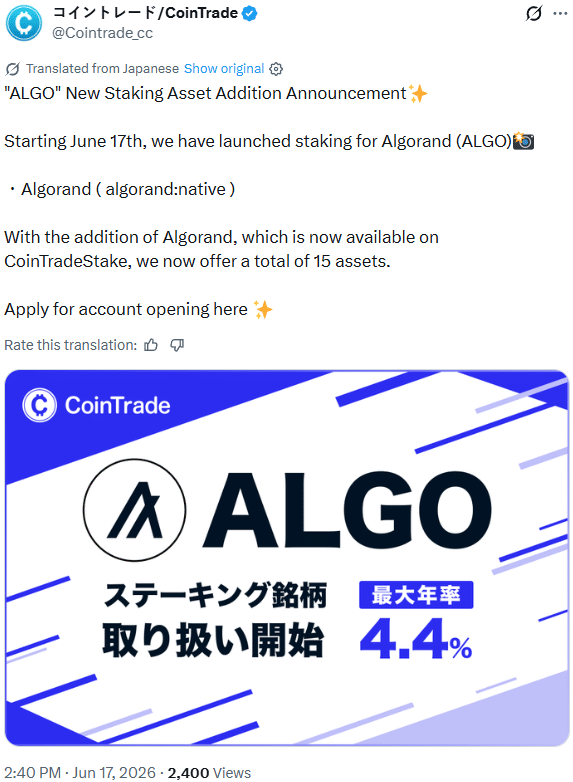
ALGO price prediction – Can Algorand’s 4.4% staking hype beat bearish wedge? image 2 Source: CoinTrade on X

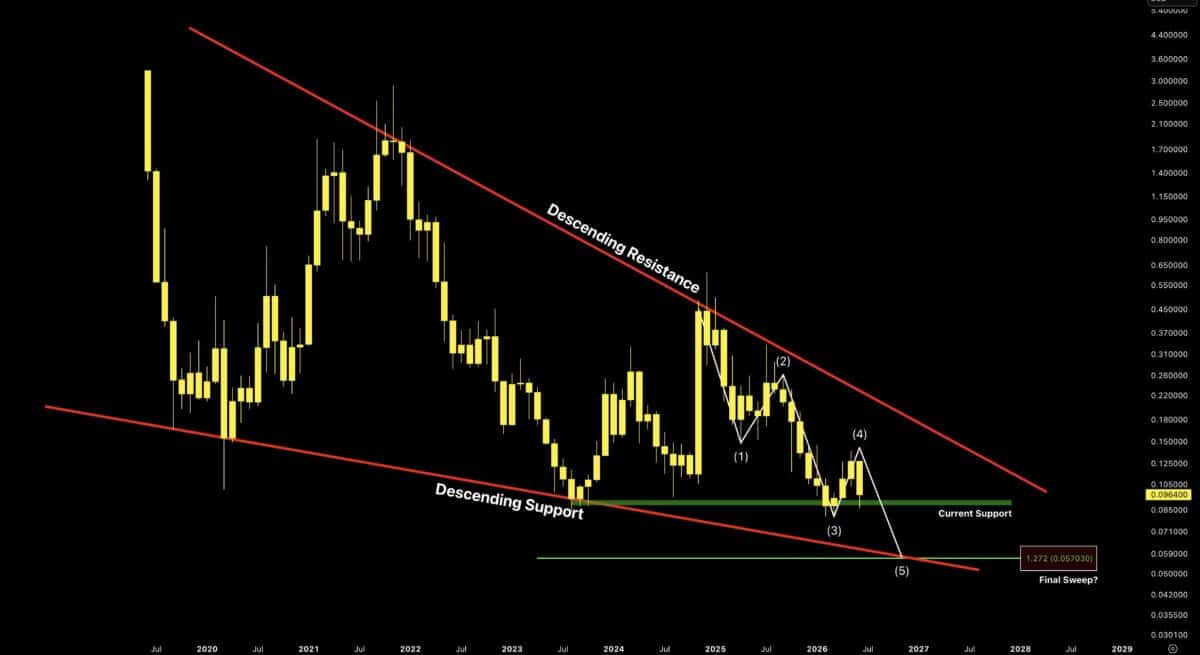
The $875 million market cap Layer-1 token was in a long-term downtrend, pointed out technical analyst Chart Nerd in a post on X.
ALGO price prediction – Can Algorand’s 4.4% staking hype beat bearish wedge? image 3 Source: Chart Nerd on X

The massive, multi-year falling wedge from the 2021 highs. The current support was at the $0.08-$0.085 area.

Based on Elliot Wave Theory, a fifth wave downward to $0.057 is possible.

Such a drop could be the final sweep of the cycle’s low and could result in a bullish breakout from the wedge in the long-term, the analyst concluded.

As things stand, the final leg downward is brewing and could arrive later in 2026. Here are the important support and resistance zones to watch out for in the coming days and weeks.

Algorand might see a bounce from oversold territory
ALGO price prediction – Can Algorand’s 4.4% staking hype beat bearish wedge? image 4 Source: $ALGO/ $USDT on TradingView

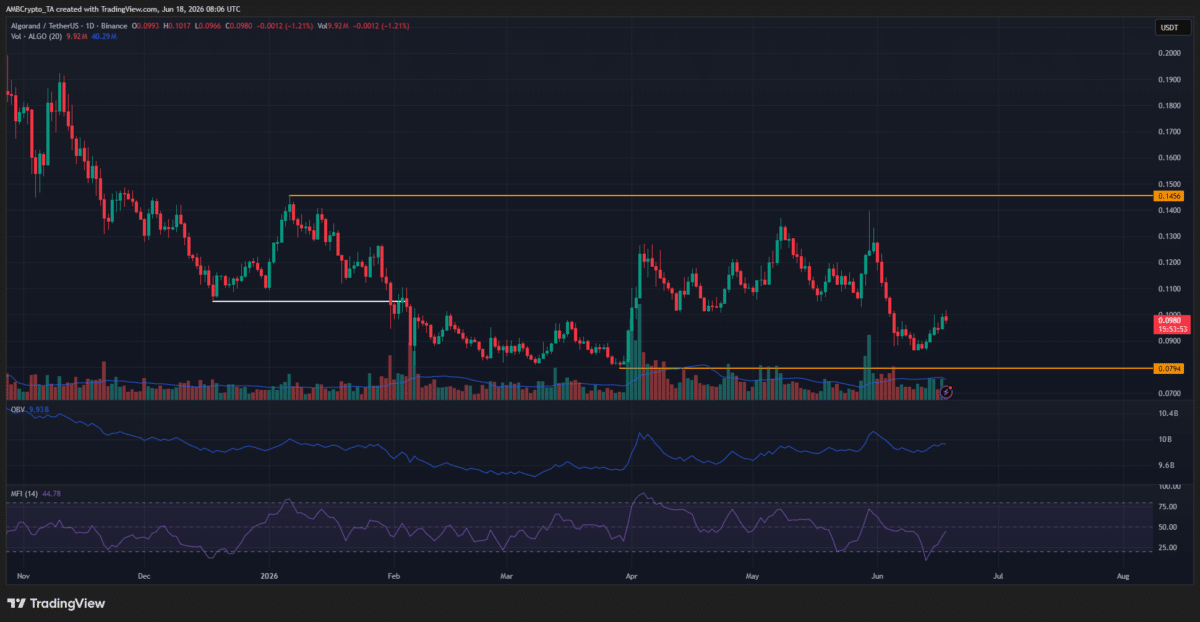
The swing points on the 1-day timeframe were at $0.145 and $0.079.

Marked in orange, neither level has been disturbed. The rally in April, which came as a result of the chain’s readiness for post-quantum computing, did not threaten the swing high set earlier in 2026.

The recent retracement below the $0.10 round-number support saw a bounce over the past week. The MFI fell into oversold territory but has since climbed back toward the neutral zone.

Meanwhile, the OBV was steadily climbing higher.
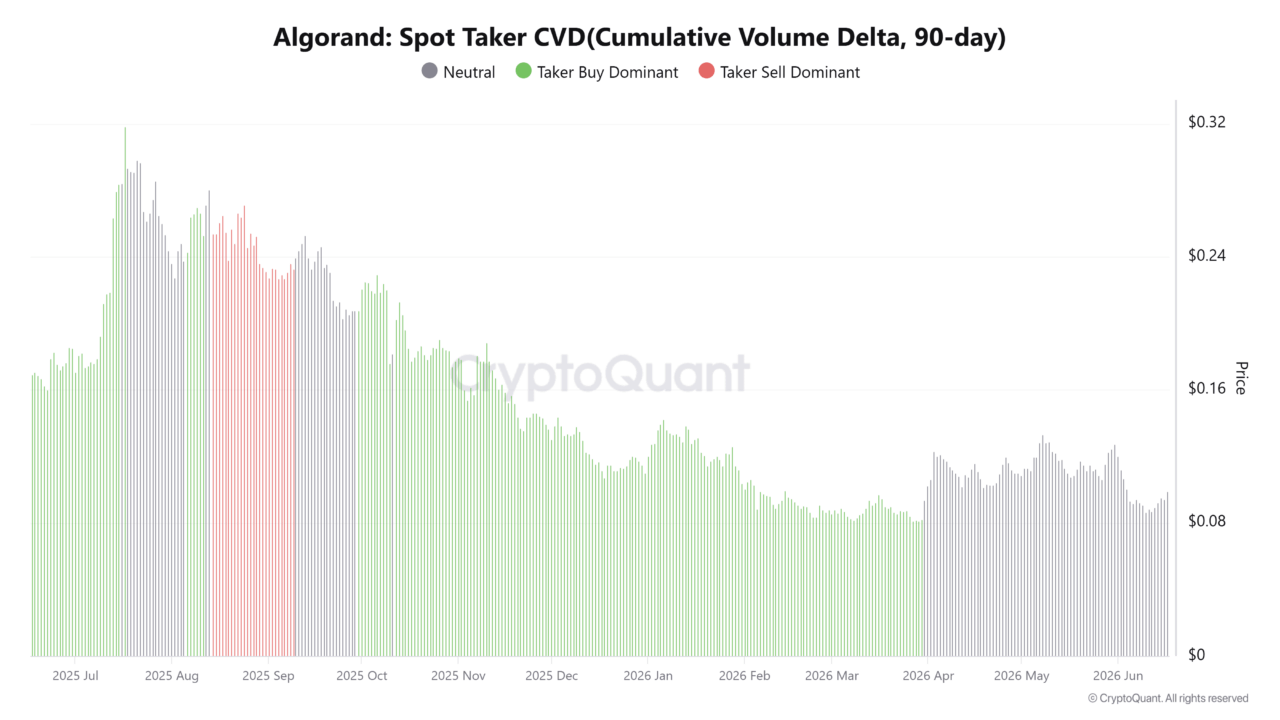
ALGO price prediction – Can Algorand’s 4.4% staking hype beat bearish wedge? image 5 Source: CryptoQuant

The 3-month Spot Taker CVD showed neither buyers nor sellers had the upper hand. The idea ran against the OBV’s uptrend in recent months.

Traders’ call to action- Wait for a bounce to sell
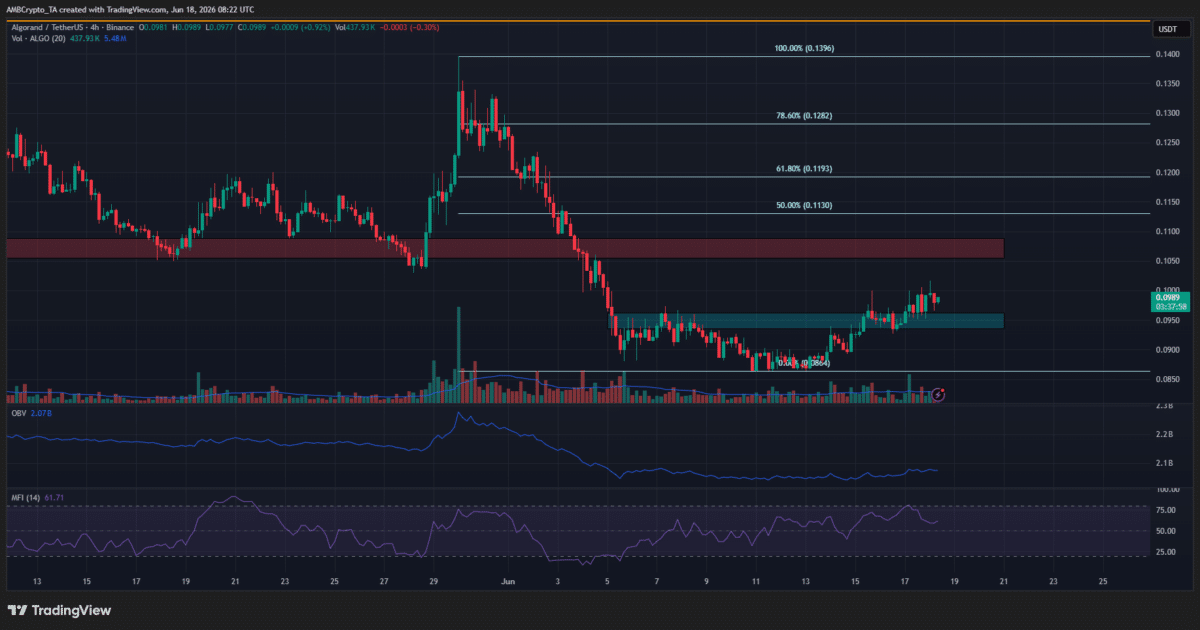
ALGO price prediction – Can Algorand’s 4.4% staking hype beat bearish wedge? image 6 Source: $ALGO/ $USDT on TradingView

The $0.095 and $0.105 areas were the nearby support/resistance zones to watch. If the $0.105 former demand, now supply zone, is cleared, it would indicate a move as high as $0.128 is possible, based on the retracement levels plotted.

Traders should be wary of going long given the wider crypto market sentiment, but also should not FOMO into an Algorand [$ALGO] relief rally if it occurs.

Final Summary

  • The Algorand staking launch on CoinTrade, combined with oversold conditions, could have helped during the recent days’ gains.
  • The higher timeframe trend remained bearish, but a bounce past $0.105 and as high as $0.128 was possible.
0
0

Disclaimer: The content of this article solely reflects the author's opinion and does not represent the platform in any capacity. This article is not intended to serve as a reference for making investment decisions.

Understand the market, then trade.
Bitget offers one-stop trading for cryptocurrencies, stocks, and gold.
Trade now!

You may also like

ROI - For the Trump-led Treasury, the "tail" of the auction is the most difficult part: McKeever

The views expressed in this article are solely those of the author, Reuters columnist Jamie McGeever. Reuters, Orlando, Florida, October 6 – U.S. Treasury auctions are typically dull, predictable, and not newsworthy. But these are not ordinary times, and the Trump administration now faces the risk of sluggish U.S. debt sales making headlines. The U.S. Treasury plans to issue nearly $120 billion in Treasuries this week, the first non-bill bond sales in two weeks: $58 billion in three-year notes on Tuesday, $39 billion in ten-year notes on Wednesday, and $22 billion in thirty-year bonds on Thursday. These auctions would usually be insignificant events, but due to the exceptionally weak performance of auctions from September 22 to 24—especially the five-year note auction on September 23, which triggered the largest spike in bond yields since April last year—they are attracting growing attention. Since then, yields have not only failed to retreat but have surged across most tenors to multi-decade highs. It's worth noting that the possibility of a U.S. Treasury auction "failing" is almost zero. Primary dealers—currently 26 Wall Street banks and institutions authorized by the New York Fed as market makers for Treasuries—are always involved. They effectively underwrite the sales, ensuring the smooth operation of the $30 trillion U.S. Treasury market, the most liquid market in the world. This, in turn, allows the entire global financial system to function, given that trillions of dollars in global debt, assets, and market derivatives are benchmarked against U.S. Treasuries. Treasuries are also the primary collateral for lubricating the financial “pipes” of the U.S. and global markets, including repo agreements, interbank loans, and financing. In short, as long as U.S. Treasuries remain the pillar of the global financial system, there will always be buyers at Treasury auctions. The question, as always, is at what price these bonds will be sold. Currently, borrowing costs in the secondary market are at their highest levels since the mid-2000s, so it's reasonable to expect that the Treasury will pay relatively high rates in the primary market as well. But as recent auctions have shown, negative surprises remain possible. "Too big to be absorbed by the market"? The $70 billion five-year auction on September 23 was among the most worrisome in years. Demand, as measured by the bid-to-cover ratio, was at a nine-year low. The Treasury ended up selling the notes at a yield of 5.033%, more than 3 basis points above the market yield at the close of bidding. Three basis points might not sound like much, but it's exceptional for a five-year note auction. This is the largest so-called "tail" since June 2022. According to JPMorgan analysts, the last time a five-year auction had a three-basis-point tail was back in 2011—amid the brewing debt ceiling crisis that eventually led to a U.S. credit rating downgrade in August that year. Currently, concerns over the U.S.'s daunting fiscal outlook are driving up long-term borrowing costs. As a result, markets generally expect the Trump administration to gradually shift the Treasury’s massive funding needs toward the lower-yield (and therefore lower-cost) short- and medium-term segments of the curve. That's why the five-year note auction two weeks ago sparked such concern. A three-basis-point tail is common in long bond auctions, but not in the "belly" of the yield curve. If the Treasury is forced to pay a higher premium to issue these bonds, then Houston, we have a problem. A large auction tail can be caused by many factors, including market volatility on the day of the auction or more concerning, fundamental issues that may erode demand over time. The two are often hard to distinguish because they are not mutually exclusive. On a brighter note, this unease has not yet spread to the short end of the yield curve. At least, not yet. Three-year and ten-year Treasury yields are up about 50 basis points from the last auction a month ago, hovering around 4.96% and 5.32%, respectively. The thirty-year yield is up roughly 35 basis points to 5.65%. These levels should be high enough to attract strong demand and ensure smooth sales, right? Maybe. But if surprises do occur, volatility and uncertainty could spill over across the market. Investors will be watching developments as closely as hawks. (The views in this article are solely those of the author, a Reuters columnist.) Like this column? Check out Reuters' "Unhedged" (ROI), your essential new source for global finance commentary. Follow ROI on LinkedIn and X. You can also listen to the daily "Morning Bid" podcast on Apple, Spotify, or the Reuters app—subscribe for in-depth market and finance news, seven days a week. US 5-year auction has biggest 'tail' since 2022 https://fingfx.thomsonreuters.com/gfx/mkt/dwpkmkzogpm/TAIL.png (For the convenience of non-English speakers, Reuters provides automated translations of its reports

路透社•2026/10/06 13:11