

 cryptoticker.io
With Solana trading around $70 — a fraction of its cycle high above $260 — the question on many investors' minds is simple: is $SOL a good buy at current prices, or is it a falling knife? The answer depends on weighing two things against each other: where the price sits relative to Solana's historical performance, and what the network is actually doing right now.
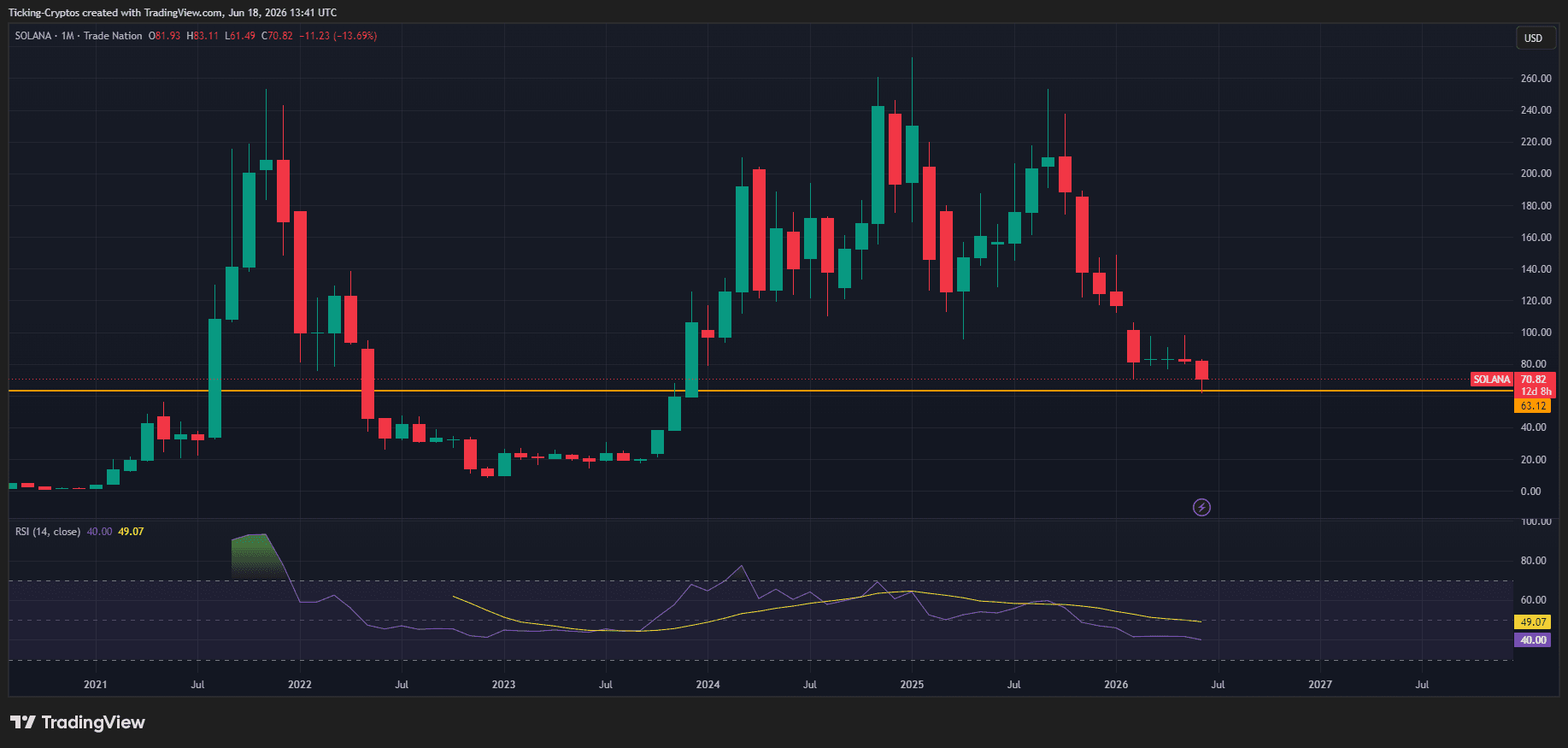
On the technical side, $SOL on the monthly chart is the most oversold it has ever been in its history. On the fundamental side, Solana just set a new single-day record for tokenized stock trading. That combination — a beaten-down price alongside accelerating real-world usage — is exactly the kind of divergence worth examining closely before deciding whether current prices represent value or a trap.
How Does Solana's Current Price Compare to Its Historical Performance?
To judge whether $SOL is cheap, it helps to put today's ~$70 price in the context of where it has been:
- 2021 cycle peak: $SOL ran from under $2 to roughly $260 at its first major top.
- 2022 bear market: It collapsed into the low single digits and teens during the broader crypto winter.
- 2024–2025 recovery: $SOL rebuilt all the way back above $260 at this cycle's high.
- Now: It has retraced to around $70, testing a long-term support zone in the low $60s to $70 — a level that has acted as significant support in past cycles.
The pattern tells the story: $SOL is a high-volatility asset that has historically delivered enormous gains from depressed levels and equally brutal drawdowns from its tops. At ~$70, it sits far closer to its accumulation zones than to its euphoric peaks — which is the first reason the current price draws value-hunters' attention.
Why Is Solana Dominating Tokenization?
Solana's grip on tokenized stocks comes down to its core technical strengths as a blockchain:
- Speed. Solana is one of the fastest chains in production, with high throughput and sub-second finality suited to rapid-fire equity trading.
- Low costs. Transaction fees often amount to a fraction of a cent, making high-frequency tokenized-stock trades economically viable where congested, high-fee chains can't compete.
- Deep liquidity and infrastructure. A mature ecosystem of DEXs, aggregators, and on-chain stockholders has formed around the network, creating a self-reinforcing liquidity advantage.
When the cost and speed of settling a trade approach zero, the friction that holds tokenization back on other chains largely disappears — which is why volume keeps concentrating on Solana.
Is Solana a Good Buy at Current Prices?
Here's how the two sides stack up. The bull case: $SOL trades at historically oversold levels, sits on long-term support, and is winning one of crypto's fastest-growing categories outright. When price weakness and rising adoption diverge like this, the market is often pricing the asset on macro sentiment rather than what the network is doing.
The bear case: oversold can get more oversold, and a genuine turn requires a turn in broader risk appetite — likely tied to easing macro conditions and returning crypto liquidity. Until that happens, "cheap" assets can stay cheap or get cheaper.
A balanced read: at ~$70, $SOL offers an arguably attractive risk-reward for investors with a long time horizon and tolerance for volatility, precisely because price is depressed while fundamentals strengthen. But it is not a low-risk bet, and nobody can reliably call the exact bottom. This is a setup that historically rewards patience and position sizing — not all-in timing.
The Bottom Line
Solana presents one of the more striking divergences in the current market: the most oversold monthly reading in its history paired with record-setting dominance of tokenized stock trading. Measured against its own historical performance, ~$70 places $SOL deep in value territory rather than euphoria.
Whether that makes it a "good buy" depends on your time horizon and risk tolerance. For short-term traders, the lack of a confirmed reversal argues for caution. For long-term investors who believe in tokenization and Solana's role in it, the current setup — depressed price, record usage — is exactly the kind of moment that tends to look attractive in hindsight, even if the timing is never certain.
Why Is Solana Dominating Tokenization?
Solana's grip on tokenized stocks comes down to its core technical strengths as a blockchain:
- Speed. Solana is one of the fastest chains in production, with high throughput and sub-second finality suited to rapid-fire equity trading.
- Low costs. Transaction fees often amount to a fraction of a cent, making high-frequency tokenized-stock trades economically viable where congested, high-fee chains can't compete.
- Deep liquidity and infrastructure. A mature ecosystem of DEXs, aggregators, and on-chain stockholders has formed around the network, creating a self-reinforcing liquidity advantage.
When the cost and speed of settling a trade approach zero, the friction that holds tokenization back on other chains largely disappears — which is why volume keeps concentrating on Solana.
Is Solana a Good Buy at Current Prices?
Here's how the two sides stack up. The bull case: $SOL trades at historically oversold levels, sits on long-term support, and is winning one of crypto's fastest-growing categories outright. When price weakness and rising adoption diverge like this, the market is often pricing the asset on macro sentiment rather than what the network is doing.
The bear case: oversold can get more oversold, and a genuine turn requires a turn in broader risk appetite — likely tied to easing macro conditions and returning crypto liquidity. Until that happens, "cheap" assets can stay cheap or get cheaper.
A balanced read: at ~$70, $SOL offers an arguably attractive risk-reward for investors with a long time horizon and tolerance for volatility, precisely because price is depressed while fundamentals strengthen. But it is not a low-risk bet, and nobody can reliably call the exact bottom. This is a setup that historically rewards patience and position sizing — not all-in timing.
The Bottom Line
Solana presents one of the more striking divergences in the current market: the most oversold monthly reading in its history paired with record-setting dominance of tokenized stock trading. Measured against its own historical performance, ~$70 places $SOL deep in value territory rather than euphoria.
Whether that makes it a "good buy" depends on your time horizon and risk tolerance. For short-term traders, the lack of a confirmed reversal argues for caution. For long-term investors who believe in tokenization and Solana's role in it, the current setup — depressed price, record usage — is exactly the kind of moment that tends to look attractive in hindsight, even if the timing is never certain.


