
Bittensor price risks deeper correction as Root Reborn debate rattles TAO bulls

Bittensor’s TAO token has fallen nearly 20% from its June 15 peak after governance concerns, derivatives liquidations, and a risk-off macro backdrop combined to erase much of last week’s rally.
- TAO has fallen nearly 20% from its June 15 high as governance concerns and liquidations hit sentiment.
- Criticism of the Root Reborn proposal has raised questions about validator power, liquidity, and regulation.
- Technical indicators show sellers remain in control, with $220 acting as a key near-term support level.
According to data from crypto.news, Bittensor (TAO) price dropped 4.3% in the last 24 hours to trade near $225 on June 19, bringing its losses to nearly 20% since June 15, when the AI-focused token peaked around $283 before governance concerns and derivatives liquidations triggered a reversal.
Bittensor’s decline accelerated after criticism emerged around the proposed Root Reborn governance overhaul, a plan designed to reduce persistent subnet token selling by changing how validators allocate capital across the network.
While supporters view the proposal as a long-term fix for Bittensor’s tokenomics, opponents argue it could introduce governance concentration, liquidity stress, and regulatory complications.
Among the most vocal critics, validator group Yuma warned that Root Reborn would transform validators from neutral network operators into active capital allocators. According to Yuma, the framework could create incentives for collusion, preferential treatment, and frontrunning while encouraging subnet teams to prioritize validator relationships over AI product development.
“Such a change could fundamentally alter the role of validators,” Yuma wrote in its assessment of the proposal.
At the same time, derivatives traders rapidly reduced exposure. CoinGlass data showed TAO futures open interest falling more than 8% over a 24-hour period to roughly $252 million-$260 million. More than $1.66 million in bullish leveraged positions were liquidated during the same stretch, adding forced market selling as prices moved lower.
Trading activity also weakened. Daily volume dropped roughly 14% to about $624 million as traders reassessed protocol risk ahead of further discussions surrounding the governance proposal
Concerns extended beyond governance mechanics. Yuma argued that rewards tied to baskets of subnet tokens could become difficult to liquidate during periods of market stress, while a wave of unstaking could create execution disadvantages for later redeemers.
Macroeconomic conditions added another headwind. Crypto markets remained under pressure after Federal Reserve Chair Kevin Warsh reinforced expectations that U.S. interest rates may remain elevated for longer than previously expected.
The stronger U.S. dollar and declining appetite for speculative assets pushed capital away from high-beta sectors, including artificial intelligence-linked cryptocurrencies.
TAO technical structure favors sellers below key resistance
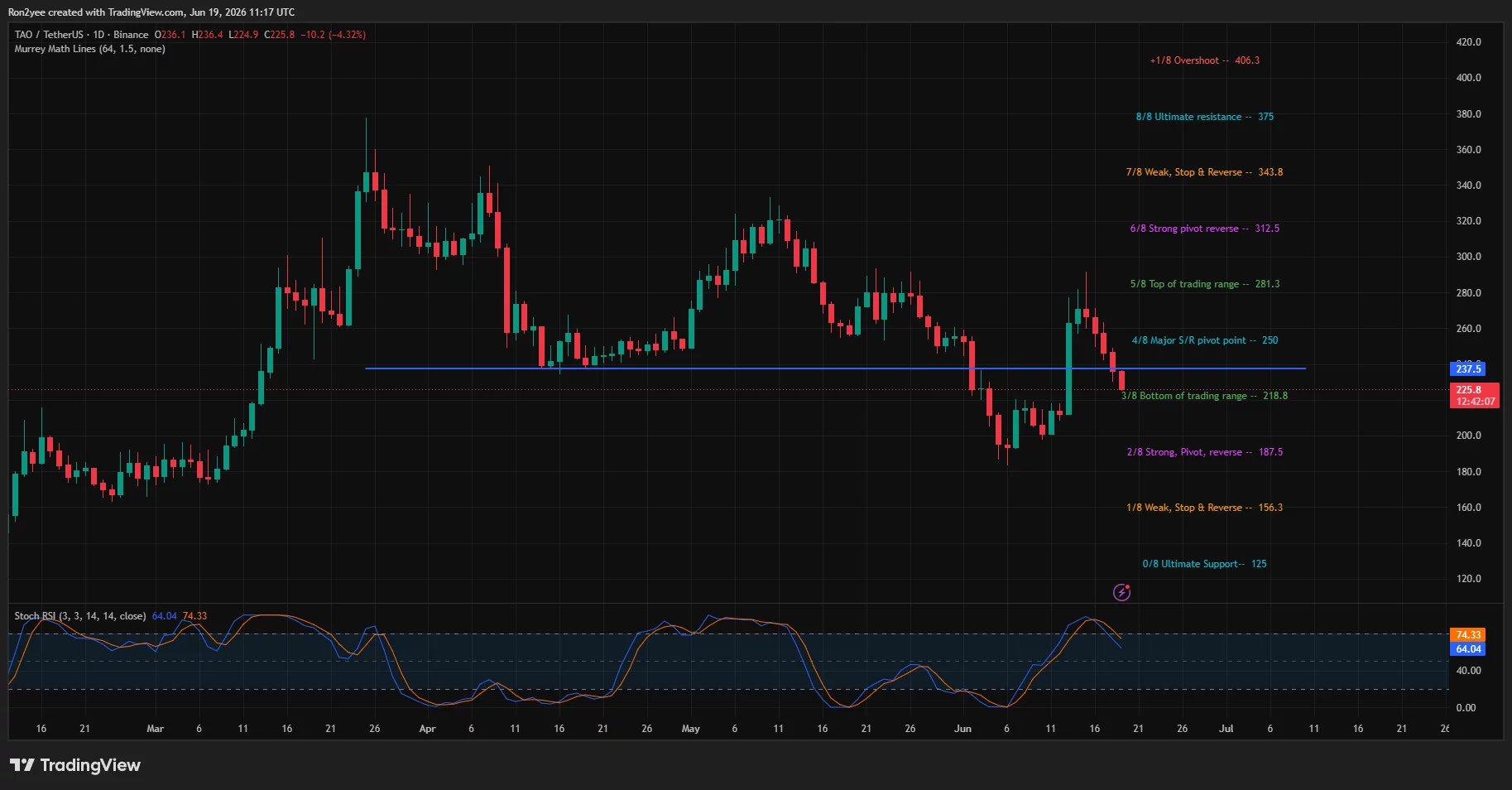
The daily chart shows TAO breaking below a major horizontal support zone near $237, a level that acted as a floor during April and May. What previously served as support now risks becoming resistance after the breakdown.
 TAO price has lost a key support level on the daily chart — June 19 | Source:
crypto.news
TAO price has lost a key support level on the daily chart — June 19 | Source:
crypto.news
Murrey Math levels place the token below the 3/8 trading range support at $218.8, while the next major resistance stands near the 4/8 pivot at $250. A recovery above that region would be required to restore bullish momentum and reopen a path toward $281, where the June rally stalled.
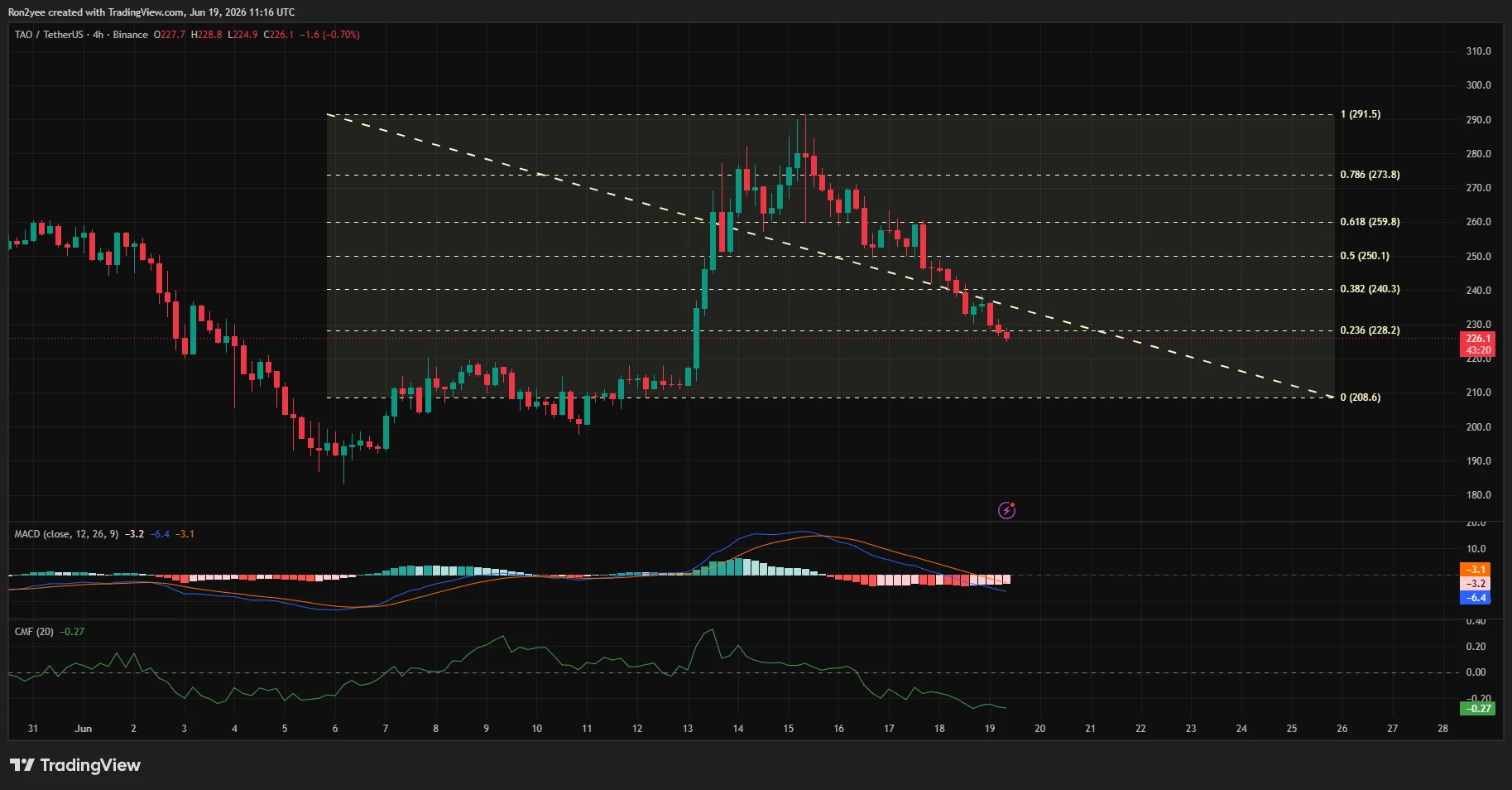
On the four-hour chart, TAO has also fallen beneath the 23.6% Fibonacci retracement level at $228.2 after rejecting the 0.786 retracement near $273.8 earlier this week. Price continues to trade below a descending trendline that has capped every recovery attempt since June 15.
 TAO 4-hour price chart — June 19 | Source:
crypto.news
TAO 4-hour price chart — June 19 | Source:
crypto.news
Momentum indicators remain weak. The MACD has crossed into negative territory with expanding bearish histogram bars, while Chaikin Money Flow sits at -0.27, showing capital leaving the market. Although the Stochastic RSI remains above oversold levels on the daily timeframe, both signal lines have turned lower.
According to the 4-hour chart, TAO’s failure to reclaim the broken $237 support leaves the market vulnerable to another leg lower toward the $208 Fibonacci support zone.
TAO loses key support as sellers target lower liquidity zones
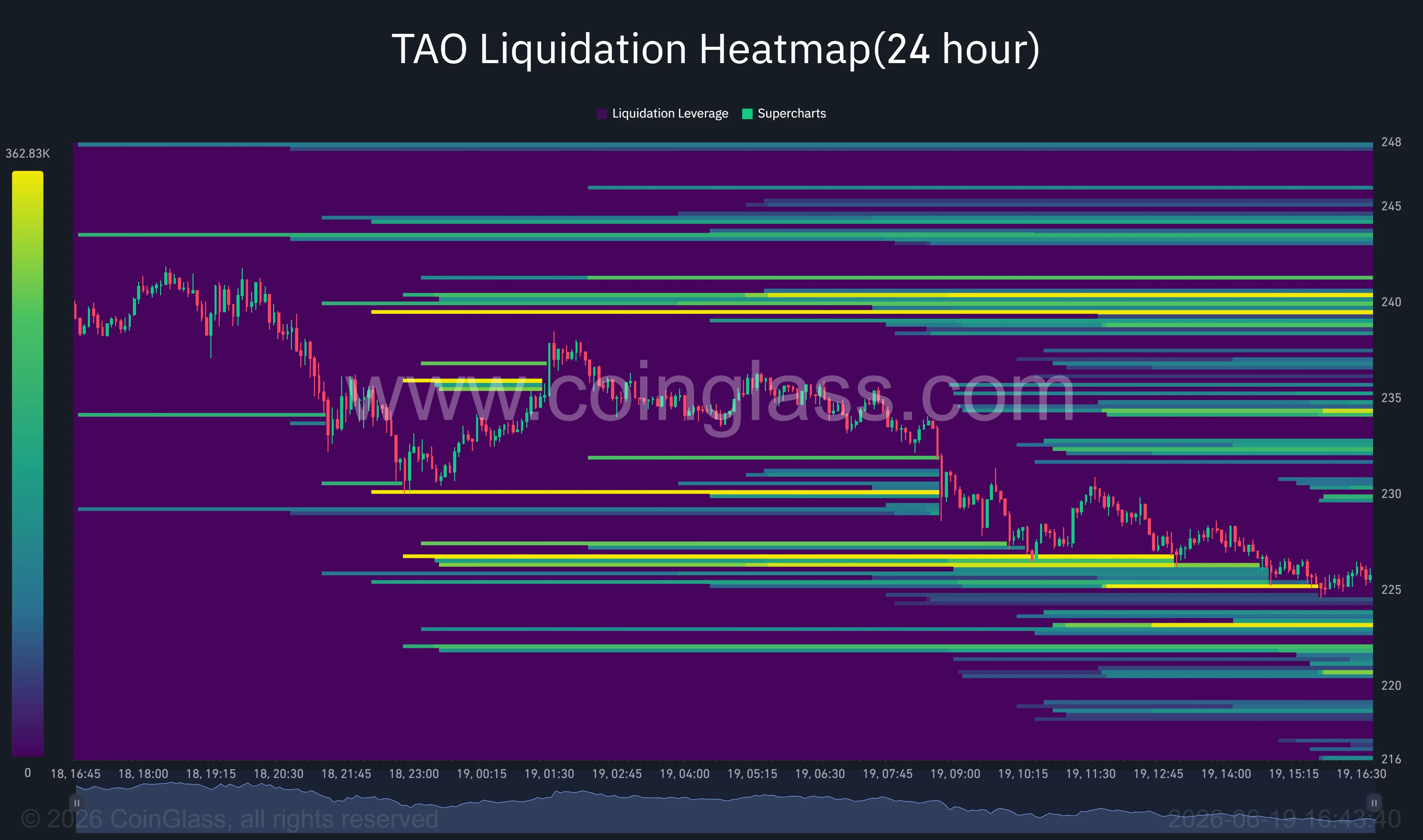
CoinGlass liquidation heatmap data shows dense liquidity clusters concentrated between $239 and $241, creating a potential magnet should buyers regain control. Several additional liquidation pockets sit near $244 and $245, where short positions could come under pressure if TAO stages a relief rally.
 TAO liquidation heatmap | Source:
CoinGlass
TAO liquidation heatmap | Source:
CoinGlass
The downside picture remains equally important. A concentration of leveraged positions has formed around the $225-$226 area, while thinner support appears below current prices until the $220 region. A decisive break beneath $220 could expose the June swing low near $190 before attention turns toward the longer-term support band between $180 and $200.
Regulatory concerns surrounding Root Reborn present another risk. Yuma argued that validators directing capital allocations could attract scrutiny typically associated with investment management activities, potentially complicating participation for exchanges, custodians, and institutional operators.
If uncertainty surrounding the proposal persists while macro conditions remain restrictive, TAO may struggle to reclaim the $237-$250 zone that bulls need to regain control.
Disclaimer: The content of this article solely reflects the author's opinion and does not represent the platform in any capacity. This article is not intended to serve as a reference for making investment decisions.
You may also like
ROI - For the Trump-led Treasury, the "tail" of the auction is the most difficult part: McKeever
The views expressed in this article are solely those of the author, Reuters columnist Jamie McGeever. Reuters, Orlando, Florida, October 6 – U.S. Treasury auctions are typically dull, predictable, and not newsworthy. But these are not ordinary times, and the Trump administration now faces the risk of sluggish U.S. debt sales making headlines. The U.S. Treasury plans to issue nearly $120 billion in Treasuries this week, the first non-bill bond sales in two weeks: $58 billion in three-year notes on Tuesday, $39 billion in ten-year notes on Wednesday, and $22 billion in thirty-year bonds on Thursday. These auctions would usually be insignificant events, but due to the exceptionally weak performance of auctions from September 22 to 24—especially the five-year note auction on September 23, which triggered the largest spike in bond yields since April last year—they are attracting growing attention. Since then, yields have not only failed to retreat but have surged across most tenors to multi-decade highs. It's worth noting that the possibility of a U.S. Treasury auction "failing" is almost zero. Primary dealers—currently 26 Wall Street banks and institutions authorized by the New York Fed as market makers for Treasuries—are always involved. They effectively underwrite the sales, ensuring the smooth operation of the $30 trillion U.S. Treasury market, the most liquid market in the world. This, in turn, allows the entire global financial system to function, given that trillions of dollars in global debt, assets, and market derivatives are benchmarked against U.S. Treasuries. Treasuries are also the primary collateral for lubricating the financial “pipes” of the U.S. and global markets, including repo agreements, interbank loans, and financing. In short, as long as U.S. Treasuries remain the pillar of the global financial system, there will always be buyers at Treasury auctions. The question, as always, is at what price these bonds will be sold. Currently, borrowing costs in the secondary market are at their highest levels since the mid-2000s, so it's reasonable to expect that the Treasury will pay relatively high rates in the primary market as well. But as recent auctions have shown, negative surprises remain possible. "Too big to be absorbed by the market"? The $70 billion five-year auction on September 23 was among the most worrisome in years. Demand, as measured by the bid-to-cover ratio, was at a nine-year low. The Treasury ended up selling the notes at a yield of 5.033%, more than 3 basis points above the market yield at the close of bidding. Three basis points might not sound like much, but it's exceptional for a five-year note auction. This is the largest so-called "tail" since June 2022. According to JPMorgan analysts, the last time a five-year auction had a three-basis-point tail was back in 2011—amid the brewing debt ceiling crisis that eventually led to a U.S. credit rating downgrade in August that year. Currently, concerns over the U.S.'s daunting fiscal outlook are driving up long-term borrowing costs. As a result, markets generally expect the Trump administration to gradually shift the Treasury’s massive funding needs toward the lower-yield (and therefore lower-cost) short- and medium-term segments of the curve. That's why the five-year note auction two weeks ago sparked such concern. A three-basis-point tail is common in long bond auctions, but not in the "belly" of the yield curve. If the Treasury is forced to pay a higher premium to issue these bonds, then Houston, we have a problem. A large auction tail can be caused by many factors, including market volatility on the day of the auction or more concerning, fundamental issues that may erode demand over time. The two are often hard to distinguish because they are not mutually exclusive. On a brighter note, this unease has not yet spread to the short end of the yield curve. At least, not yet. Three-year and ten-year Treasury yields are up about 50 basis points from the last auction a month ago, hovering around 4.96% and 5.32%, respectively. The thirty-year yield is up roughly 35 basis points to 5.65%. These levels should be high enough to attract strong demand and ensure smooth sales, right? Maybe. But if surprises do occur, volatility and uncertainty could spill over across the market. Investors will be watching developments as closely as hawks. (The views in this article are solely those of the author, a Reuters columnist.) Like this column? Check out Reuters' "Unhedged" (ROI), your essential new source for global finance commentary. Follow ROI on LinkedIn and X. You can also listen to the daily "Morning Bid" podcast on Apple, Spotify, or the Reuters app—subscribe for in-depth market and finance news, seven days a week. US 5-year auction has biggest 'tail' since 2022 https://fingfx.thomsonreuters.com/gfx/mkt/dwpkmkzogpm/TAIL.png (For the convenience of non-English speakers, Reuters provides automated translations of its reports
Money market fund inflows plummet to 158 billion—Is short-term US Treasury liquidity flashing a warning sign?
Money market fund inflows have sharply dropped to $158 billion in the first three quarters of this year, driving Treasury yields higher. Increased volatility at the short end has raised market concerns about tightening short-term financing.
TAO crypto price consolidates – Why $318 is Bittensor’s next big test
Tokenization Becomes a Key Focus for the U.K. Financial Sector

Crypto prices
More


