Bitget App
Trade smarter
Buy cryptoMarketsTradeFuturesStocksEarnInstitutionAI & More
Hyperliquid (HYPE) Prints Up to 1700% Liquidity Loss, More Pressure to Come

Hyperliquid (HYPE) Prints Up to 1700% Liquidity Loss, More Pressure to Come

UTodayUToday2026/06/22 13:15
By:UToday

Although recent market data indicates that short-term conditions may be worsening, Hyperliquid continues to be one of the best-performing assets of the current market cycle. Liquidity metrics are showing red flags that traders shouldn't ignore, even though HYPE is still trading well above its major moving averages and maintaining a strong long-term uptrend. The sharp decline in futures liquidity flows is among the most noteworthy developments. 

According to recent data, losses in net futures liquidity can reach 1,700% over shorter time periods. Futures outflows surpassed inflows by approximately $17.6 million during the four-hour window alone, and several shorter intervals showed similarly aggressive capital withdrawal patterns. This is important because strong rallies are frequently fueled by liquidity. Momentum can rapidly wane when inflows start to decline while traders withdraw money from derivatives markets concurrently. 
Hyperliquid (HYPE) Prints Up to 1700% Liquidity Loss, More Pressure to Come image 0

Since HYPE's dominance in perpetual futures trading has contributed significantly to its valuation growth, the situation becomes especially significant. The figures show conflicting results. The fact that open interest is still high at $2.8 billion indicates that traders are still very interested in the asset. Binance accounts continue to have a slight bullish bias and long-short ratios are likewise comparatively balanced. But data on futures flows tells a different tale. 

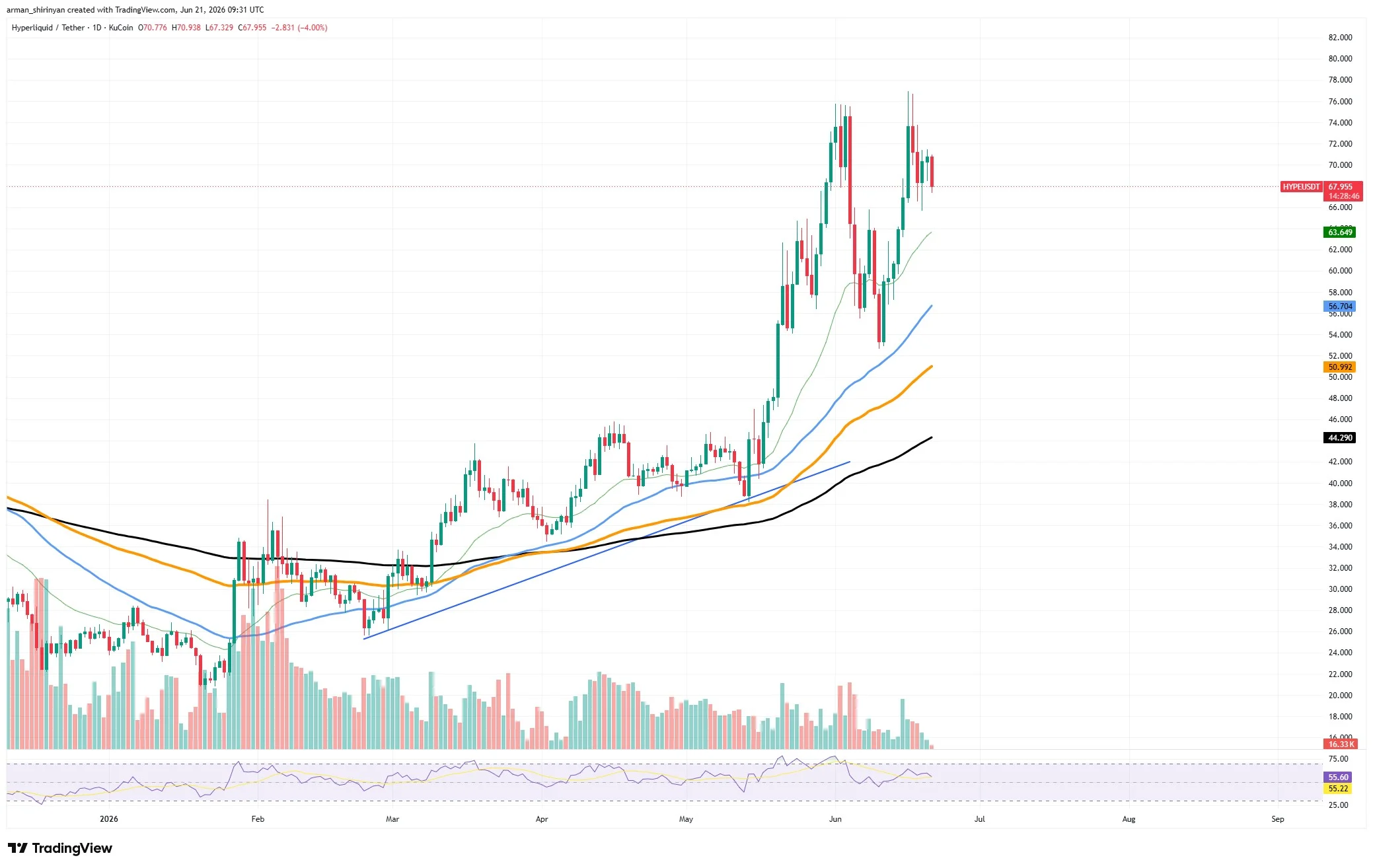
After HYPE's massive rally in recent months, almost every tracked timeframe currently exhibits net negative flows, indicating that market participants are growing more cautious. That uncertainty is reflected in the chart. After rejecting the $75–$76 range for the second time, HYPE is currently in a consolidation phase around $68. 

Momentum has obviously decreased even though the asset is still comfortably above its 50-, 100-, and 200-day moving averages. The market is no longer experiencing the same euphoric conditions that drove the previous breakout, as evidenced by the RSI's retreat from overbought territory. Crucially, none of this necessarily means that the wider uptrend is coming to an end. In actuality, liquidity frequently leaves the market before a new phase of accumulation starts in strong bull markets. 

Whether buyers come back before important support levels break is the crucial distinction. The $63–$64 range is still the first significant support zone as of right now. A deeper correction toward the 100-day moving average, which is close to $56, could be possible if HYPE loses that level.

0
0

Disclaimer: The content of this article solely reflects the author's opinion and does not represent the platform in any capacity. This article is not intended to serve as a reference for making investment decisions.

Understand the market, then trade.
Bitget offers one-stop trading for cryptocurrencies, stocks, and gold.
Trade now!

You may also like

Technoprobe Started at Overweight by JPMorgan

Technoprobe Started at Overweight by JPMorgan

Dow Jones•2026/10/06 05:39

Our Pinterest Stock Pick Hasn't Worked. We're Dropping It. -- Barrons.com

By Jacob Sonenshine Pinterest is down about 42% since Barron's recommended the stock in June 2025. During that time the S&P 500 has gained 29%. Time to move on. The problem isn't that Pinterest doesn't have long-term growth potential. It's that it has repeatedly failed to sustain a super high growth rate, creating uncertainty. Our thesis was that revenue growth would hold strong and the company's artificial intelligence usage would enable it to match the right products and advertisements with users. The hope was that Pinterest, with its hundreds of millions of users and more than $4 billion of annual sales, would grow within a global digital ad market worth hundreds of billions, as it would increasingly monetize its users. It has grown -- but not consistently at a high rate. Pinterest will continue to grow, but the market's concern doesn't appear likely to subside soon; revenue growth often decelerates by several percentage points, which causes large selloffs in the shares. The root of the problem is that whenever growth slows, the market is left to wonder if the platform is beginning to lose its relevance. Users now have a crowded field of options for finding personal and household trinkets to buy. Maybe the growth story isn't as beautiful as investors had hoped years ago, when the stock was at record highs of close to $90. Consider second quarter earnings, which management released Aug. 4, and caused the stock to drop. Yes, sales of $1.18 billion beat analyst's expectations and grew about 18% year over year, and yes, adjusted earnings per share of 43 cents beat estimates and grew 30%, as profit margins expanded. But the guidance signaled slowing growth yet again. Management guided for third quarter revenue of $1.2 billion at the midpoint of the range. That implies 14% year over year growth. Chief Financial Officer Julia Donnelly said on the earnings call that second quarter growth was strong partly due to the combination of brands increasing their ad spend around Amazon Prime Day and "World Cup-related spend th

Dow Jones•2026/10/06 03:34