The West African country of Guinea has grown to be the world’s largest supplier of bauxite, the raw material ultimately transformed into aluminum.
It’s now looking to use this newfound dominance to exert greater control over both price and industry structure, just as Indonesia and the Democratic Republic of Congo is attempting to do in cobalt.
All three resource giants are struggling to rein in mining sectors that have grown too big too fast, swamping global markets and crashing prices.
Indonesia is using mining quotas, the Congo export quotas, and Guinea looks minded to implement a mix of both as a way of stopping operators exporting more than their mining quotas allow them to produce.
For Conakry, it’s also a chance to emulate Indonesia by capturing more of its resource value by moving from bauxite mining to alumina refining.
Chinese state aluminum producer Chalco’s in the country is a sign the strategy is working.
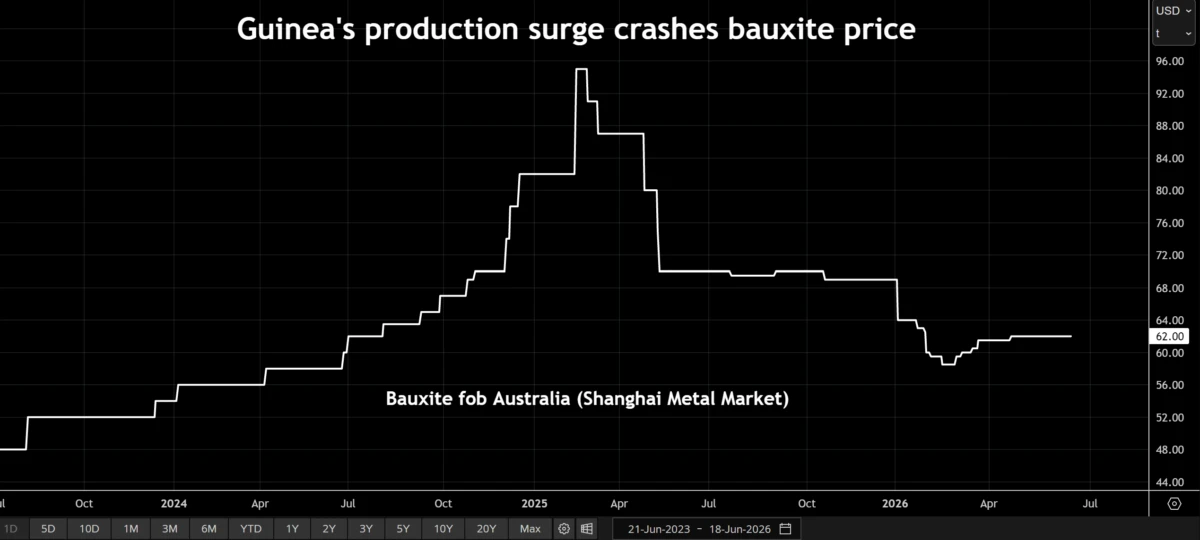 Guinea’s over-production crashes bauxite price.
Bauxite boom
Bauxite is the third most abundant element in the Earth’s crust but is mostly too dispersed or too low quality to allow for conversion into alumina.
Guinea not only boasts the world’s largest reserves of metallurgical bauxite but also produces a high-purity product prized for its natural low silica content.
Thanks to heavy Chinese investment, the country overtook Australia as the world’s largest bauxite producer in 2023 and now accounts for around 40% of global output and 70% of the seaborne export market.
Guinea’s exports jumped by 25% year on year to 183 million metric tons in 2025, which unsurprisingly caused prices to slump by almost half over the course of last year and the first part of 2026.
That is why the government is searching for the most effective way of hitting the brakes without generating the sort of market disruption caused by Congo’s cobalt export quota system.
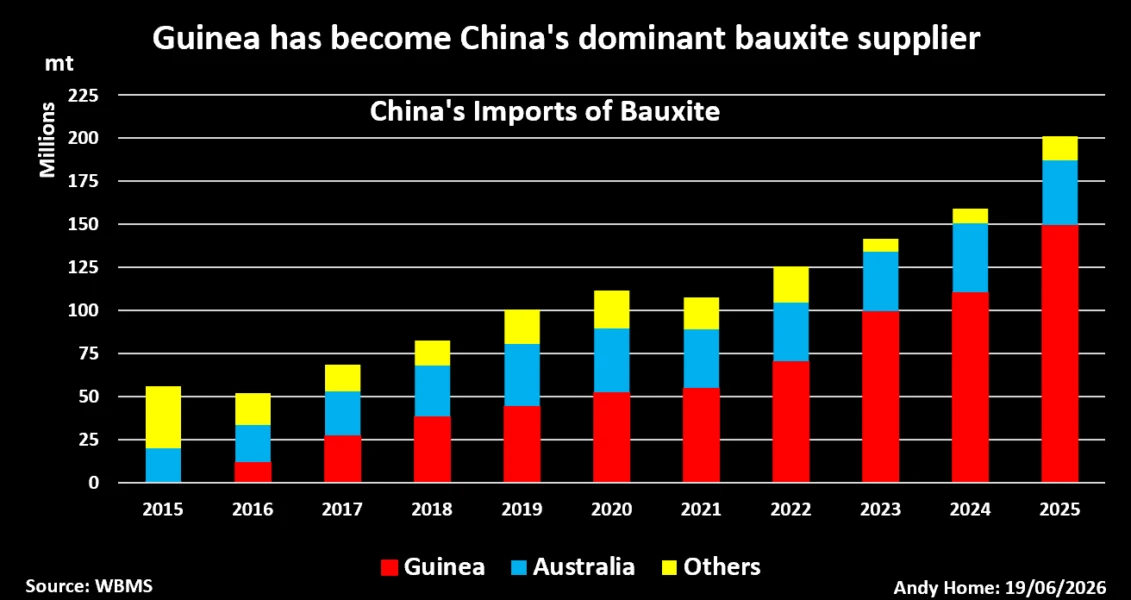 China has grown increasingly dependent on Guinea’s bauxite.
Chinese dependency
China has become increasingly reliant on Guinea for bauxite to feed its huge aluminum production sector.
Imports of Guinean material mushroomed from just 334,000 tons in 2015 to 149 million tons in 2025, by which point they accounted for 74% of all bauxite imports.
China has its own bauxite reserves but they’ve been depleted by decades of mining and are lower quality than those in Guinea.
Moreover, the country has massively expanded its aluminum smelting capacity this century, requiring a similar build-out in alumina refining, far beyond its domestic bauxite mining capacity.
Guinea’s planned crackdown on its runaway bauxite sector has been well flagged, and Chinese buyers have had plenty of time to build precautionary stocks. March imports from Guinea hit a monthly record of 18 million tons.
But there’s little prospect of breaking the dependency, given the scale of the material flow. What will change, however, is the nature of that dependency.
Alumina ambitions
Chalco’s commitment to building the new 1.2-million-ton-per-year alumina refinery shows how seriously China takes the threat to the flow of raw materials.
It’s the first major overseas investment in alumina by China’s state giant. It’s also the third Chinese-backed alumina refinery project to be announced in recent months.
Guinea’s only existing refinery is the Friguia plant, built in the 1960s and owned first by France’s Pechiney, then by US producer Reynolds and since 2008 by Russia’s Rusal. It was out of action between 2012 and 2018 but is operating again, albeit below its 650,000-ton-per-year capacity.
The Conakry government is aiming for five or six more processing plants with a combined capacity of 7 million tons of alumina by 2030.
The seizure of mining assets from Emirates Global Aluminium last year for its failure to follow through on a commitment to refining has served as a stark warning for other operators.
New industry hub
Guinea is following closely in the footsteps of Indonesia, which banned bauxite exports in 2023 as a way of forcing miners to build out processing capacity.
While Indonesia has plenty of coal-fired power to both refine alumina and smelt the intermediate product into aluminum, Guinea doesn’t currently have sufficient energy resources to go beyond the alumina stage.
But if Guinea can successfully implement its strategy, it will turbo-charge the creation of a West African alumina hub.
Not least because other African bauxite producers are travelling the same value-added pathway to keeping more of their mineral revenues.
Nigeria has signed a $1.3 billion investment deal with Africa Finance Corporation (AFC) to build an alumina refinery, while Ghana is looking to do the same under the auspices of the Ghana Integrated Aluminium Development Corporation.
The African shift from mining to first-stage processing could have transformative effects on the aluminum supply chain.
The seaborne bauxite market will shrink. The global alumina export market will expand and China’s domestic alumina refineries will find themselves in competition with their largest raw material supplier.