Bitget App
Trade smarter
Buy cryptoMarketsTradeFuturesStocksEarnInstitutionAI & More
Shiba Inu (SHIB) Witnesses 80 Trillion Threshold Comeback: How Things Are to Change

Shiba Inu (SHIB) Witnesses 80 Trillion Threshold Comeback: How Things Are to Change

UTodayUToday2026/06/23 12:30
By:UToday

Shiba Inu is getting close to a crucial on-chain milestone that might have a big impact on the token's future price movement.

Recent blockchain data indicates that SHIB exchange reserves are returning to the 80 trillion token threshold, which traders have historically kept a close eye on because of its connection to market liquidity and possible selling pressure.

Shiba Inu inflows flip

According to the most recent data, exchange reserves have reached one of the highest levels in recent months, at about 80.5 trillion SHIB. In the most recent reporting period, more than 959 billion SHIB entered trading platforms, indicating a sharp increase in exchange inflows. Because tokens moved to exchanges are typically thought to be more likely to be sold than assets kept in private wallets, such movements frequently draw attention.
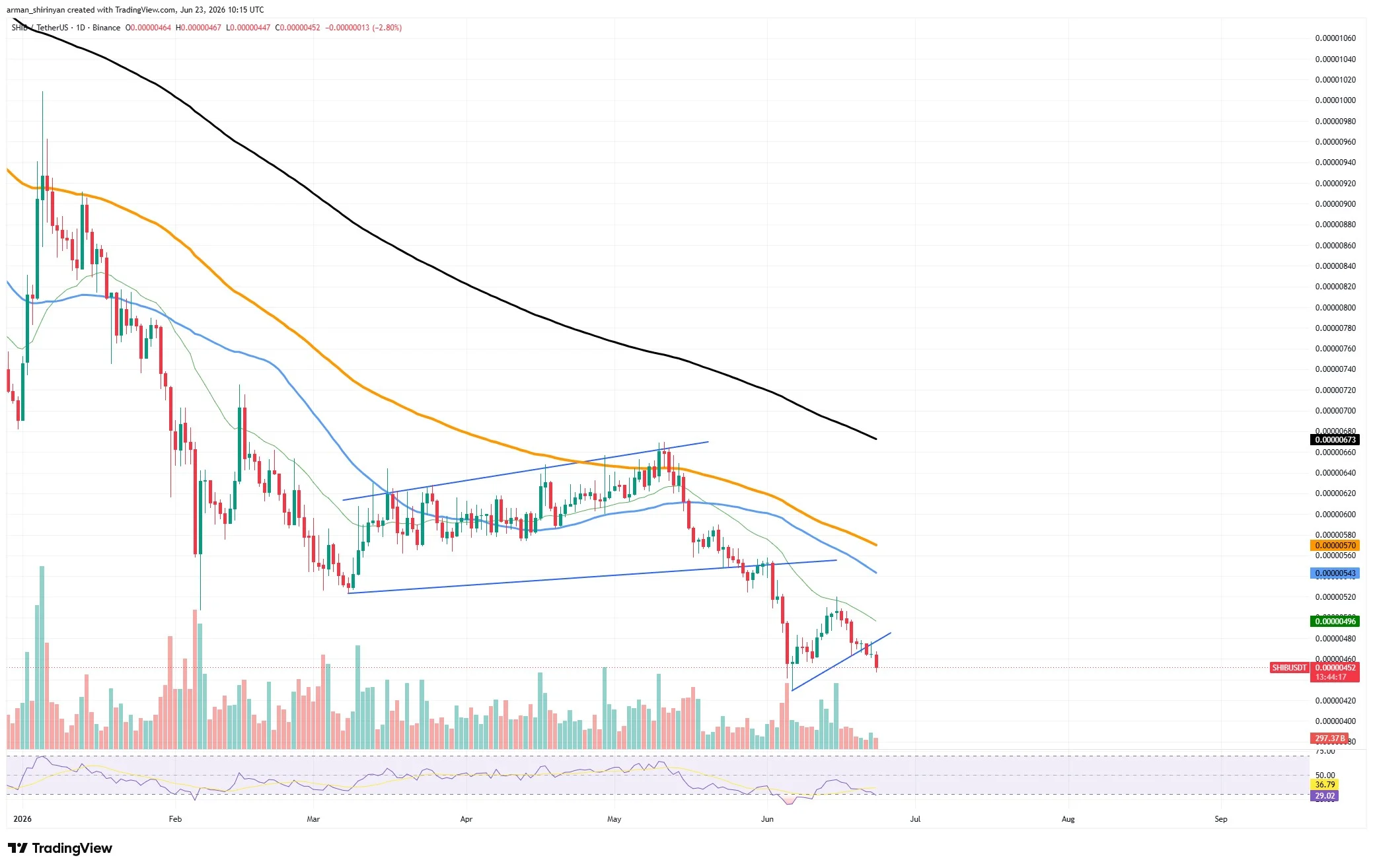
Shiba Inu (SHIB) Witnesses 80 Trillion Threshold Comeback: How Things Are to Change image 0 SHIB/USDT Chart by TradingView

Given SHIB's current technical state, the timing is especially crucial. The token is still stuck below all significant moving averages after recently breaking below a rising wedge formation. The price is currently trading close to $0.0000045, and the 50-, 100-, and 200-day moving averages are still much higher, supporting the overall downward trend.

Rising exchange reserves have historically had conflicting effects on SHIB. Large reserve increases have occasionally preceded waves of selling pressure, as investors transferred tokens to exchanges in an effort to increase profits or reduce exposure. In other cases, increased reserves did not cause significant drops; rather, they simply represented increased market participation and better liquidity conditions.

The larger market environment is what distinguishes the current situation. After months of weakness, SHIB is already trading close to local lows, indicating that many speculative holders have already sold their positions. Therefore, another significant selloff is not necessarily ensured by the return of the 80 trillion reserve threshold.

Exchange activity matters

It does, however, heighten the significance of closely monitoring exchange activity. If reserves keep increasing in tandem with faster inflows, traders might see this as a sign that more supply is getting ready to hit the market. On the other hand, the market may absorb the available liquidity without suffering major negative effects if reserves stabilize while prices start to rise.

Technically and fundamentally, SHIB is still under pressure as of right now. Although the return of the 80 trillion reserve level is a significant change in on-chain dynamics, it is not necessarily a bearish event on its own. SHIB's next big move will probably depend on whether it becomes a source of selling pressure or merely a sign of increased market activity.

0
0

Disclaimer: The content of this article solely reflects the author's opinion and does not represent the platform in any capacity. This article is not intended to serve as a reference for making investment decisions.

Understand the market, then trade.
Bitget offers one-stop trading for cryptocurrencies, stocks, and gold.
Trade now!

You may also like

Our Pinterest Stock Pick Hasn't Worked. We're Dropping It. -- Barrons.com

By Jacob Sonenshine Pinterest is down about 42% since Barron's recommended the stock in June 2025. During that time the S&P 500 has gained 29%. Time to move on. The problem isn't that Pinterest doesn't have long-term growth potential. It's that it has repeatedly failed to sustain a super high growth rate, creating uncertainty. Our thesis was that revenue growth would hold strong and the company's artificial intelligence usage would enable it to match the right products and advertisements with users. The hope was that Pinterest, with its hundreds of millions of users and more than $4 billion of annual sales, would grow within a global digital ad market worth hundreds of billions, as it would increasingly monetize its users. It has grown -- but not consistently at a high rate. Pinterest will continue to grow, but the market's concern doesn't appear likely to subside soon; revenue growth often decelerates by several percentage points, which causes large selloffs in the shares. The root of the problem is that whenever growth slows, the market is left to wonder if the platform is beginning to lose its relevance. Users now have a crowded field of options for finding personal and household trinkets to buy. Maybe the growth story isn't as beautiful as investors had hoped years ago, when the stock was at record highs of close to $90. Consider second quarter earnings, which management released Aug. 4, and caused the stock to drop. Yes, sales of $1.18 billion beat analyst's expectations and grew about 18% year over year, and yes, adjusted earnings per share of 43 cents beat estimates and grew 30%, as profit margins expanded. But the guidance signaled slowing growth yet again. Management guided for third quarter revenue of $1.2 billion at the midpoint of the range. That implies 14% year over year growth. Chief Financial Officer Julia Donnelly said on the earnings call that second quarter growth was strong partly due to the combination of brands increasing their ad spend around Amazon Prime Day and "World Cup-related spend th

Dow Jones•2026/10/06 03:34