
Kalshi adds India to growing list of restricted jurisdictions

Prediction market Kalshi has added India to its list of restricted jurisdictions, according to a members' agreement document updated on Wednesday.
The document now lists a total of 55 restricted jurisdictions whose residents are blocked from accessing the platform.
India's Ministry of Electronics and Information Technology warned virtual private network (VPN) providers in April to stop facilitating access to “illegal and blocked online betting and prediction market platforms.”
The development adds to growing regulatory pressure on prediction markets. In May, Spanish authorities blocked access to Polymarket and Kalshi over local gambling laws, while Indonesia blocked access to Polymarket after the platform listed contracts on whether President Prabowo Subianto would leave office before the end of his term.
Other countries, including Singapore, Poland, Portugal, Hungary, Ukraine and Brazil, have also blocked or prohibited prediction market platforms such as Kalshi and Polymarket.
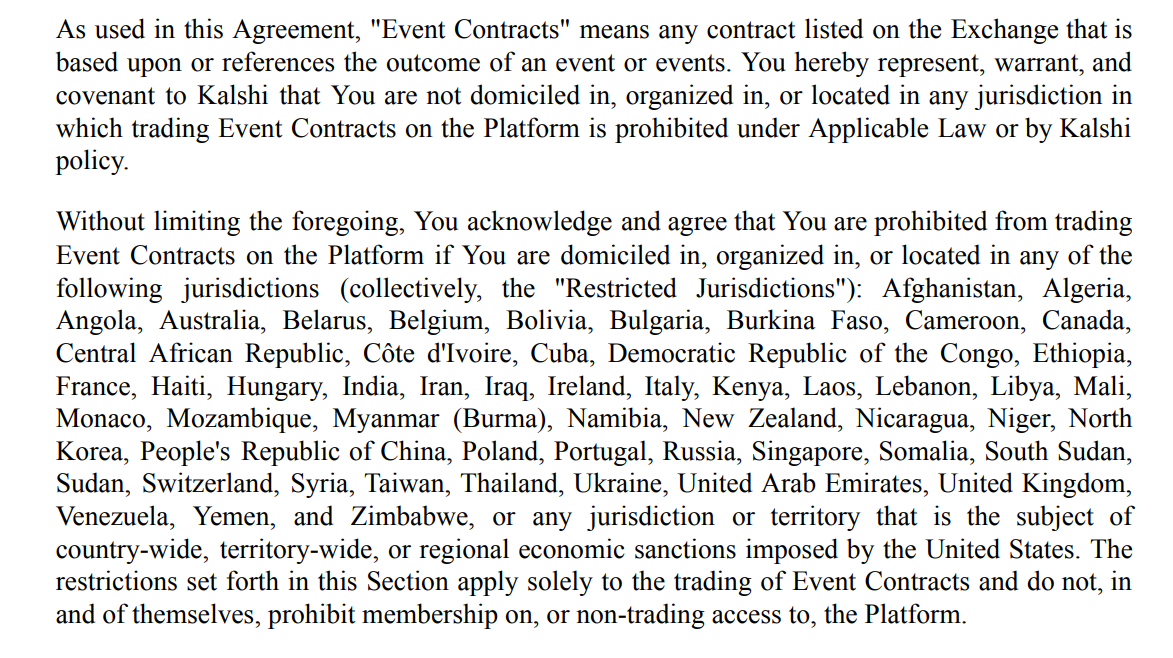
Kalshi updated the members' agreement document. Source: Kalshi
Prediction markets face scrutiny over sports and political contracts
Political betting and sports-related event contracts have drawn increased regulatory scrutiny.
In January, US lawmakers proposed legislation aimed at restricting political prediction market trading by government officials after a Polymarket user netted over $400,000 on a contract related to the removal of then-Venezuelan President Nicolás Maduro, fueling insider trading concerns.
Kentucky was the latest state to sue five prediction market platforms, including Kalshi and Polymarket, accusing them of “operating unlicensed and illegal sports betting and gambling platforms,” as Cointelegraph reported on Thursday.
Related: Kalshi in early IPO talks with investment banks: Report
Kalshi and Polymarket are two of the largest prediction market platforms, with $3.7 billion and $3.2 billion in weekly trading volume, respectively.
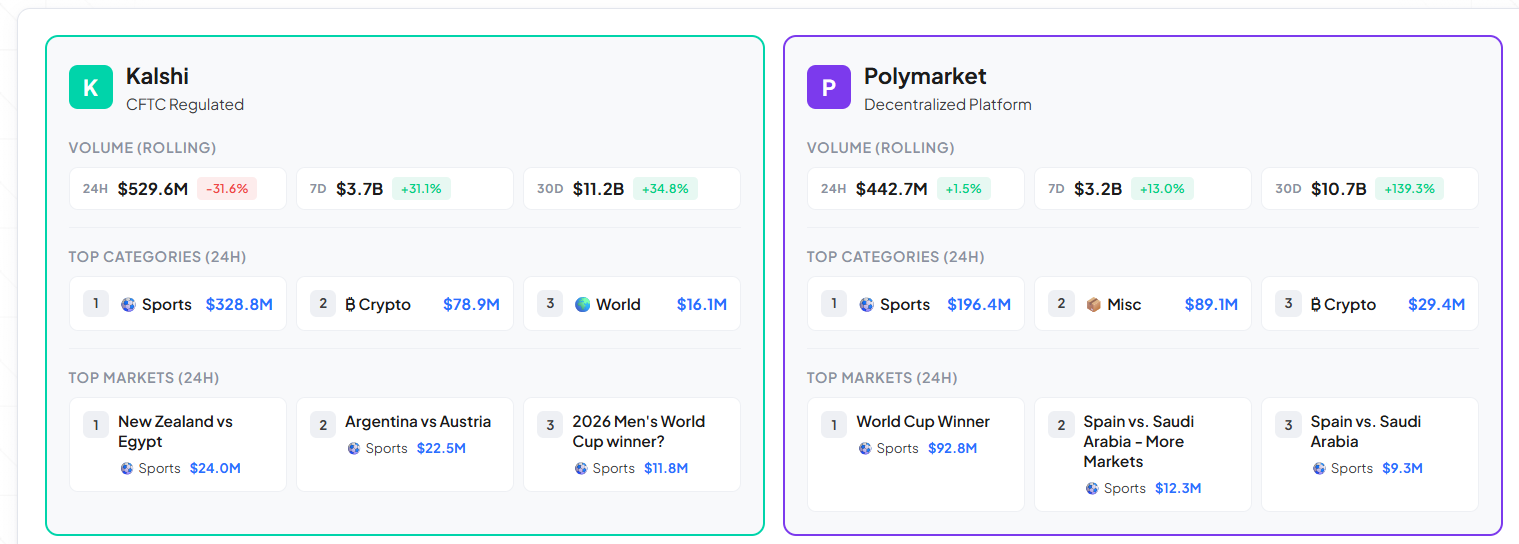
Kalshi and Polymarket, key stats, top categories. Source: Defirate.com
Sports betting was the largest category on both platforms, accounting for $328 million in daily volume for Kalshi and $196 million for Polymarket, according to data from Defirate.
Magazine: Should users be allowed to bet on war and death in prediction markets?
Disclaimer: The content of this article solely reflects the author's opinion and does not represent the platform in any capacity. This article is not intended to serve as a reference for making investment decisions.
You may also like
Our Pinterest Stock Pick Hasn't Worked. We're Dropping It. -- Barrons.com
By Jacob Sonenshine Pinterest is down about 42% since Barron's recommended the stock in June 2025. During that time the S&P 500 has gained 29%. Time to move on. The problem isn't that Pinterest doesn't have long-term growth potential. It's that it has repeatedly failed to sustain a super high growth rate, creating uncertainty. Our thesis was that revenue growth would hold strong and the company's artificial intelligence usage would enable it to match the right products and advertisements with users. The hope was that Pinterest, with its hundreds of millions of users and more than $4 billion of annual sales, would grow within a global digital ad market worth hundreds of billions, as it would increasingly monetize its users. It has grown -- but not consistently at a high rate. Pinterest will continue to grow, but the market's concern doesn't appear likely to subside soon; revenue growth often decelerates by several percentage points, which causes large selloffs in the shares. The root of the problem is that whenever growth slows, the market is left to wonder if the platform is beginning to lose its relevance. Users now have a crowded field of options for finding personal and household trinkets to buy. Maybe the growth story isn't as beautiful as investors had hoped years ago, when the stock was at record highs of close to $90. Consider second quarter earnings, which management released Aug. 4, and caused the stock to drop. Yes, sales of $1.18 billion beat analyst's expectations and grew about 18% year over year, and yes, adjusted earnings per share of 43 cents beat estimates and grew 30%, as profit margins expanded. But the guidance signaled slowing growth yet again. Management guided for third quarter revenue of $1.2 billion at the midpoint of the range. That implies 14% year over year growth. Chief Financial Officer Julia Donnelly said on the earnings call that second quarter growth was strong partly due to the combination of brands increasing their ad spend around Amazon Prime Day and "World Cup-related spend th
Gold steady as firm dollar counters softer US rate-hike bets
CFTC Clears Path for US Exchanges to Launch Perpetual Futures

Brazil Stocks Hit Record as Dollar Crashes After Election Shock
Crypto prices
More


