
$170M Ether longs liquidated as crypto market tumbles: Is ETH doomed?

Key takeaways:
- Negative ETH futures funding rates and six weeks of spot ETF outflows highlight a fragile investment climate.
- Ethereum’s 53% market share in DeFi keeps it well-placed for a recovery, even as negative news continues to batter the network.
Ether (ETH) price faced a 5% correction on Tuesday, erasing gains from the previous 12 days. The move triggered $170 million in liquidations of bullish leveraged ETH positions, putting traders on . Disconcerting news that the Ethereum Foundation was laying off 20% of its staff contrasts with optimism surrounding an upcoming network upgrade, but should ETH traders be worried?
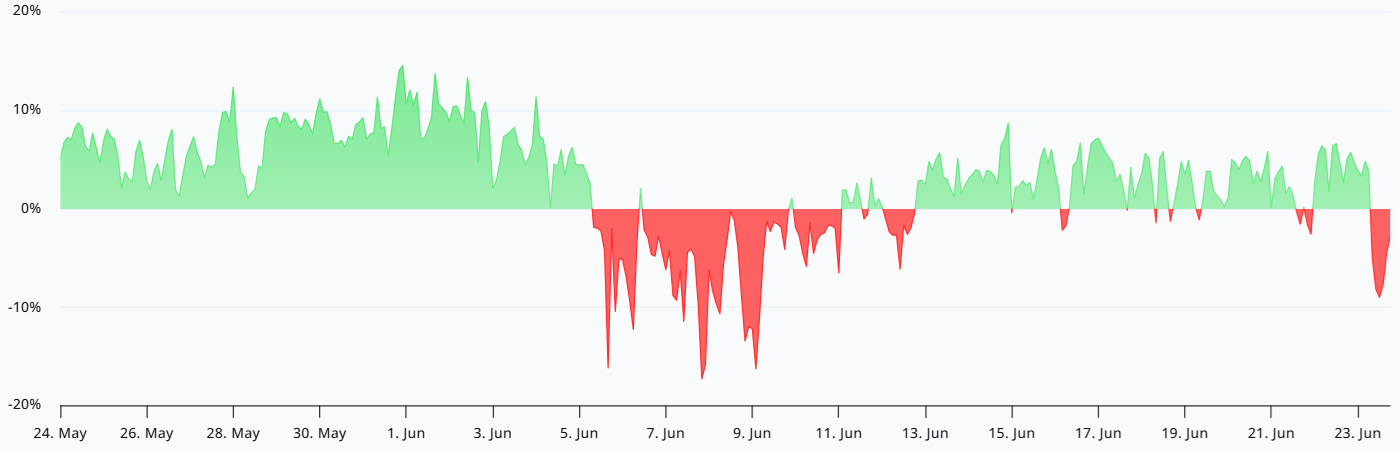
ETH perpetual futures annualized funding rate. Source:
Demand for bearish ETH positioning briefly surged on Tuesday as the perpetual futures annualized funding rate flipped into deeply negative territory, meaning shorts (sellers) paid to keep their positions open. The current 3% level signals a lack of confidence from bulls, but it should not come as a surprise given Ether’s recent weakness.
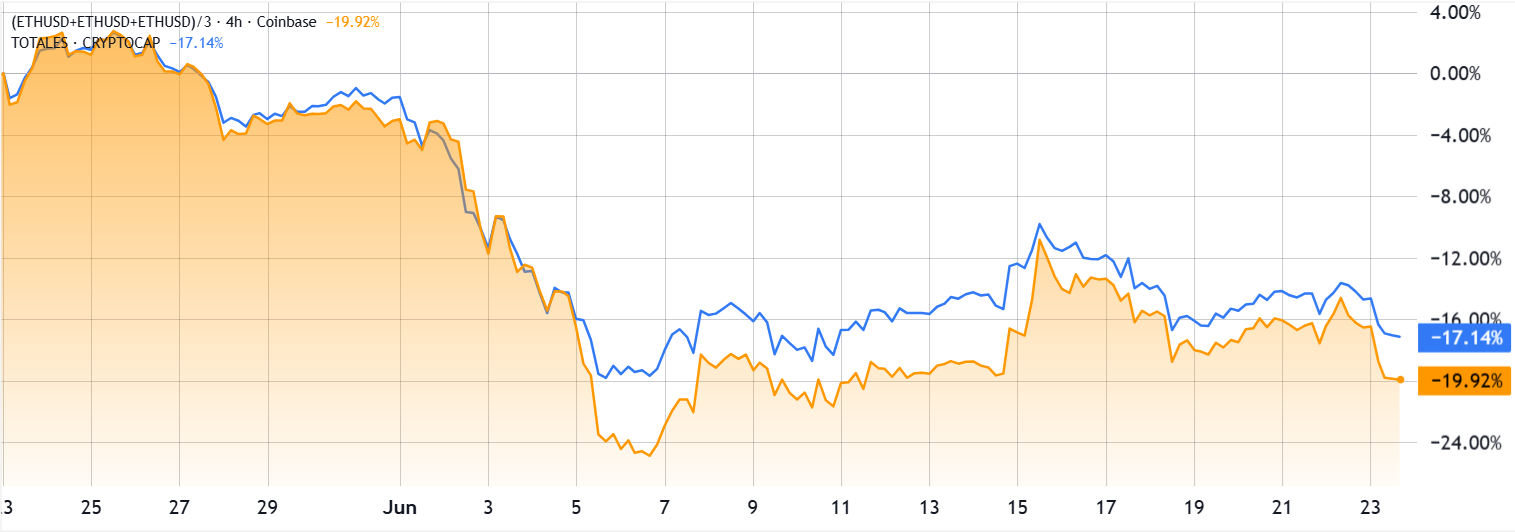
ETH/USD (orange) vs Total crypto capitalization (blue).
Ether price declined by 20% over 30 days, slightly worse than the 17% drop in the broader cryptocurrency market capitalization. Part of the move ties to investors’ fear over ongoing peace negotiations between the US and Iran. Moreover, high costs of artificial intelligence build-out have led investors to act more cautiously.
Ethereum leads DeFi even as activity slumps
The overall weakness in the decentralized applications (DApps) industry has led multiple projects to shut down, while the aggregate total value locked (TVL) shrank by 23% in three months. Lower demand for blockchain data processing weakens the case for ETH investment, although the Ethereum network’s leadership in TVL and activity should not be understated.
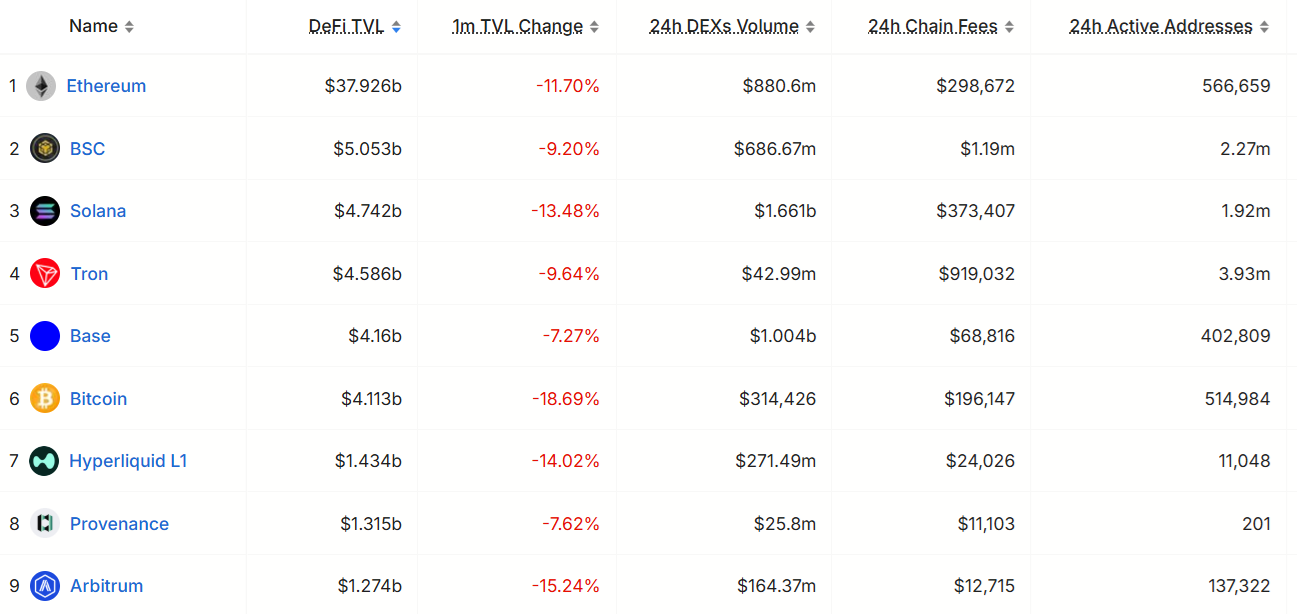
Blockchains ranked by Total Value Locked, USD. Source: DefiLlama
Ethereum’s $38 billion decentralized finance (DeFi) TVL represents a 53% market share, signaling institutional investors’ preference. Additionally, when including its layer-2 scaling solutions, the Ethereum ecosystem accounts for 43% of decentralized exchange (DEX) volumes. However, Ethereum faces criticism for relatively low 30-day fees of $11 million.
Despite controlled ETH issuance at 0.8% equivalent annual inflation, the staking reward rate was 2.7%, lower than the US money market yield. Adding to investors' concerns, the publicly listed company BitMine (BMNR US) held $9.3 billion in unrealized losses on its ETH reserves. The company, led by its Chairman Tom Lee, continues to increase its position.
Even though there is no imminent risk of BitMine being forced to reduce its ETH holdings, the situation likely deters institutional investors’ appetite. More concerningly, US-listed Ether spot exchange-traded funds (ETFs) posted net outflows for six consecutive weeks. Regardless of the rationale behind the move, the constant selling pressure undermined traders’ sentiment.
Related:
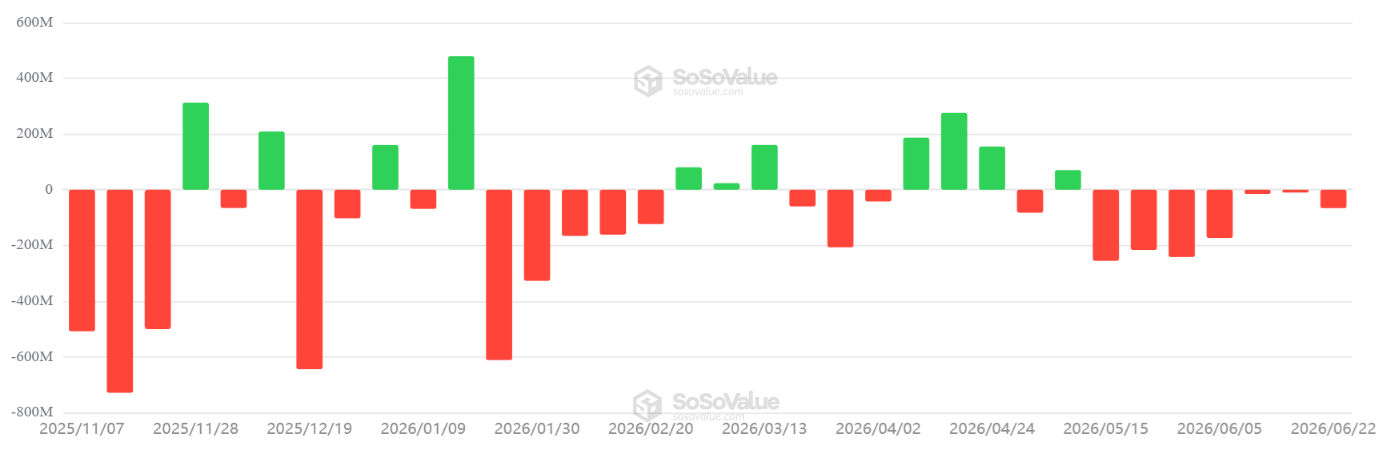
US-listed spot Ether ETFs weekly net flows, USD. Source: SoSoValue
A total of $910 million has left the US-listed spot Ether ETFs since mid-May, reducing total net assets to $9.4 billion. The downturn in the cryptocurrency market coincided with the Ethereum Foundation's (EF) organizational restructuring due to a 40% budget cut. The EF announced on Tuesday that 20% of its workforce was let go.
Still, Ethereum’s development does not depend solely on EF's work, and the upcoming Glamsterdam protocol upgrade is expected to reduce centralization by splitting block creation while improving security and execution efficiency through parallel transaction processing.
At least in relative terms, ETH stands well-positioned to capture the eventual comeback in DApp demand, given the Ethereum network’s dominance in institutional investor activity.
Disclaimer: The content of this article solely reflects the author's opinion and does not represent the platform in any capacity. This article is not intended to serve as a reference for making investment decisions.
You may also like
Our Pinterest Stock Pick Hasn't Worked. We're Dropping It. -- Barrons.com
By Jacob Sonenshine Pinterest is down about 42% since Barron's recommended the stock in June 2025. During that time the S&P 500 has gained 29%. Time to move on. The problem isn't that Pinterest doesn't have long-term growth potential. It's that it has repeatedly failed to sustain a super high growth rate, creating uncertainty. Our thesis was that revenue growth would hold strong and the company's artificial intelligence usage would enable it to match the right products and advertisements with users. The hope was that Pinterest, with its hundreds of millions of users and more than $4 billion of annual sales, would grow within a global digital ad market worth hundreds of billions, as it would increasingly monetize its users. It has grown -- but not consistently at a high rate. Pinterest will continue to grow, but the market's concern doesn't appear likely to subside soon; revenue growth often decelerates by several percentage points, which causes large selloffs in the shares. The root of the problem is that whenever growth slows, the market is left to wonder if the platform is beginning to lose its relevance. Users now have a crowded field of options for finding personal and household trinkets to buy. Maybe the growth story isn't as beautiful as investors had hoped years ago, when the stock was at record highs of close to $90. Consider second quarter earnings, which management released Aug. 4, and caused the stock to drop. Yes, sales of $1.18 billion beat analyst's expectations and grew about 18% year over year, and yes, adjusted earnings per share of 43 cents beat estimates and grew 30%, as profit margins expanded. But the guidance signaled slowing growth yet again. Management guided for third quarter revenue of $1.2 billion at the midpoint of the range. That implies 14% year over year growth. Chief Financial Officer Julia Donnelly said on the earnings call that second quarter growth was strong partly due to the combination of brands increasing their ad spend around Amazon Prime Day and "World Cup-related spend th
Gold steady as firm dollar counters softer US rate-hike bets
CFTC Clears Path for US Exchanges to Launch Perpetual Futures

Brazil Stocks Hit Record as Dollar Crashes After Election Shock
Crypto prices
More


