
Qatar Returns to Asian Crude Oil Market, Middle East 'Wartime Premium' Rapidly Narrows After US-Iran Agreement

With the temporary peace agreement between the US and Iran in place and the reopening of the Strait of Hormuz, crude oil exports from Persian Gulf oil-producing countries are accelerating their recovery, and the Middle Eastern war premium is quickly being erased.
According to media reports citing informed traders, Qatar this week sold a batch of Al-Shaheen crude oil to Formosa Petrochemical, with delivery scheduled for August to September. Last week, it also sold various grades such as Al-Shaheen, Marine, and Land to an Indian refiner. This is the first time since the outbreak of the war that Qatari crude has been observed trading with Asian refiners, marking a comprehensive acceleration of the country’s energy exports.
These transactions are directly reflected in oil price trends. Brent crude benchmark prices have plummeted this month, erasing all wartime gains. At the same time, UAE crude exports have rebounded significantly, while Iraq and Kuwait have also resumed exports, highlighting a clear trend of supply rebuilding across the Gulf region.
The reopening of the Strait of Hormuz is the core driver of this wave of supply recovery. According to Bloomberg, after the passage was restored, crude oil sales and transport resumed, rapidly repairing supply in the market.
Qatari Crude First Finds Asian Buyers
This round of transactions involves Formosa Petrochemical and an Indian refiner, representing the first observable Qatari crude deals with Asian plants since the conflict began. According to informed traders cited by the media, Formosa Petrochemical’s Al-Shaheen crude procurement covers August to September, while the sale to the Indian buyer last week included three grades: Al-Shaheen, Marine, and Land.
Notably, before reentering the crude oil market, Qatar had already been proactively reviving its liquefied natural gas (LNG) production and exports. The return to crude oil exports now means its overall energy export portfolio is moving towards full recovery.
From the perspective of physical transportation, signs of Qatar’s export recovery are also evident. Ship tracking data shows that the Greek-flagged supertanker Kiku is currently loading approximately 2 million barrels of Qatari crude at the Al-Shaheen floating storage and offloading terminal. Kiku arrived in the Persian Gulf on the morning of June 19, with its last reported position being in the Gulf of Oman on June 13, making it one of the first mainstream large crude carriers (VLCCs) to enter the Persian Gulf after the US-Iran agreement.
In addition, QatarEnergy has issued a tender to export gasoline from the Mesaieed refinery in the Persian Gulf next month, indicating that both its upstream and downstream processing and export operations are accelerating. According to the Equasis database, Kiku is managed by Apex Shipping & Energy Ltd. of Greece, which has not responded to any request for comment.
War Premium Fades, Brent Erases All Gains
The swift return of crude oil supply is strongly suppressing prices. Brent crude has fallen sharply this month, completely giving back all the wartime premium accumulated since the outbreak of conflict, directly reflecting the market’s pricing adjustment to supply recovery.
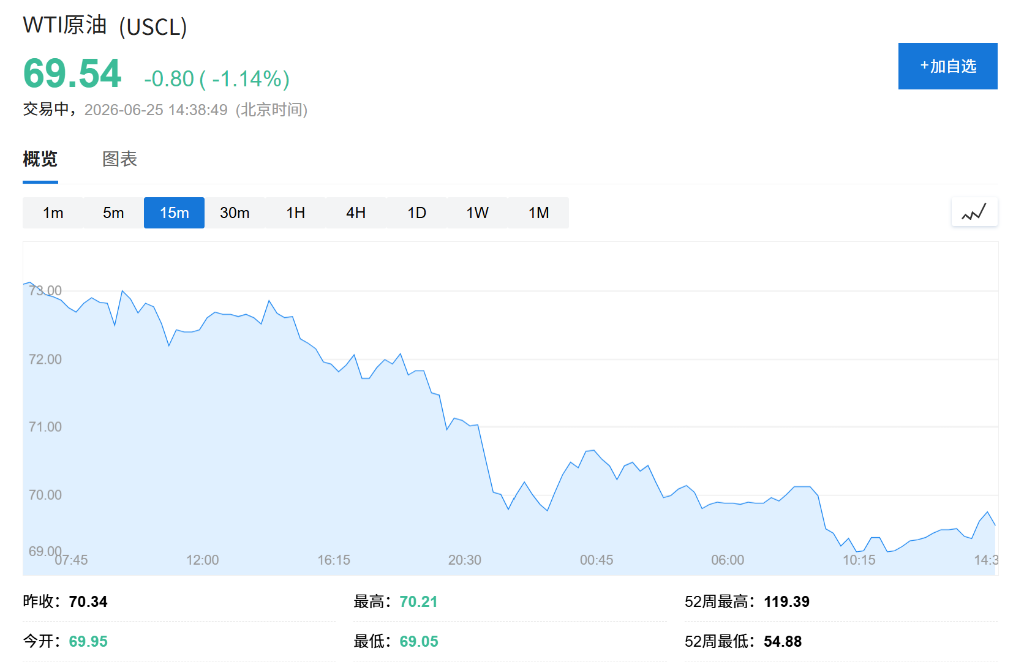
The reopening of the Strait of Hormuz is the key turning point for this supply shock. According to previous reports by Bloomberg, after navigation resumed in the strait, pent-up crude sales and transport demand were quickly released, and regional supply began flooding into the market.
Currently, crude exports from the UAE have recovered significantly, while exports from Iraq and Kuwait are resuming one after the other. Oil-producing countries throughout the Gulf are rebuilding their supply chain in unison, rapidly pushing the war premium out of the market.
LNG Exports Also Accelerating, Capacity Recovery Imminent
In the LNG sector, Qatar’s recovery is also gaining speed. According to sources cited by the media, Qatar plans to sharply ramp up super-cooled fuel production once the Strait of Hormuz is fully reopened, and expects to restore most of its export capacity within two months.
According to previous reports by Bloomberg, Qatar has recently deployed more empty LNG ships into the Persian Gulf and has been sending out more LNG carriers through the Strait of Hormuz this week. Activity around the Ras Laffan facility—the key energy export hub for Qatar—has also grown significantly.
QatarEnergy is responsible for all national energy supplies, including crude oil, refined products, and LNG. With its entire export chain now springing back to life, Qatar is rapidly shifting from wartime stagnation to full-speed export mode.
Disclaimer: The content of this article solely reflects the author's opinion and does not represent the platform in any capacity. This article is not intended to serve as a reference for making investment decisions.
You may also like
TSMC captures Intel's market and discusses Terafab cooperation with Musk, reaching a record high in stock price
TSMC's US stock closed up 2.8%, while Intel, which joined the Terafab project in April this year, saw its share price fall by 2.6%. Musk confirmed on social media that preliminary discussions have taken place between TSMC and Terafab. According to reports, industry insiders estimate there is over an 80% probability of collaboration between TSMC and Terafab.
Record-breaking AI chip financing launches distribution: 42 billion senior debt backed by Broadcom credit endorsement, 18 billion subordinated debt awaits Anthropic IPO
According to reports, approximately $42 billion in Broadcom-secured senior secured loans have taken the lead in syndicate distribution, with Bank of America, Citigroup, and Morgan Stanley beginning to sell portions of the debt to other banks. Leveraging Broadcom's A- credit rating, the debt may later enter the private placement or investment-grade bond markets. Additionally, $18 billion in unsecured subordinated debt not guaranteed by Broadcom will be launched later, with Blackstone having committed to subscribe to about $9 billion of it.
Crypto prices
More


