
The Dangerous Divergence in Inflation Expectations: Consumers "Pricing In" 3.5% Contradicts Wall Street, Soaring Non-Cyclical Prices Squeeze Policy Space for Walsh

The divergence in inflation expectations is becoming a core risk that is currently underestimated in the US macro narrative.
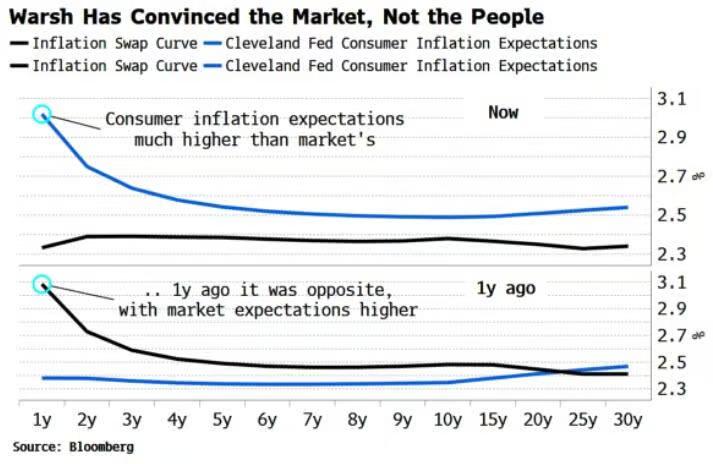
Financial markets are pricing in a “smooth return of inflation to 2%,” with inflation expectations implied by the interest rate futures market continuing to decline, reflecting strong confidence in the effectiveness of tightening policy. However, household surveys indicate that US inflation expectations have continued to rise, with medium-term expectations approaching 3.5%. This rare divergence between the two forces paints a split picture of “market optimism and consumer pessimism.”
What’s even more challenging is that the driving force behind current inflation is undergoing a structural shift. “Non-cyclical inflation” represented by services, healthcare, and housing costs continues to rise, and this type of price is known to respond sluggishly to interest rate tools.
Even if the Federal Reserve further tightens monetary policy, its suppressive effect on these sectors is relatively limited, meaning that the Walsh’s potential policy path will face greater real-world constraints—the most effective tool of monetary policy is currently mismatched with the most stubborn sources of inflation.
As the gap between market pricing and household perception continues to widen, inflation expectations themselves may become a “self-fulfilling” force. Perhaps this is the variable that should be most closely watched in current macro trading.
Markets vs. Consumers: Two Completely Opposing Narratives on Inflation
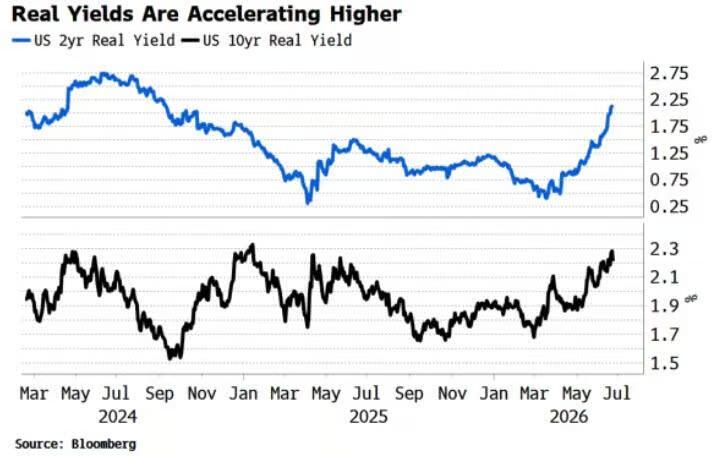
In recent months, US financial markets have experienced a significant repricing of tightening. The interest rate path was revised upward, approximately 50 additional basis points of rate hikes were priced in by year-end, and real interest rates climbed sharply. In the derivatives market, the 12-month CPI swap once fell below 2%, almost completely returning to the “target anchor range.”
But “price perception” in the real economy has moved in the opposite direction. Multiple consumer surveys show that household expectations for inflation over the next one to several years have continued to climb, with medium-term expectations generally above 3%, and some measures close to 3.5%. More importantly, this trend is not a short-term shock but a structural rise since the pandemic.
In other words: markets are “trading the end of inflation,” while households are “experiencing the continuation of inflation.”
Which Is More Reliable: Market Pricing or Consumer Expectations?
Financial markets usually prefer to believe in “price signals.” But history shows that inflation derivatives are not particularly accurate forecasters.
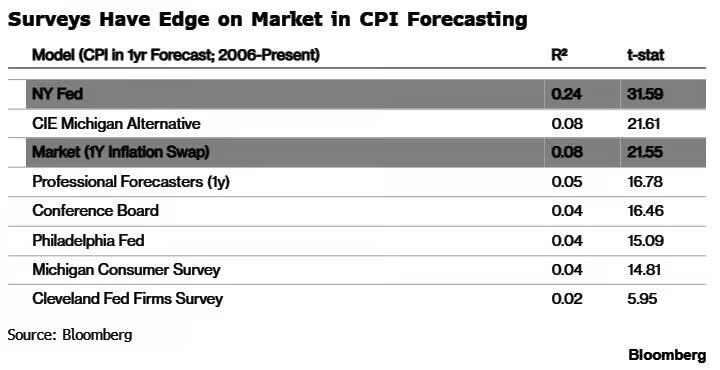
Empirical research shows that the one-year inflation swap explains only about 8% (R² ≈ 0.08) of future CPI variance, which is almost as good as a random walk. In contrast, most consumer surveys perform no worse, and the New York Fed survey does even better, with an explanatory power around 24%.
Even more contentious are the “long-term sample” results: Over longer periods, the correlation between the University of Michigan’s consumer inflation expectations and actual CPI rises significantly, with an explanatory power of nearly 60%. This suggests a counterintuitive conclusion: in the context of high short-term financial market noise, the price perceptions of “non-professional groups” may actually be closer to the real inflation path.
Why Does the Market Continue to Underestimate Inflation?
The core assumption in the market right now is: strong monetary policy + tight financial conditions = rapid fall in inflation, but this logic has three key cracks:
Inflation structure mismatch. According to San Francisco Fed breakdowns, rate-sensitive cyclical inflation has indeed cooled, but non-cyclical inflation (services, healthcare, housing), which monetary policy barely affects, continues climbing. The Fed has won the “easy battlefield” but is losing on the “toughest front.”
Feedback loop of liquidity contraction. Declining excess liquidity directly weighs on asset prices, and through tighter financial conditions, pushes up real rates, forming a self-reinforcing cycle of "less money → more expensive borrowing → less consumer spending → higher costs." Even if policy rates hold steady, the real financing environment automatically tightens—this mechanism usually shows up before major market corrections and is an important forward warning signal.
“Walsh expectations” untested. The market’s pricing of a more hawkish Fed remains hypothetical. Should inflation prove stickier than expected or political disturbances intensify, the current consensus on terminal rates would face a significant reassessment risk.
The “Illusion” of Inflation under Structural Divergence
The core of the divergence in the current US macro narrative is no longer about whether inflation will return to 2%, but the risk of the market misjudging path dependency.
The market’s linear extrapolation is: tightening suppresses demand, falling demand pulls inflation down. But consumption data and structural decomposition reveal another picture—cyclical components are falling while non-cyclical components are rising, making overall inflation “sticky.” If the latter is true, then today’s financial pricing around 2% is systematically underestimating the possibility of future reflation.
As markets continue to price in lower inflation expectations, real rates rise passively, creating hidden pressure of “nominal optimism + real tightening.” This mismatch is amplifying asset prices’ sensitivity to liquidity. If economic data stabilizes or inflation picks up, the market risks a nonlinear repricing.
The current macro focus is not “whether inflation improves,” but “where the future anchor lands.” The market sees inflation as a problem solved, while consumers perceive it as ongoing pressure. The real risk may not be which side is ultimately correct, but rather that when reality picks a side, the price adjustment may not be gentle.
Disclaimer: The content of this article solely reflects the author's opinion and does not represent the platform in any capacity. This article is not intended to serve as a reference for making investment decisions.
You may also like
Updated Version 4 - Mattel Investor Ariel Urges Sale Amid Stalled Turnaround
Ariel Investments holds a 5.4% stake in Mattel and believes the stock remains severely undervalued. Mattel stated it will take into account the opinions of Ariel and other shareholders. According to sources, Authentic Brands Group approached Mattel last week, with a potential valuation of around $6 billion. Analyst comments and a chart were added in paragraph 10. Juveria Tabassum/Angela Christy M Reuters, October 5 – A letter obtained by Reuters shows that a major shareholder of Mattel (MAT.O) on Monday urged the Barbie-maker to explore a sale, citing stagnant growth in performance and profitability. Ariel Investments, holding a 5.4% stake in Mattel, stated that the company’s stock is still severely undervalued. “We believe that strategic buyers would be willing to acquire your company at a price significantly above the current share price,” Ariel Co-CEO John Rogers wrote in a letter to Mattel’s board. The asset management firm suggested Mattel's options include “divesting significant assets, mergers, and/or an outright sale of the company.” Ariel believes other toy companies may be interested in Mattel’s asset portfolio, as well as entertainment firms and traditional private equity companies. In recent years, despite Mattel’s stabilizing business and the box-office success of the Barbie movie, the company has faced fluctuating sales and rising input costs. Operating profit has declined for six consecutive quarters. In after-hours trading, Mattel's shares rose 0.9% to $16.20. Ariel’s initiative comes as Mattel undergoes leadership changes (link). CEO Ynon Kreiz stepped down last month to become Co-CEO of Paramount Skydance (PSKY.O), while board member Roger Lynch—former editor-in-chief of Vogue and head of Condé Nast, parent company of The New Yorker—will assume the CEO role next month. Mattel replied to Reuters by email: “Our board and management team are committed to acting in the best interests of all shareholders, and will consider the views expressed in the letter from Ariel Investments, as well as those of other Mattel shareholders.” This is the second time this year investors have asked Mattel to consider strategic options. In May, Mattel investor Southeastern Asset Management called for the company to explore various options (link), including privatization, acquisition by competitor Hasbro (HAS.O), or by a major media company that could value Mattel’s assets more fairly than the public market. Last week, a person familiar with the matter told Reuters that Authentic Brands Group (AUTH.N) approached Mattel about a potential acquisition (link), which could value the toymaker at about $6 billion or higher. The source noted that there is no guarantee Mattel will accept Authentic Brands’ proposal, and the company is not conducting a formal sale process at this time. Following the news, Mattel’s share price soared. Despite the rebound, the stock remains down about 20% year-to-date. According to London Stock Exchange Group (LSEG) data, Mattel’s 12-month forward price-to-earnings ratio stands at 9.99, compared to an industry average of 14.03. “I think this just reflects the market’s frustration about the business possibly being a bit stagnant. Given the current level of valuation, now may be a good time to turn around the business away from the spotlight of investors,” said Morningstar analyst Jaime Katz. (For the convenience of non-English speakers, Reuters automatically translates its reports into several languages. As automated translations may contain errors or lack context, Reuters does not guarantee the accuracy of automated translation texts and provides them solely for readers’ convenience. Reuters assumes no liability for any loss or damage resulting from the use of the automated translation feature.)
42% premium, five years to break even with capital cost, Schneider Electric sets record with $23 billion acquisition of PTC, stock price plunges
Schneider Electric’s acquisition of industrial software company PTC marks the latest move by European industrial companies to accelerate their bets on AI. While the strategic rationale is acknowledged by analysts, the financial cost of the deal is heavy. PTC is expected to generate only about $1.5 billion in operating profit by 2031, and the anticipated cost savings to be realized three years from now will only contribute an additional $280 million.
Custodia Bank CEO Caitlin Long warns tokenized deposits could outpace stablecoins

Spacex closed up 7.6%, reaching a new high since June, helping Musk "regain" his trillionaire status
SpaceX's stock surged nearly 8% on Monday, with Elon Musk's net worth rebounding to approximately $1.03 trillion, reclaiming the top spot on the billionaire list. Morgan Stanley released a bullish report, setting a target price of $300 and stating that the company's value is underestimated. The rally was driven by multiple catalysts, including expectations for Starship recovery, expansion of AI business, and over $12.7 billion in defense contracts.
Crypto prices
More


