
The yen falls below its all-time low again, Ministry of Finance sighs in powerlessness

Morning FX
As expected, the yen exchange rate broke through the 162 mark, reaching a 40-year low. Since the signing of the Plaza Accord in 1985, the yen has never depreciated to such an extreme level.
Traditional exchange rate factors have lost their effectiveness, making Ministry of Finance intervention increasingly challenging. Whether from the perspective of nominal interest rate spreads, real interest rate spreads, or the balance of payments, none can explain the severe weakness of the yen. The root of the structural selling pressure has forced Japan to reassess the entire exchange rate system.
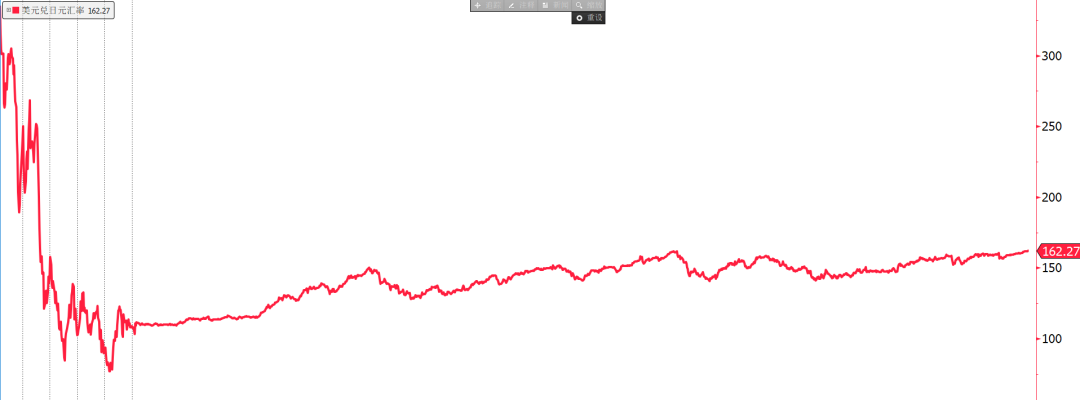
Chart: Yen at a forty-year low
1. The deterrent effect of intervention is diminishing
The Ministry of Finance last intervened at the end of April, spending approximately 10 trillion yen (63 billion USD), pushing the USDJPY exchange rate down from 160 to a low of 155. However, in less than a month, the yen’s depreciation resumed.
The last intervention shifted its basis from the speed of fluctuations (rapid depreciation in a short period) to fixed price points. The psychological threshold in the market was 160, and the operation started once 160 was breached, with a strategy of repeatedly and swiftly entering the market to have a continued deterrent effect.
As the 160 mark is breached again, the market anticipates another possible intervention. However, both the Ministry of Finance and the Bank of Japan showed great restraint, expressing concern about the exchange rate only verbally. Without sending a strong signal at a fixed threshold, the market will continuously test the bottom line, giving short sellers growing confidence, and making future intervention increasingly costly.
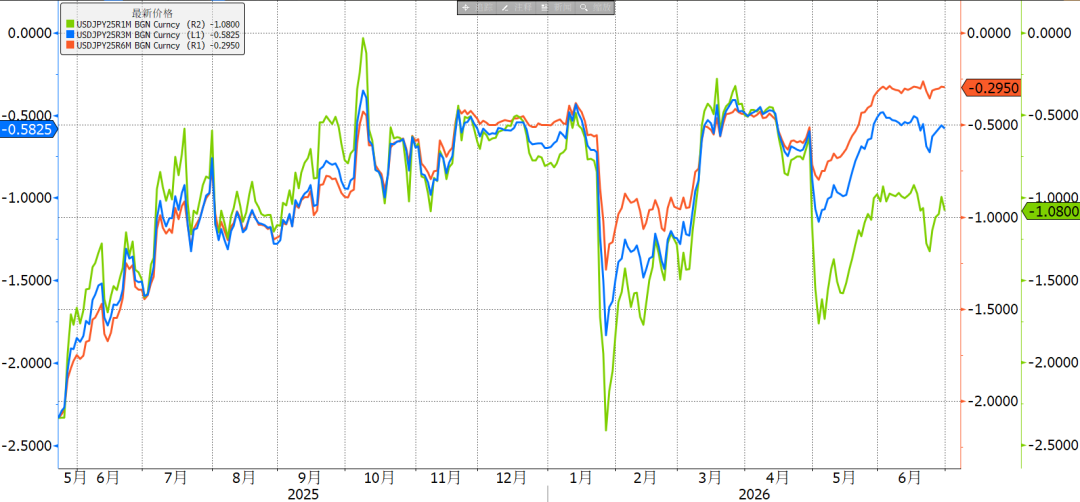
Chart: Panic over intervention fades away
Yen risk reversal option prices dropped significantly after both breakthroughs above 160, and the market once priced in the risk of intervention. However, this panic has subsided, and RR prices have returned to normal.
2. The failure of macroeconomic factors is the most critical
Although the recent rise in USDJPY has been driven by a hawkish turn from the Federal Reserve and the strong US dollar, traditional factors can no longer explain the magnitude of this depreciation.
Looking at the US-Japan interest rate spread, after US rates peaked in 2024, the spread has continued to narrow. The short-term spread fell from a high of 5% to the current 2.5%; the ten-year bond spread dropped from 4% to 1.73%. If last year's depreciation could be attributed to the widening real interest rate spread, this year’s simultaneous cooling off of inflation in both the US and Japan has lead to a narrowing real interest rate spread.
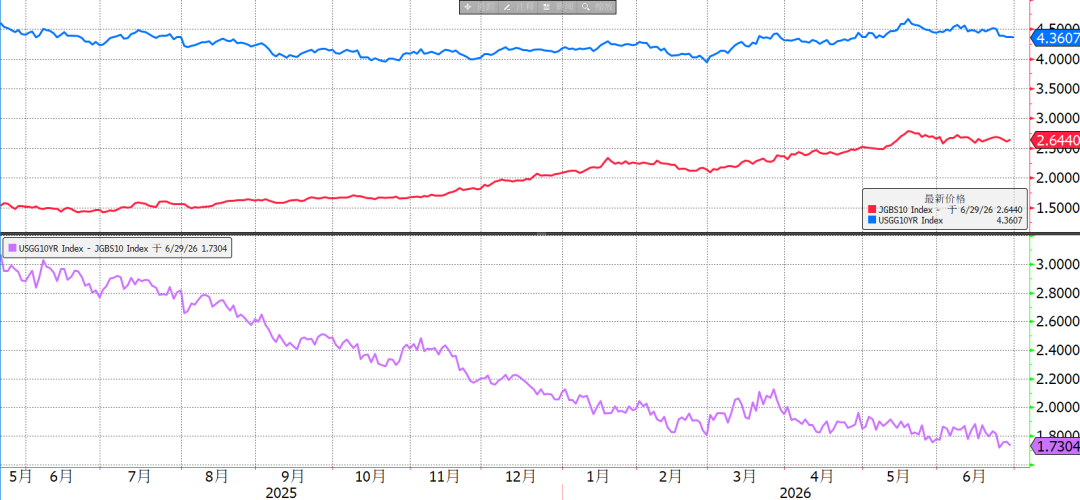
Chart: Yield spreads can't explain the yen's weakness
In the first quarter, the current account surplus was about 9.8 trillion yen, significantly up year-on-year. However, it appears only capital account outflows are driving the exchange rate. The foreign exchange settlement rate for the current account surplus is extremely low, the narrowing spread doesn't dampen the appetite for carry trades, and selling pressure on the yen remains undiminished.
With macro factors no longer effective, intervention is like a mantis stopping a chariot, and there is also no suitable environment (such as weak US data) to implement. Only by showing sufficient strength and determination can the depreciation of the yen be suppressed.
3. Summary
(1) The yen has depreciated to a 40-year low, continuing to fall after breaching 160, and is now approaching the most extreme levels since the Plaza Accord.
(2) The yen’s current weakness can no longer be explained by macro factors. Structural selling pressure has rendered Ministry of Finance interventions increasingly ineffective, yet strong deterrence is still needed to prevent a vicious cycle.
Disclaimer: The content of this article solely reflects the author's opinion and does not represent the platform in any capacity. This article is not intended to serve as a reference for making investment decisions.
You may also like
Breaking! Apple's brand-new product line revealed, Siri AI enters the home
Paramount (PSKY.US) $110 Billion Acquisition Financing Delayed: Bond Issuance Postponed for Three Months, May Have to Pay $500 Million More in Annual Interest
Paramount has been continuously pitching financing bonds to investors for the acquisition of Warner Bros. Discovery (WBD.US) for several months. However, as the negotiation period has been forced to extend, the financing costs have also risen.
Trump Plans to Announce South Korea's $200 Billion Energy Investment in the U.S., Covering Eight Nuclear Power Plants and the Alaska LNG Project
U.S. President Trump is expected to announce a plan on Wednesday for approximately $200 billion in South Korean-supported U.S. energy projects, involving eight large nuclear power plants, major power generation facilities in Texas, and an Alaskan liquefied natural gas (LNG) export project.
Apple (AAPL.US) plans to enter the next major category of smart homes in the new AI application sector, with a central device set to be released on October 13
Apple is finally preparing to enter the next major sector: smart home.
Crypto prices
More


