Bitget App
Trade smarter
Buy cryptoMarketsTradeFuturesStocksEarnInstitutionAI & More
Pi Network nosedives 12% post-rebound – Identifying the reasons

Pi Network nosedives 12% post-rebound – Identifying the reasons

AMBCryptoAMBCrypto2026/07/16 22:03
By:AMBCrypto

Pi Network [PI] reached a new all-time low near $0.07060 on the 14th of July.

The altcoin rebounded over 16% the following day, but the recovery quickly faded. The token then fell by around 12% within 24 hours.

Trading volume also declined roughly 13% to $23 million. Token unlocks and profit-taking may have contributed to the renewed weakness.

@media only screen and (min-width: 0px) and (min-height: 0px) { div[id^="bsa-zone_1774359638628-7_123456"] { min-height: 50px; transition: min-height 0.3s ease; } } @media only screen and (min-width: 640px) and (min-height: 0px) { div[id^="bsa-zone_1774359638628-7_123456"] { min-height: 90px; } }
AD

Why did PI fall again?

Data from PiScan showed that massive token releases are set to be unlocked daily, with the highest release this week occurring on the 16th of July. That is, more than 7 million PI, worth well over $527K, would be hitting the market, adding to the 5.181 million tokens unlocked the previous day.

Over the next five days, well over 24 million PI would be released, resulting in immense selling pressure. Each day, an average of 4.25 million PI are unlocked, with a value exceeding $315K.
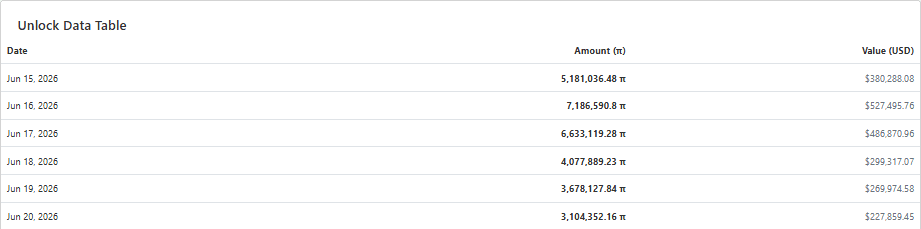
Pi Network nosedives 12% post-rebound – Identifying the reasons image 0 Source: PiScan

Profit-taking may have added further pressure after PI rebounded from its record low. The recovery briefly carried PI toward $0.085.

That move placed dip buyers in profit, potentially encouraging some traders to exit. PiScan also recorded small swaps into Bitcoin [BTC], XRP, and Tether [USDT].

Still, the available data did not establish whether those swaps materially affected PI’s market price.
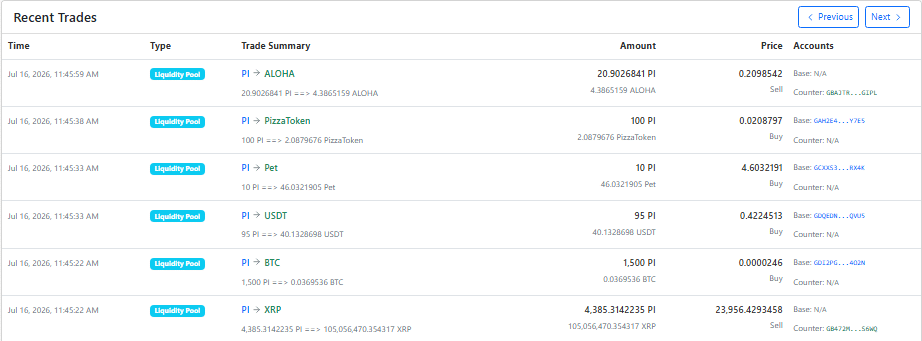
Pi Network nosedives 12% post-rebound – Identifying the reasons image 1 Source: PiScan

Can Protocol v25 support PI?

PI’s technical structure remained bearish after the token broke below its three-week trading range.

The range held between the 5th and 29th of June. Afterward, PI formed several lower highs on the four-hour chart. The latest rejection pushed PI back toward its all-time low. It traded near $0.07312 when the chart was captured.

Additionally, the Cumulative Volume Delta [CVD] reflected strong selling on OKX. The chart recorded approximately 18.65 million PI in net selling.

The Directional Movement Index [DMI] supported this bearish structure. The Negative Directional Indicator stood at 22, above the Positive Directional Indicator at 14.

This setup suggested sellers retained control, leaving PI vulnerable to another lower high.
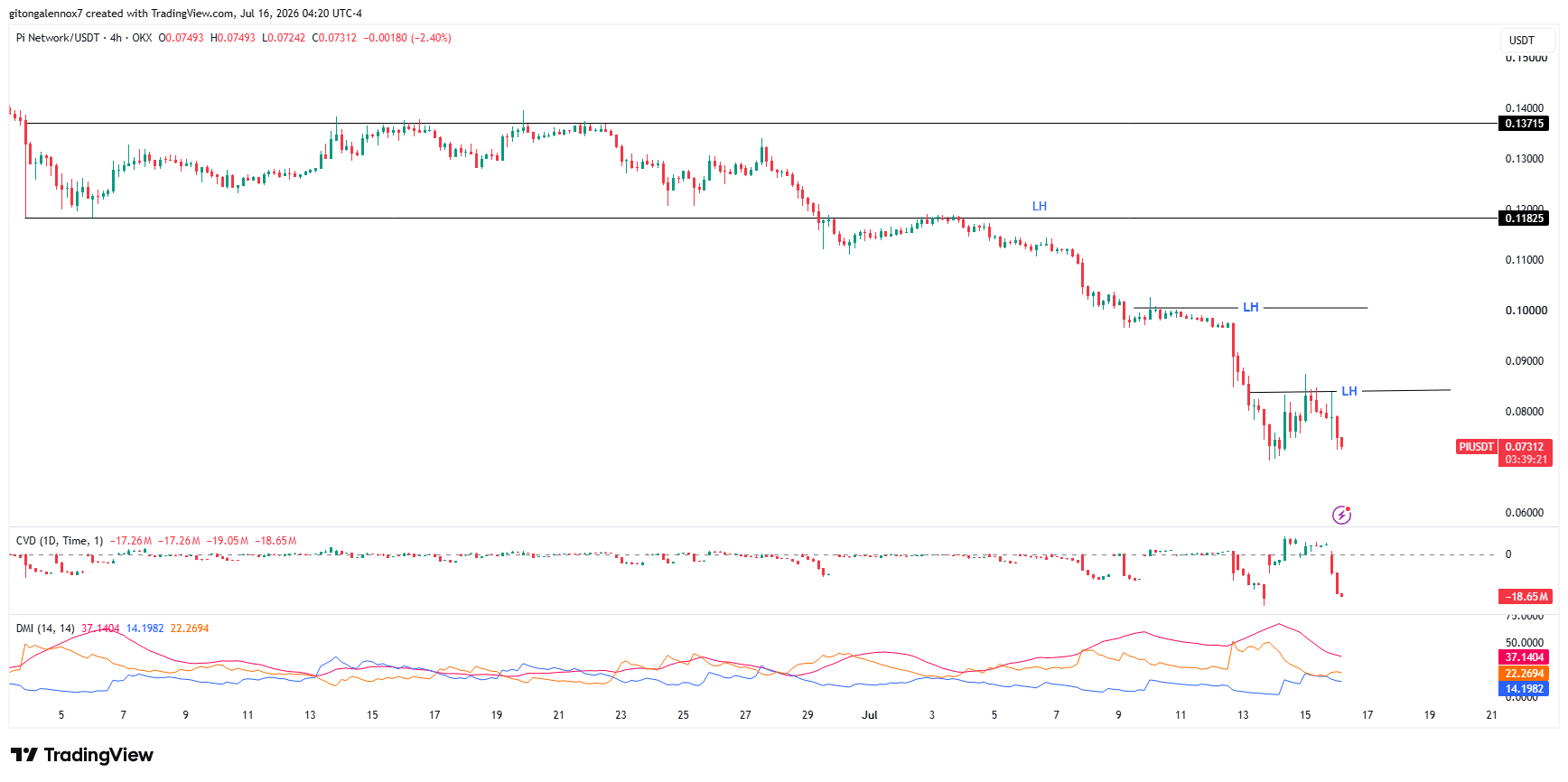
Pi Network nosedives 12% post-rebound – Identifying the reasons image 2 Source: PI/USDT on TradingView

However, Pi Network scheduled its Protocol v25 upgrade for the 22nd of July. The update targeted network stability, reliability, and privacy-preserving capabilities.

The upgrade could improve sentiment, but its effect on demand remains uncertain. Continued unlocks and broader market weakness may limit any recovery.

Final Summary

  • Pi Network declines 12%+ in 24 hours amid massive token unlocks and profit-taking. 
  • PI continues to make new lower highs, but the Protocol v25 upgrade could halt that trend.

0
0

Disclaimer: The content of this article solely reflects the author's opinion and does not represent the platform in any capacity. This article is not intended to serve as a reference for making investment decisions.

Understand the market, then trade.
Bitget offers one-stop trading for cryptocurrencies, stocks, and gold.
Trade now!

You may also like

Samsung Electronics' 2nm yield approaches 60%, aiming at TSMC to compete for tech giants' orders

The yield rate of Samsung Electronics' foundry division's 2nm process has increased to nearly 60%, a significant improvement from around 30% in mid-2023. After stabilizing the yield, Samsung has shifted its engineering focus to power consumption and heat dissipation optimization, and is accelerating the development of the more powerful second-generation process, SF2P, aiming for mass production within the year. Strategically, Samsung plans to supply 2nm chips to Tesla next year, using this as a stepping stone to enter the large-scale tech client market.

华尔街见闻•2026/09/29 04:01

From connecting users to hosting computing power, Philippine telecom giant Globe bets on AI data centers! Targeting the next billion-dollar business.

Globe Telecom Inc. plans to invest at least $1 billion by 2027 to expand its data business. The company regards its data center business as the next billion-dollar venture, with the rapid development of artificial intelligence being a key driving factor behind this goal.

智通财经•2026/09/29 03:41

Quantum Computing Reaches Historic Turning Point: Moving Beyond "Physical Experiments," Supply Chain and Manufacturing Become Key to Success

After attending the Quantum World Congress, Jefferies issued a major evaluation: the industry's core challenge has shifted from "creating good qubits" to "building truly usable computers." The source of competitive advantage has fully moved from physics innovation to system engineering and manufacturing barriers. The U.S. government has elevated its role from a funding provider to a rule-maker, with federal funding now linked to performance and the NQI Act about to be implemented. Whoever first achieves repeatable manufacturing and supply chain resilience will earn the ticket to compete in commercializing this technology.

华尔街见闻•2026/09/29 03:26