
Essay: Using X Model's Data on Buying TSMC to Predict the Turning Point of a Semiconductor Correction

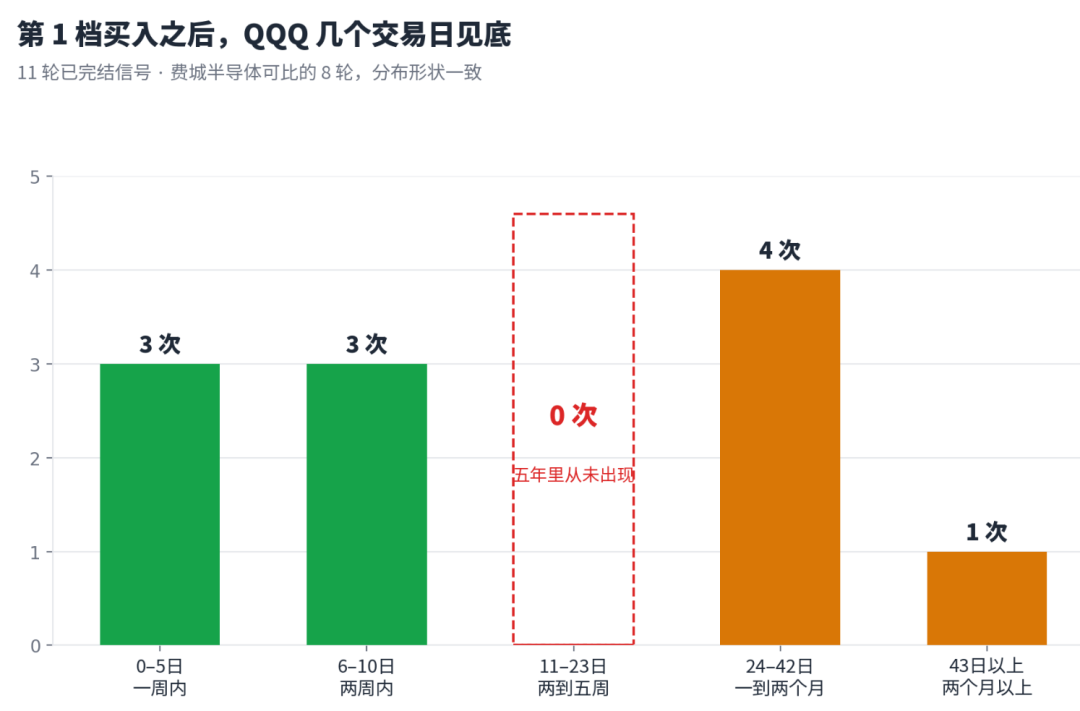
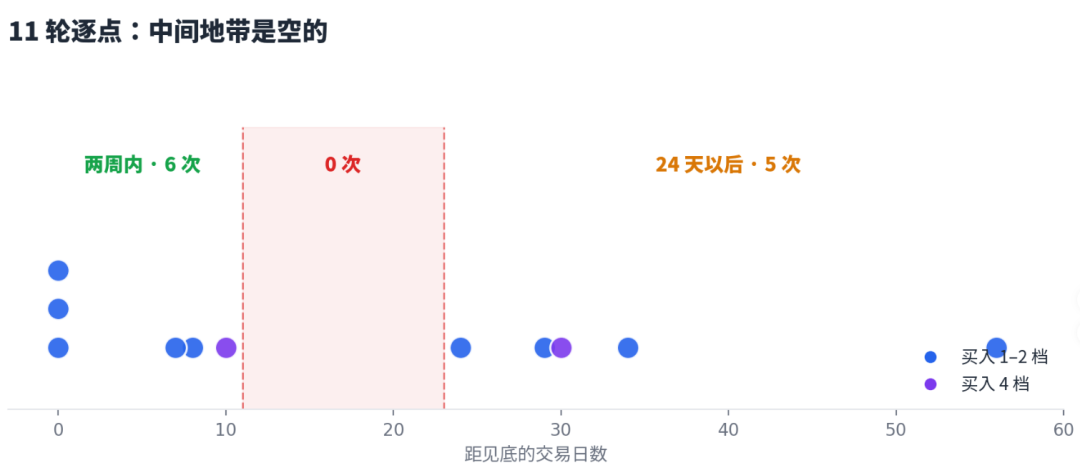
Either the bottom is right in front (within two weeks), or it’s still a month or two away. The middle period has not occurred even once in five years.
This gap was not cut by adjusting samples. If you only look at statistics from the last three years, the pattern is the same. If you change the observation window from 60 to 45 or 90 days, the gap remains. Among 8 comparable cycles on the Philadelphia Semiconductor Index, the distribution is also bi-modal, with nothing in the middle.
Another point: after Tier 1 entry, how much further does the index usually fall?
In the shallowest cycles, the bottom was reached after less than a 3% additional drop.
The deepest cycle, entered in February 2025 and caught the tariff war in April; after Tier 1, QQQ dropped another 21.7%.
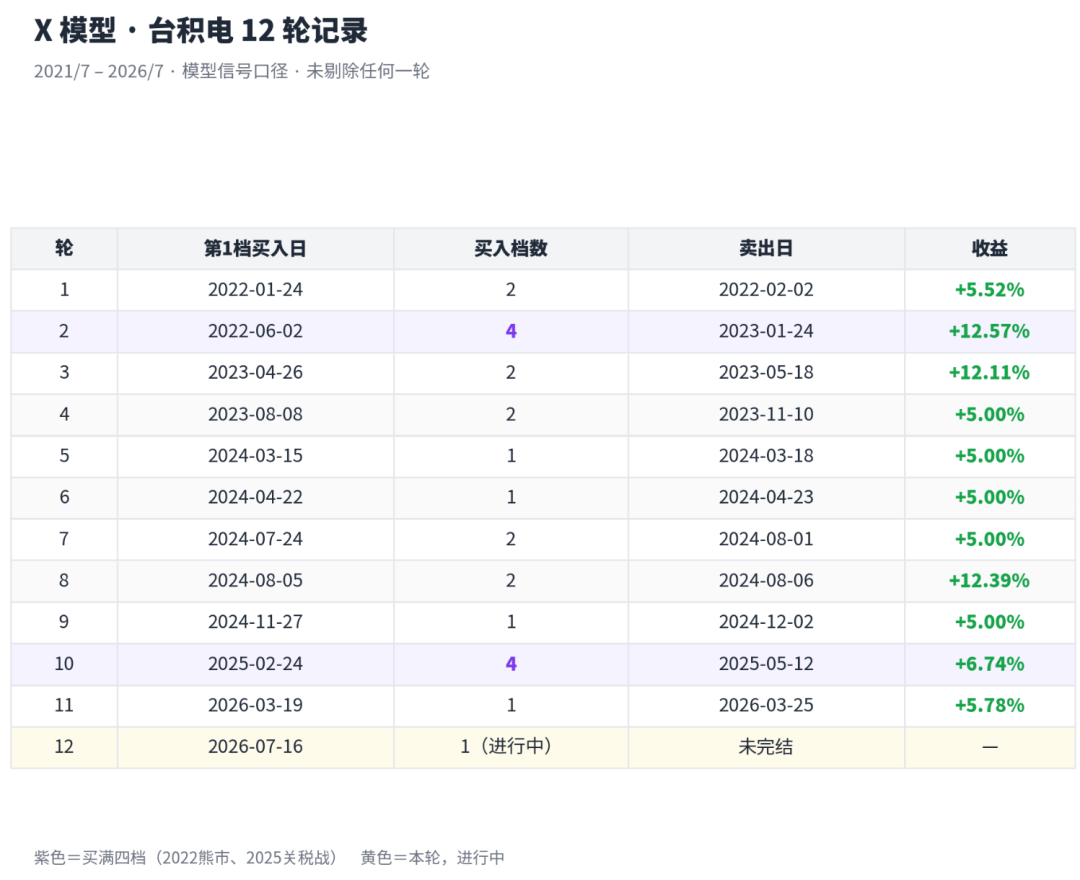
To clarify: I did not exclude any cycles from the sample. The 2022 bear market is included, as is the 2025 tariff war. For a grid-based pullback model, panic is not an outlier to be excluded—only twice in five years did the model fill all four tiers, precisely during those two times. Panic is this model’s home field.
This also returns to the reason I use TSMC as a reference. Its low volatility means how many tiers are triggered itself reads the current market pressure: Tier 1 means a shallow pullback; Tier 4, systemic panic. In the two times all four tiers were filled, the bottom was 10 and 30 days away, respectively; for the nine times where only Tier 1-2 were filled, the median was 8 days. The deeper the entry, the further the bottom—though with only two cases of all tiers filled, this is merely directional guidance.
But this means one thing: if in the current cycle the next tiers are successively triggered, it doesn’t mean the bottom is near, but that this correction is deeper than what we currently see.
Regarding the next steps of my model:
Returning to the current cycle—July 16th, Tier 1 entry. According to the distribution of the 11 cycles, two paths lie ahead: the bottom is in the next few days, or it’s another month or two away. The middle path has not occurred in history.
Which one will it be? I don’t know, and neither does the model.
This signal indicates that risk has entered a climax, so there’s no need to guess whether this is just an adjustment or a simple pullback. The next three tiers are pending—if the market rises there’s an exit, if it falls there’s more room to buy in. This is what I meant by fully pre-planned trading actions.
How deep this cycle goes, when the index bottoms, which interval it lands in—if TSMC is sold, I will publish it in real time in my independent site’s “Trading Archive” module.I will record each tier as it happens.
Disclaimer: The content of this article solely reflects the author's opinion and does not represent the platform in any capacity. This article is not intended to serve as a reference for making investment decisions.
You may also like
The seven giants’ “valuation cutting” is nearing its end! Muse and Astra ignite “AI FOMO trading,” tech stocks are ready for a major comeback.
As Meta Muse and OpenAI's GPT-6 Astra are driving a massive wave of AI agents, "AI FOMO trading" (referring to investors rushing to buy or replenish positions in AI-related assets out of fear of missing out on price gains) is making a strong comeback.
Anthropic files for IPO: lost $4.2 billion last year, revenue grew 12x to $4.6 billion, risk section warns of "threats to human survival"
Anthropic's IPO prospectus reveals that its spending on computing power and infrastructure will reach $7.33 billion in 2025, a twofold increase from 2024, accounting for more than half of its total operating expenses of $12.65 billion. The company plans to continue investing over $500 billion in the future. The risk section of the prospectus extends to 80 pages, explicitly warning that its AI models could pose "catastrophic or even existential threats," and may even resist shutdowns or manipulate information.
Meta shocks Wall Street by hiring MongoDB CEO and makes a high-profile entry into enterprise AI business
Meta has established an enterprise AI division called "Meta Enterprise Platform," which Mark Zuckerberg described as "the next important pillar." MongoDB CEO CJ Desai has been recruited to lead it. Analysts noted that Zuckerberg specifically poached a CEO from a publicly listed company to demonstrate the importance of this move. Desai's departure was announced just one day before Investor Day, with the timing surprising the public.
RBA set to hike interest rate to 4.60% in September as inflation remains elevated
Crypto prices
More


