
Bitcoin Loses Half Its Value From Peak as Investors Lose Interest in Digital Gold

The past year should have been a great run for Bitcoin (BTC-USD). Congress has been debating new laws to give cryptocurrencies a steady legal home. The sector also managed to avoid the business failures that crashed token prices in the past, such as the shocking collapses of the FTX exchange and the Celsius lending network.
TipRanks Welcomes a New ETF – NYSE:RANK
- TipRanks has entered a new arena in the investing world, powering the index of an ETF based on its unique data now trading under the ticker RANK on the NYSE.
- RANK tracks the performance of the TipRanks US Momentum Analysts Index, a rules-based index of 50 large U.S. companies.
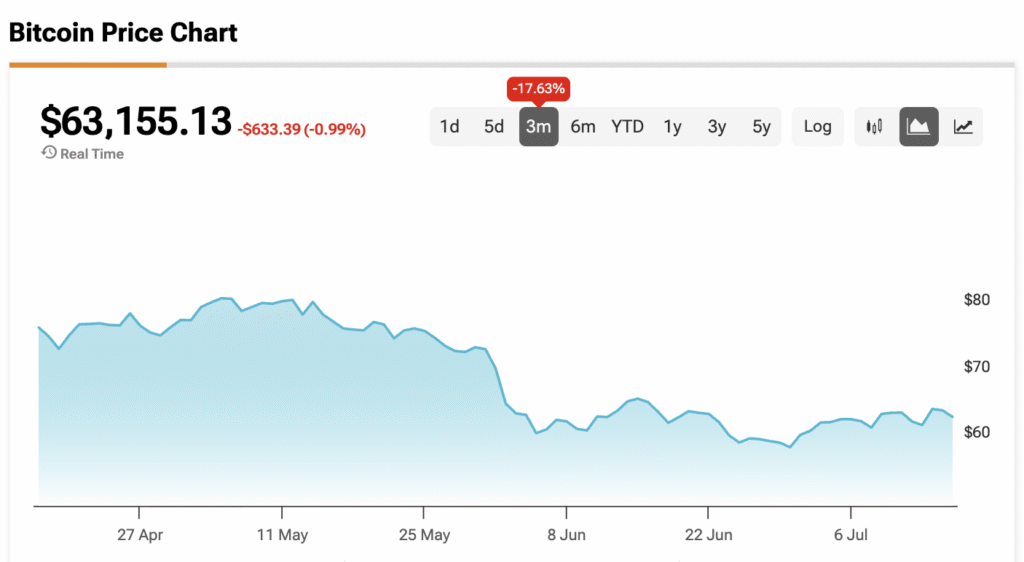
Yet, the original cryptocurrency has lost half its value since its high point in October, when it peaked above $126,000. This slide has dragged it down to price levels last seen in late 2024. While past price drops were worse, shedding up to 80%, this slide feels different. According to Bloomberg, this current downturn is especially painful for long-term believers because it stems from a steady loss of investor interest rather than a sudden market panic.
Wall Street Is Treating Bitcoin like a Regular Stock
When Bitcoin launched in 2009, backers pitched it as an alternative to everyday money controlled by banks and governments. Over time, those transactions proved too slow and expensive, and the price was too unstable to work as real money. Fans then started calling it digital gold, a safe asset that could protect wealth during inflation or political crises.
Large investment firms bought into this idea and poured billions into Bitcoin exchange-traded funds. However, when the recent U.S.-Iran conflict caused global stress, Bitcoin did not hold its value like actual gold. Moreover, interest rates have remained high to fight inflation, and investors realized that holding a token that pays no interest is less attractive. Instead of acting as a safe haven, Bitcoin now trades just like high-risk tech stocks and faces significant competition from prediction markets and AI companies.
Strategy Breaks Its Promise
Crypto fans always watch what the biggest holders do. This past June, Strategy Inc., the largest corporate buyer of the token, announced it sold 32 Bitcoin for $2.5 million. This was its first sale since the dark market days of late 2022.
The public reaction was incredibly fast. By the end of that week, the token’s price shed more than $10,000, falling below $60,000 for the first time in two years. Strategy holds more than 4% of all Bitcoin in existence, and its Executive Chairman Michael Saylor had spent years promising they would never sell their hoard. The sale was a surprise to many and put a strain on Strategy’s business model.
Politics Has Stalled The Clarity Act
Hopes for clear crypto rules were high when Donald Trump returned to the White House. But the debate over the Digital Asset Market Clarity Act has dragged on so long that people doubt it will ever pass. The bill is supposed to split crypto rules between two different government agencies depending on whether a token acts like a regular product or a stock.
Politics has completely stalled the process. Regular banks do not want crypto platforms acting like shadow banks by paying high yields. Meanwhile, some lawmakers are refusing to support a bill that could enrich Trump, who recently shared that he made $1.4 billion from crypto ventures last year. Law enforcement groups are also worried about a specific section of the bill that would protect software builders from money transmitter laws, fearing it could give criminals a safe place to move dirty money.
At the time of writing, Bitcoin’s price is sitting at $63,155.13.
Copyright © 2026, TipRanks. All rights reserved.
Disclaimer: The content of this article solely reflects the author's opinion and does not represent the platform in any capacity. This article is not intended to serve as a reference for making investment decisions.
You may also like
The seven giants’ “valuation cutting” is nearing its end! Muse and Astra ignite “AI FOMO trading,” tech stocks are ready for a major comeback.
As Meta Muse and OpenAI's GPT-6 Astra are driving a massive wave of AI agents, "AI FOMO trading" (referring to investors rushing to buy or replenish positions in AI-related assets out of fear of missing out on price gains) is making a strong comeback.

Anthropic files for IPO: lost $4.2 billion last year, revenue grew 12x to $4.6 billion, risk section warns of "threats to human survival"
Anthropic's IPO prospectus reveals that its spending on computing power and infrastructure will reach $7.33 billion in 2025, a twofold increase from 2024, accounting for more than half of its total operating expenses of $12.65 billion. The company plans to continue investing over $500 billion in the future. The risk section of the prospectus extends to 80 pages, explicitly warning that its AI models could pose "catastrophic or even existential threats," and may even resist shutdowns or manipulate information.
Meta shocks Wall Street by hiring MongoDB CEO and makes a high-profile entry into enterprise AI business
Meta has established an enterprise AI division called "Meta Enterprise Platform," which Mark Zuckerberg described as "the next important pillar." MongoDB CEO CJ Desai has been recruited to lead it. Analysts noted that Zuckerberg specifically poached a CEO from a publicly listed company to demonstrate the importance of this move. Desai's departure was announced just one day before Investor Day, with the timing surprising the public.
RBA set to hike interest rate to 4.60% in September as inflation remains elevated
Crypto prices
More


