
Bitget App
Trade smarter
Buy cryptoMarketsTradeFuturesStocksEarnInstitutionAI & More
$324 Billion in Shiba Inu (SHIB) Outflows: Are Whales Ready to Push for Uptrend?

$324 Billion in Shiba Inu (SHIB) Outflows: Are Whales Ready to Push for Uptrend?

CryptoNewsNetCryptoNewsNet2026/07/21 12:42
By:CryptoNewsNet
Back to the list

$324 Billion in Shiba Inu (SHIB) Outflows: Are Whales Ready to Push for Uptrend?

$324 Billion in Shiba Inu (SHIB) Outflows: Are Whales Ready to Push for Uptrend? image 0  u.today 7 m
$324 Billion in Shiba Inu (SHIB) Outflows: Are Whales Ready to Push for Uptrend? image 1

Over 324 billion $SHIB have left centralized trading platforms, marking one of Shiba Inu's biggest exchange withdrawal events in recent weeks. The market has taken notice of the move right away because significant exchange outflows are typically linked to accumulation rather than active selling. The most recent on-chain data shows that total exchange outflows increased to about 325.7 billion $SHIB, greatly outpacing exchange inflows of about 251.5 billion $SHIB.

Shiba Inu is ready to take over

Exchange netflows consequently became extremely negative, at about -74.2 billion $SHIB. To put it simply, during the reporting period, significantly more $SHIB left exchanges than entered them. Investor accumulation is the most apparent explanation. Tokens are usually moved onto exchanges by traders who plan to sell. Withdrawing assets into long-term storage options, staking platforms, or private wallets frequently denotes a diminished desire to sell right away.
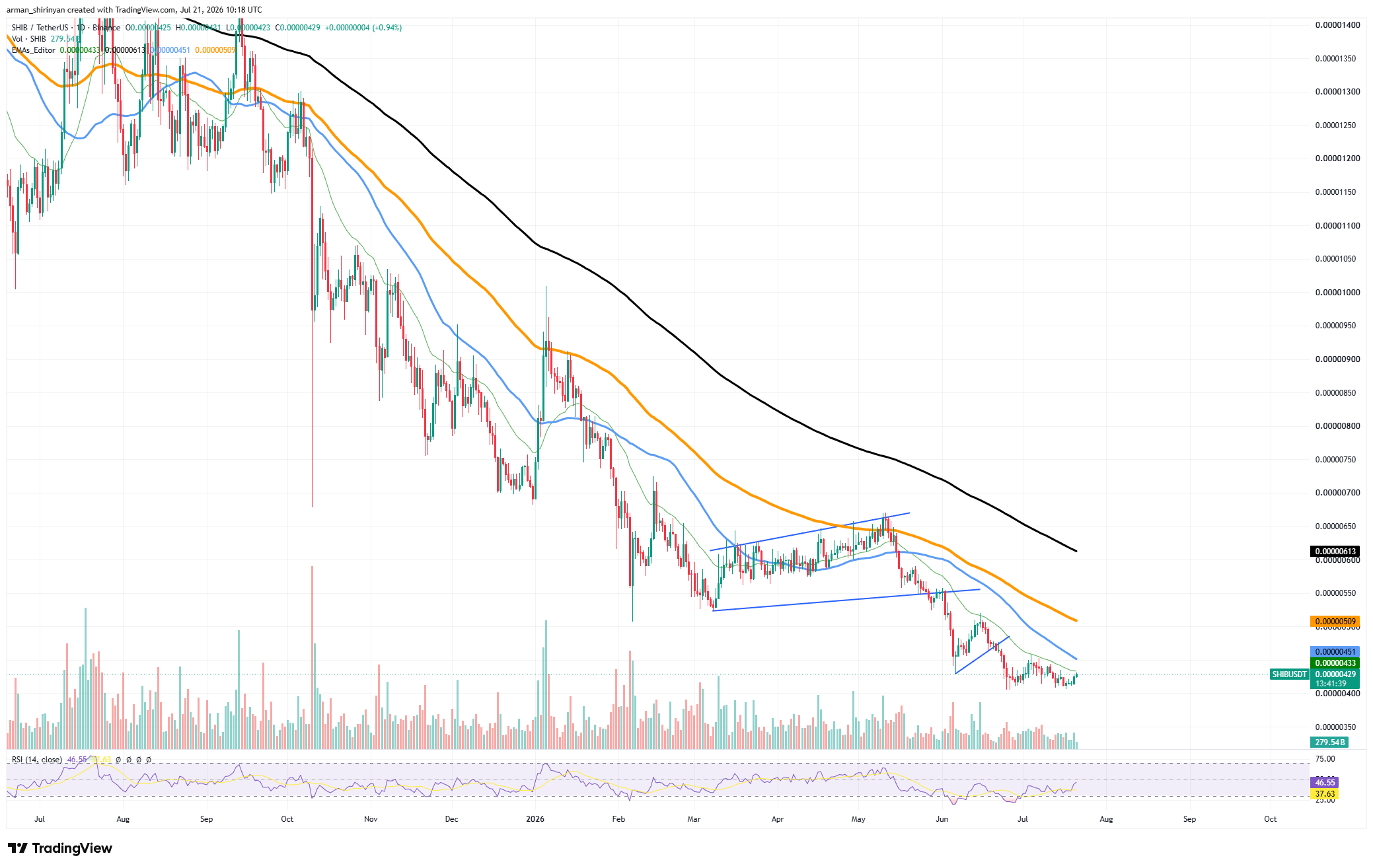
$324 Billion in Shiba Inu (SHIB) Outflows: Are Whales Ready to Push for Uptrend? image 2 $SHIB/USDT Chart by TradingView

This interpretation is supported by the exchange reserves' ongoing decline, as the overall $SHIB reserves on trading platforms continue their wider downward trend. The timing is what makes the situation especially intriguing. At $0.0000114, $SHIB is still trapped close to some of its lowest points from 2025.

The asset has been in a protracted downtrend for months, losing several support levels and consistently failing to create a long-term recovery. In the past, when long-term holders started to accumulate during weak periods, significant outflow events frequently occurred. Tokens are often removed from exchanges by investors who believe an asset is undervalued rather than being made available for immediate trading.

After a prolonged decline, the chart itself indicates that $SHIB has entered a stabilization phase. In contrast to the sharp movements observed earlier in the year, price action has flattened around the $0.0000110–$0.0000115 region, and volatility has significantly decreased.

Momentum decreases substantially

Bearish momentum may not be as strong as it was in June, as indicated by the RSI's recovery toward the neutral zone. But an instant rally is not guaranteed by the outflow event alone. The overall trend is still negative, and $SHIB continues to trade below all major moving averages. Additional barriers are located closer to the 100-day and 200-day trend indicators, while the first significant resistance is still close to the 50-day moving average.

As of right now, it seems that increasing accumulation activity rather than panic selling is responsible for the 324 billion $SHIB withdrawal. The ability of buyers to translate improving on-chain dynamics into real price strength over the upcoming weeks will determine whether that accumulation results in a sustainable recovery.
0
0

Disclaimer: The content of this article solely reflects the author's opinion and does not represent the platform in any capacity. This article is not intended to serve as a reference for making investment decisions.

Understand the market, then trade.
Bitget offers one-stop trading for cryptocurrencies, stocks, and gold.
Trade now!

You may also like

Nvidia earnings report and Anthropic trillion-dollar IPO coming in succession! The bigger test for AI trading is next week

The aftershocks of Jensen Huang's resignation have not subsided, and next week the AI sector faces a "double test": Nvidia's first financial report in the "post-Huang era"—if the performance falls short of expectations, the market's punishment will be intensified; Anthropic is launching its IPO with a trillion-dollar valuation. Two major uncertainties are looming, which will directly determine whether global capital's faith in AI can be sustained.

华尔街见闻•2026/11/14 10:31
Nvidia earnings report and Anthropic trillion-dollar IPO coming in succession! The bigger test for AI trading is next week

Goldman Sachs Global Stock Market Outlook: AI Capital Expenditure to Peak Next Year, Earnings Growth to "Slow Down Significantly", Cloud Giants Become "Defensive Assets"

Goldman Sachs’ 2027 Global Equity Strategy points out that the AI capital expenditure boom is nearing its peak, and global profit growth will slow significantly. S&P 500 earnings growth is expected to drop from 36% to 11%, with depreciation pressures gradually emerging. However, cloud giants’ valuations have adjusted to a forward P/E of 19.7, lower than the staples sector, and are classified as “relatively defensive” assets. Goldman Sachs predicts an S&P 500 target of 8,700 points and suggests overweighting the US and Japan, while underweighting Europe.

华尔街见闻•2026/11/14 06:56

With $135 billion worth of Nvidia stock, will Jensen Huang cash out?

After Jensen Huang stepped down, his Nvidia holdings of approximately 812 million shares, valued at $135 billion, became a major pressure on the stock price. Any reduction in holdings is subject to both legal and market constraints: shares can only be sold compliantly after the disclosure of any undisclosed negative information, and the volume is equivalent to six trading days’ total market transactions, meaning large-scale cashouts would have to be spread over several months.

华尔街见闻•2026/11/14 06:56
With $135 billion worth of Nvidia stock, will Jensen Huang cash out?

Will the traditional Christmas rally still happen in the US stock market this year?

After a simultaneous technical and position-based recovery in the US stock market, Goldman Sachs, Morgan Stanley, and JPMorgan have successively signaled a year-end rebound. Extremely light positions, mean reversion of valuations, and seasonal support together create conditions for a short squeeze. However, global manufacturing import price inflation has annualized at around 24%, surpassing the pandemic peak, and the inflation bill will come due intensively in the first quarter of next year. Goldman Sachs warns that once the year-end rally materializes, it may exhaust future upside potential.

华尔街见闻•2026/11/14 02:56
Will the traditional Christmas rally still happen in the US stock market this year?