
Crypto market breakout could accelerate as AI trade cools, analyst says

Bitcoin and the broader cryptocurrency market looked poised for a recovery on Tuesday as progress on landmark US crypto legislation boosted sentiment, with analysts also pointing to a slowdown in the AI trade as a potential catalyst for capital rotating back into digital assets.
Bitcoin (BTC) briefly climbed above $67,000 and Ether (ETH) neared $1,950, while crypto-related stocks rallied sharply. Coinbase shares rose 12%, American Bitcoin gained 14% and Cipher Digital jumped 17%.
The gains came after US Treasury Secretary Scott Bessent lawmakers were at the “1-yard line” on the long-debated CLARITY Act, which would define the regulatory roles of the Securities and Exchange Commission and Commodity Futures Trading Commission over digital assets.
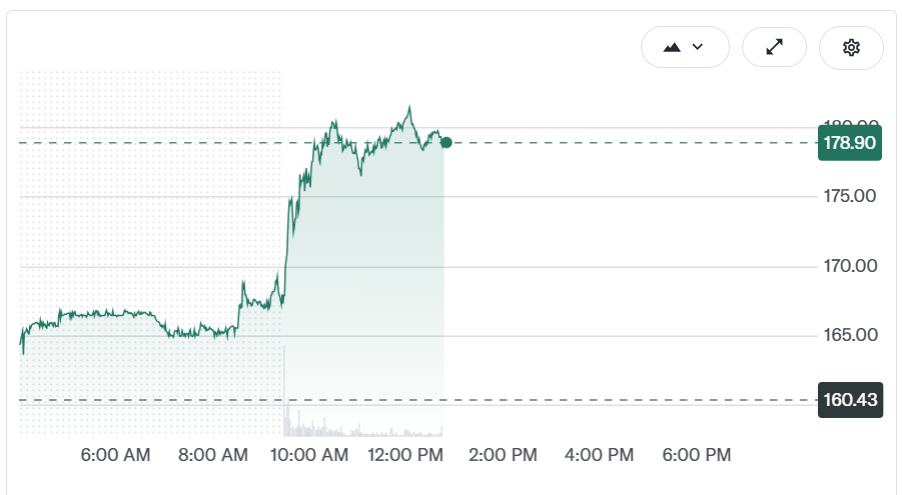
Coinbase (COIN) was among the market’s top-performing stocks on Tuesday. Source:
Beyond the regulatory tailwinds, some analysts said crypto could also benefit from investors shifting capital away from AI-linked equities.
“With Bitcoin at the top end of the range, we see the path of least resistance being higher and an elevated likelihood of a breakout of the range as the AI trade slows and the market becomes more comfortable with the path of interest rates,” FRNT Financial CEO Stephane Ouellette told Bloomberg.
Related:
AI trade loses momentum as chipmakers fall
AI-related stocks have dominated speculative markets over the past year, with the Philadelphia Semiconductor Index (SOX) — a widely watched benchmark for chipmakers powering the AI boom — surging roughly 110%.
However, the rally has begun to lose momentum. Last week, the SOX index entered a technical bear market after falling more than 20% from its recent high, as investors grew increasingly concerned about lofty valuations and the risk of overcapacity in AI infrastructure spending.
This follows an extended period in which AI largely overshadowed digital assets. Since the launch of ChatGPT in late 2022, a wave of innovation, venture capital investment and retail enthusiasm has shifted much of the market’s speculative appetite toward AI.

Source:
Related:
Disclaimer: The content of this article solely reflects the author's opinion and does not represent the platform in any capacity. This article is not intended to serve as a reference for making investment decisions.
You may also like
Hashrate orders are booming, why is "AI trading" falling out of favor? JPMorgan reveals the time lag between AI investment and productivity realization
Joseph Lupton from the JP Morgan Global Economic Research Team pointed out in a research report on November 10 that recent improvements in labor productivity have been driven more by capital deepening and increased intensity of factor utilization. The broad efficiency gains from AI, resulting from process reconstruction, data integration, and organizational adjustments, will still take time to materialize. This means orders for chips, servers, and electrical equipment may grow first, but continuous investment returns for computing power operators and end users may not arrive at the same pace.
AI investment enters the "Trough of Disillusionment", the next 18 months will be a life-or-death test!
Goldman Sachs believes that the AI investment cycle is currently in the "trough of disillusionment," but this is not the first time. The core contradiction lies in the fact that the business models of new cloud computing providers are highly dependent on end-user returns from AI spending, while currently "there are basically zero companies that can attribute profits to AI." Social Capital founder Palihapitiya has clearly defined an 18-month key window, during which the market will decide which AI business models are sustainable and which are not.

Anthropic's Core Concern: Revenue Can Be Withdrawn at Any Time, but Computing Power Costs Are Locked in for up to 20 Years
Zheshang Securities believes that Anthropic's revenue is mainly based on usage-based billing, with remaining performance obligations covering only about 5.1 months of annualized revenue, while compute power costs are already locked in with $895.4 billion in irrevocable commitments, some extending as far as 2045. Revenues can be reduced at any time, but costs are non-exitable, creating a highly asymmetric maturity gap between the two—this is the company's real core constraint.
Triple Pressure from the Federal Reserve, Treasury, and Congress; Goldman Sachs: Liquidity Crisis May Occur in 2027
Goldman Sachs warns that the reserve ratio of bank assets has dropped to around 11%, only slightly above the crisis trough of 2019. In the second half of 2027, a deadlock in debt ceiling negotiations will force the Treasury to rebuild the TGA, triggering a "perfect storm" of a sharp drop in reserves and a surge in T-bill supply; combined with stalled money market fund buying, this will create a huge liquidity black hole. The Federal Reserve could be forced into the awkward position of lowering interest rates and launching large-scale bond purchases to rescue the market.

Crypto prices
More


