
Institution: The Negative Factors for Gold Are Mostly Priced In, Turning Point Has Arrived, Expecting $5,100 by Year-End

Huitong Network, August 19—— Analysts at Wells Fargo point out that after several months of adjustment, bearish factors for gold have largely been priced in. With rate hike expectations cooling and the Middle East situation easing, gold prices have started to rebound. Persistent accumulation by Asian investors and various central banks has provided a solid floor of support for gold. While gold prices face short-term technical volatility risks, the long-term risk-reward ratio remains attractive and its hedging value stands out. Institutions forecast that gold still has room for further upside this year, and the long-term bull market logic remains intact.
Since 2026, gold has undergone persistent corrections driven by higher U.S. real yields and rising Fed rate hike expectations, but market support at the bottom has remained solid.
According to the latest market analysis from Wells Fargo Investment Institute, with market expectations for further rate hikes gradually cooling, and ongoing rigid demand for gold accumulation from Asian investors and central banks,
Gold Price Recovery Underway, Multiple Positives Underpin Short-term Trend
After five months of a weak correction, the gold market outlook has seen a clear warming trend. The Wells Fargo strategist team noted that the expectation of renewed talks as the Middle East situation eases, together with cooling Fed rate hike expectations, has collectively pushed gold prices back into an upward channel. In the first week of August, gold prices rose more than 7%, marking the best single-week performance since January this year. At the same time, gold ETF outflows have completely stabilized, shifting gradually towards net inflows, as investment sentiment continues to recover.
Looking back at this round of correction, since March 2026, U.S. inflation-adjusted real yields have continued to rise. Gold, as a non-yielding asset, became less attractive compared to various income-generating assets, and, combined with concerns over the Fed's tightening policy, gold prices remained under pressure. However, the market overlooked gold's underlying resilience—global demand for gold remained steady in the first half of 2026, which became the core support for gold prices resisting further declines.
Resilient Asian Demand, Central Bank Gold Purchases Intact
Despite the global spot price of gold declining in the first half of the year, trends among different regions have diverged significantly, with the Asian market forming the core foundation for global gold support. In major Asian economies, factors such as a low interest rate environment, geopolitical uncertainty, and inflation risks have led investors to continue accumulating gold during dips. Data shows that the gold price during Asian trading sessions rose 13% in the first half of the year, demonstrating strong support from domestic buyers. Meanwhile, heightened geopolitical and market risks prompted central banks to resume gold purchases in Q2 this year, with official reserves-driven gold buying continuing to expand and further strengthening support for gold’s price floor.
Given the multiple positives on the demand and supply sides, Wells Fargo maintains an overall bullish outlook on the precious metals sector. However, considering external headwinds from U.S. monetary policy,
Significantly Improved Risk-Reward Ratio, Long-term Value Highlighted
Sameer Samana, Wells Fargo’s Global Head of Equities and Real Assets Strategy, stated that gold's current investment cost-effectiveness has reversed significantly. After a more than 20% deep pullback from historical highs earlier this year, most bearish factors have already been fully priced in by the market. The current futures market pricing for two to three Fed rate hikes is also already reflected in the gold price trend, and the probability of much more aggressive rate hikes is now very low—inflationary pressures are no longer enough to support ultra-tight monetary policy.
From a technical perspective, gold still faces short-term volatility and correction risk, with the possibility of testing the $3,500 level. There is also technical resistance around the $4,500–$4,900 range due to earlier trapped positions. However, from a macro long-term view, high oil prices and high-interest rates will ultimately drag down U.S. economic growth, forcing the Fed to eventually restart more accommodative monetary policies, thus opening up further long-term upside for gold prices.
Gold’s Unique Hedging Attribute, a Core Safeguard in Portfolio Construction
Compared to traditional assets such as stocks and bonds, gold has a significant risk-resistant advantage. In past economic recessions and monetary tightening cycles, gold’s drawdowns have been much milder than for most risk assets, and it has rarely suffered cliff-edge plunges, displaying very strong trend stability. In market environments where both traditional stock and bond assets trend downward, gold often appreciates or retains value against the trend, serving an irreplaceable diversification and hedging role.
Currently, after a deep correction, gold is reasonably valued, with limited downside risk and ample upside potential. It remains a core hedging asset for long-term portfolio allocation.
Conclusion
Overall, in the short term, gold is subject to volatility due to U.S. monetary policy cycles, but the three core factors—rigid Asian demand, persistent central bank gold purchases, and bearish pricing-in—remain unchanged. Short-term volatility does not alter the long-term bull cycle. Looking ahead, as rate hike expectations further cool and economic slowdown pressures emerge, gold prices are positioned for a steady recovery trend, and the upside potential for the year is worth anticipating.
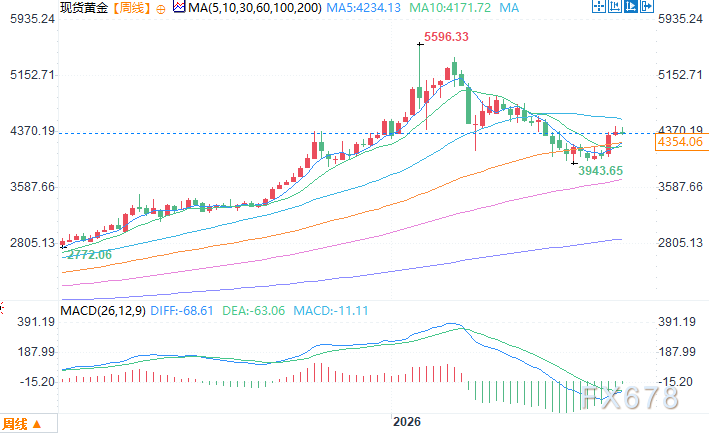
Spot gold weekly chart Source: EasyHuitong
East 8th Zone August 19, 10:10 Spot gold quoted at $4,355.06/oz
Disclaimer: The content of this article solely reflects the author's opinion and does not represent the platform in any capacity. This article is not intended to serve as a reference for making investment decisions.
You may also like
Anthropic has been profitable for two consecutive quarters ahead of its IPO
Anthropic has achieved positive adjusted operating profit for two consecutive quarters, with Q2 revenue surging 14-fold year-on-year to $11.5 billion and annualized revenue reaching $65 billion. The gross margin exceeds 80%. The company has chosen to list on Nasdaq, with a potential valuation of up to $2 trillion. Dramatically, the CEO has made a rare call to slow down AI development just before the IPO. Analysts believe that balancing safety concerns with commercial competition will become the core challenge.
Anthropic signs $13.7 billion computing power agreement with "Trump-linked company" Rum Group
Anthropic has signed a $13.7 billion, six-year computing power agreement with Rum Group. The core of the agreement is a data center under construction in Georgia. Rum Group was formerly the conservative video platform Rumble, whose early investors include current U.S. Vice President Vance.
Will the midterm elections cause the US stock market to crash? 75 years of history give an unexpected answer
Currently, with less than eight weeks until the midterm elections, one of the greatest uncertainties facing Wall Street is imminent. But will the reshuffling of power in Congress lead to a stock market crash? Looking back over 75 years of history, the answer is surprising, and ultimately leans toward optimism.

Crypto prices
More


