Filecoin (FIL), Bitway (BTW), and Teller (DEBIT) have entered critical phases after delivering powerful gains. All three tokens show bullish structures, but their recent rallies have created different risks.
FIL has pushed above major moving averages after recovering from the $0.60 area. BTW has extended its breakout after clearing a broad resistance zone. Meanwhile, Teller has suffered heavy profit-taking following a parabolic move toward $4.27.
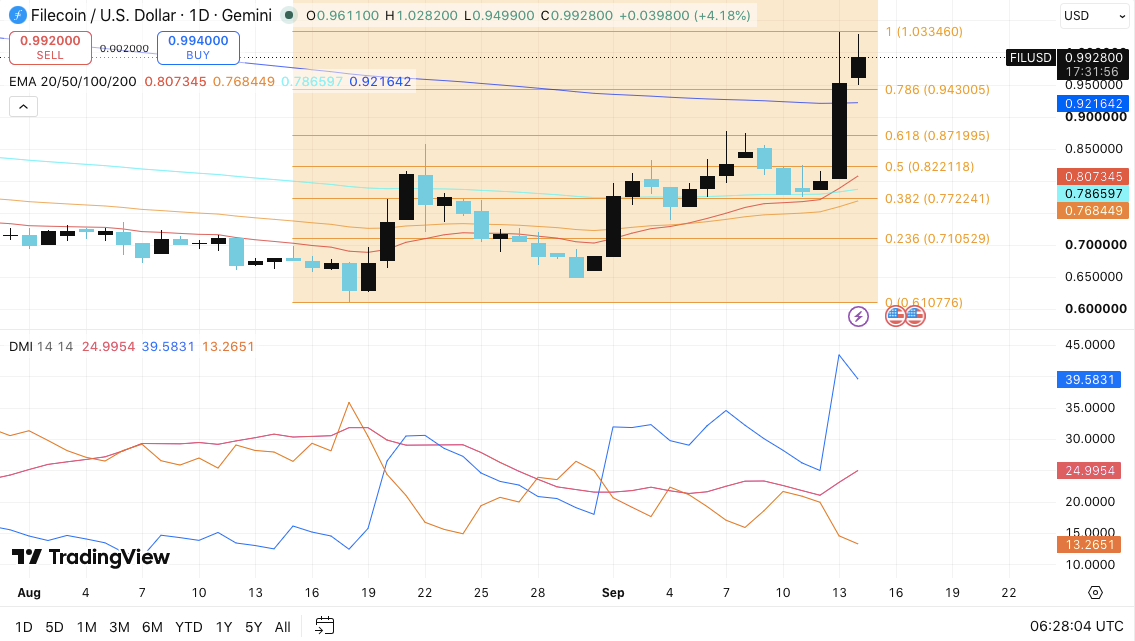
FIL has strengthened considerably after rebounding from the $0.60 region. The token recently reached around $0.99 after briefly testing $1.03. Price now trades above the 20, 50, and 100 EMAs, reinforcing the bullish structure.
Significantly, the DMI shows strong buyer control, with +DI at 39.58 against -DI at 13.27. The ADX reading near 24.95 also points toward improving trend strength.
The $1.03 level remains the immediate barrier for FIL. A sustained move above that resistance could support further gains toward higher psychological levels.
On the downside, $0.92 offers the first important support. Additionally, the $0.87-$0.82 area could provide stronger protection during a deeper pullback. The $0.79-$0.76 zone represents another important defensive area.
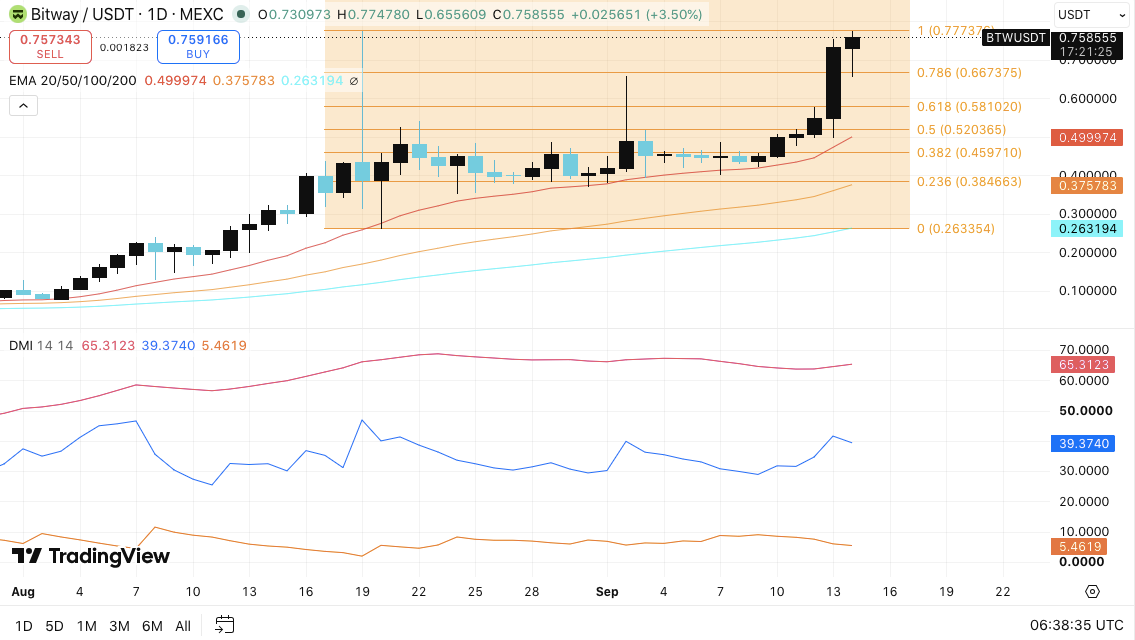
BTW has displayed the strongest trend momentum among the three assets. The token climbed from the $0.58-$0.67 region before reaching a recent high near $0.7748.
Moreover, BTW trades comfortably above its 20, 50, and 100 EMAs. The DMI reinforces this strength, with +DI at 39.37 and -DI at only 5.46. An ADX reading of 65.31 signals exceptionally strong momentum.
A daily close above $0.7748 could push BTW toward $0.80. Consequently, sustained buying could extend the advance toward $0.85-$0.90.
However, rejection near the recent high could trigger profit-taking. The $0.6674 level offers the first major support during such a decline. Deeper supports sit at $0.5810, $0.5204, and $0.4597.
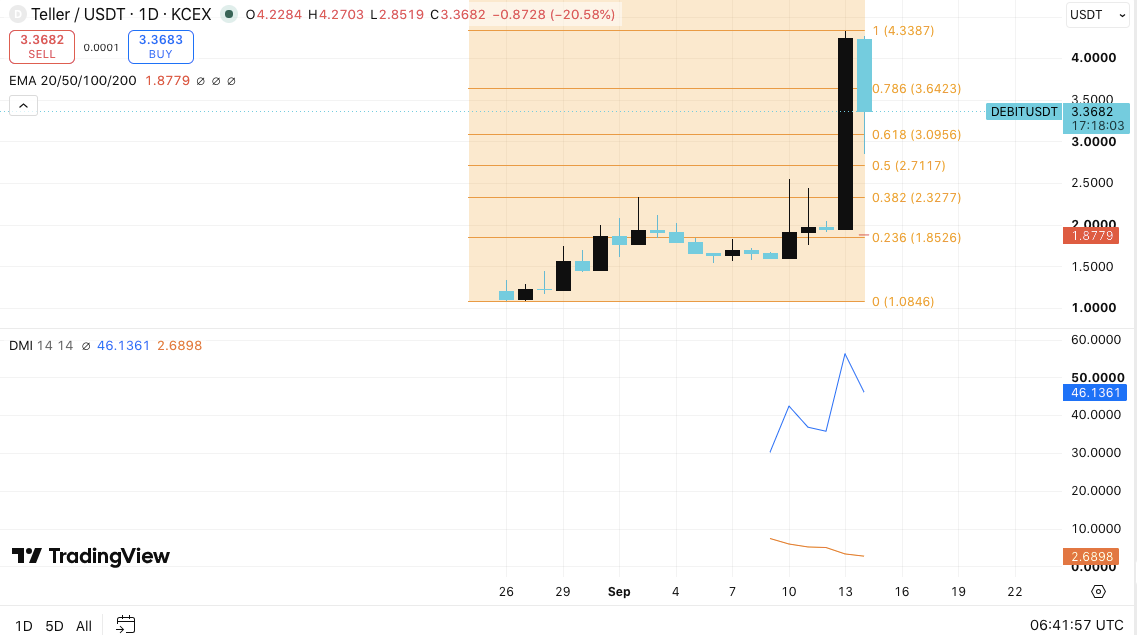
Teller has experienced the sharpest pullback after climbing from roughly $1.08 to $4.27. The token currently trades near $3.37 following a decline of about 20.6%.
Despite the correction, the broader trend remains bullish. The DMI and ADX reading of 46.14 indicate powerful underlying momentum.
However, $3.10 now represents a crucial level for the bullish structure. Holding this support could help buyers target $3.64 again. A breakout above $4.34 could then create room for new highs.
Conversely, losing $3.10 could expose Teller to $2.71 and $2.33. Hence, upcoming price action around these support levels could determine the next major move.