
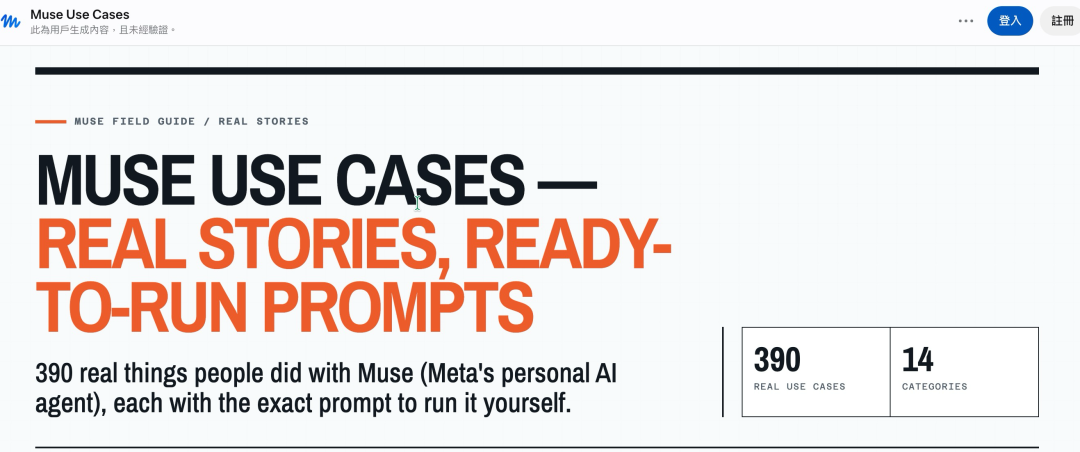
I have finished translating 390 real-world use cases of Meta Muse and discovered an important fact.

Show original
By:美股投资网
Bitget offers one-stop trading for cryptocurrencies, stocks, and gold. Trade now!
A welcome pack worth 6200 USDT for new users! Sign up now!
The fact is:
Ordinary people don't need "super intelligence" at the moment; what they need more is an AI that can handle returns, negotiate bills, schedule doctor appointments, and deal with annoying chores on their behalf.
Among these 390 cases, the top use case is saving money, refunds, and personal finance, accounting for 77 cases or 19.7%.
Some users had Muse and Amazon customer service pursue refunds; others had it re-compare car insurance and saved $800 a year; someone had it check their AT&T bill, expecting to save $1,050 in two years; another had it scan six months of emails and discover a forgotten $100/month Claude Max subscription.
The second most common scenario is work and small business, 51 cases, accounting for 13.1%.
People used it to organize founders' emails, analyze Instagram data, create media kits, generate content calendars, and look for local sales leads. Some even had Muse act as project manager and assigned development tasks to Devin.
Third is administrative chores, 48 cases, or 12.3%.
Filling out visa forms, updating passports, making DMV appointments, cleaning out tens of thousands of emails, contacting insurance companies, calling customer service, and paying traffic fines.
These tasks are not complicated, yet they are exactly the ones people are most willing to pay money to get rid of.
Following these are travel (45 cases), shopping (44 cases), entertainment (39 cases), food and ordering (25 cases), and family management (24 cases).
Among these 390 cases, the top use case is saving money, refunds, and personal finance, accounting for 77 cases or 19.7%.
Some users had Muse and Amazon customer service pursue refunds; others had it re-compare car insurance and saved $800 a year; someone had it check their AT&T bill, expecting to save $1,050 in two years; another had it scan six months of emails and discover a forgotten $100/month Claude Max subscription.
The second most common scenario is work and small business, 51 cases, accounting for 13.1%.
People used it to organize founders' emails, analyze Instagram data, create media kits, generate content calendars, and look for local sales leads. Some even had Muse act as project manager and assigned development tasks to Devin.
Third is administrative chores, 48 cases, or 12.3%.
Filling out visa forms, updating passports, making DMV appointments, cleaning out tens of thousands of emails, contacting insurance companies, calling customer service, and paying traffic fines.
These tasks are not complicated, yet they are exactly the ones people are most willing to pay money to get rid of.
Following these are travel (45 cases), shopping (44 cases), entertainment (39 cases), food and ordering (25 cases), and family management (24 cases).
Someone had Muse plan a ten-day self-driving trip and book all the hotels along the route; someone had it search for out-of-print books on global websites; someone photographed a handwritten grocery list at home and had Muse buy a week's worth of groceries directly.
Some parents even have it check school systems daily, tracking kids' homework and deadlines.
Money, admin, travel, shopping, eating, family, health, and home management combined account for almost 74% of all cases.
This set of data suggests that the earliest real demand consumer-grade Agents can fulfill might not be content creation, but eliminating trivial chores.
Ordinary chatbots tell you what you should do.
Muse, on the other hand, will open websites, log into accounts, compare prices, fill in forms, contact merchants, and wait for responses, only coming back to you for confirmation when it's time to pay, send an email, or modify an account.
The former provides answers, the latter delivers results.
This is also one of the reasons why the capital market started listening to Zuckerberg tell the story of "personal super intelligence" again after Muse’s launch.
Muse launched on September 8th. Meta's share price rose from about $613 to around $670, a cumulative increase of nearly 9%; on September 9th alone, the price jumped 6.55%. By market capitalization, over $100 billion was added in a week.
Ordinary chatbots tell you what you should do.
Muse, on the other hand, will open websites, log into accounts, compare prices, fill in forms, contact merchants, and wait for responses, only coming back to you for confirmation when it's time to pay, send an email, or modify an account.
The former provides answers, the latter delivers results.
This is also one of the reasons why the capital market started listening to Zuckerberg tell the story of "personal super intelligence" again after Muse’s launch.
Muse launched on September 8th. Meta's share price rose from about $613 to around $670, a cumulative increase of nearly 9%; on September 9th alone, the price jumped 6.55%. By market capitalization, over $100 billion was added in a week.
Previously, the market was worried that Zuckerberg was investing too aggressively in "personal super intelligence" without delivering consumer-facing products that matched the spending.
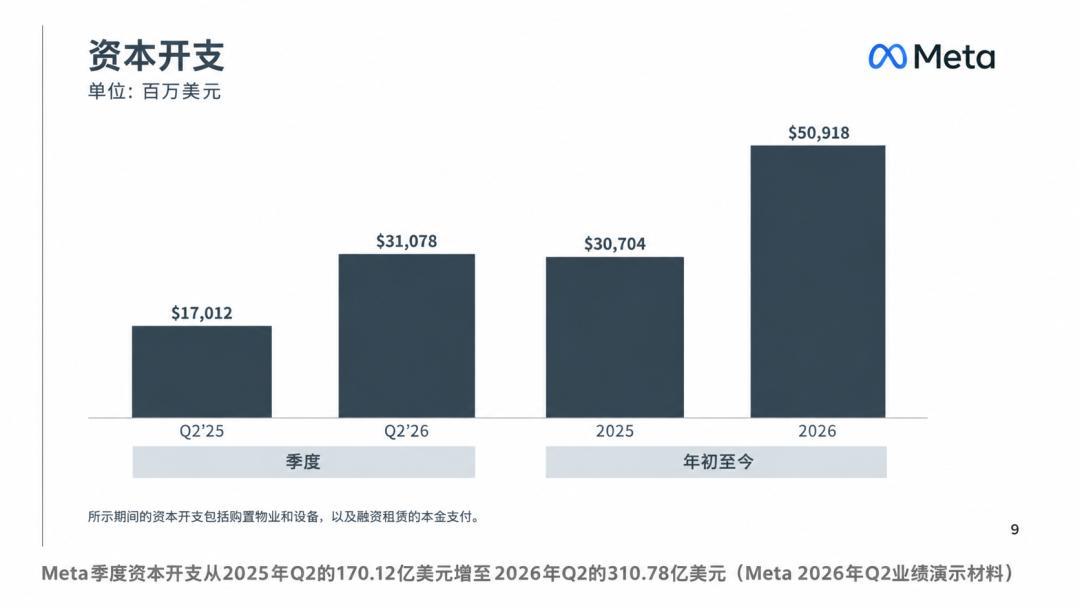
Meta expects capital expenditures of $130-145 billion in 2026, nearly double that of 2025. What investors really want to know is not how much more AI can burn, but whether these investments will eventually turn into users, revenue, and profits.
Meta expects capital expenditures of $130-145 billion in 2026, nearly double that of 2025. What investors really want to know is not how much more AI can burn, but whether these investments will eventually turn into users, revenue, and profits.
Muse has at least provided, for the first time, an answer ordinary consumers can understand:
The AI capabilities that Meta spent huge sums to build can help you handle real-life hassles.
Zuckerberg calls Muse a "personal AI Agent for everyone" and says Meta ultimately wants to bring "personal super intelligence" to billions of people.
It's a very bold statement.
The AI capabilities that Meta spent huge sums to build can help you handle real-life hassles.
Zuckerberg calls Muse a "personal AI Agent for everyone" and says Meta ultimately wants to bring "personal super intelligence" to billions of people.
It's a very bold statement.
With the current 390 cases, all that can be proven is that Muse has demonstrated early product-market pull, but it still cannot prove that it possesses stable retention, payment, or a viable business model.
This case library was mainly collected proactively from X, Threads, Instagram, and Hacker News, which naturally capture more early users willing to share successful experiences. There are also plenty of failures: booking the wrong restaurant, backend monitoring errors, fabricating tax numbers, and the system claiming tasks were completed after repeated failures.
The more useful Muse is, the harder it is to avoid trust issues.
To truly get things done for users, it needs to read emails, calendars, financial records, health information, and payment accounts. Meta says Muse data won't go into ad systems and has designed a dedicated Secure VM, permission approvals, and operation records for it.
But whether consumers are willing to entrust their entire digital lives to Meta remains unanswered.
So, the American Stock Investment Network's assessment of Muse is:
It is not yet the "personal super intelligence" that Zuckerberg describes, but it may be the first consumer-grade product that truly lets ordinary people understand the value of an AI Agent.
ChatGPT taught people how to ask questions to AI.
What Muse needs to validate is whether people are willing to hand over accounts and tasks to AI and let it actually take action.
Don’t just look at download numbers next. What truly determines the value of Muse are three metrics: retention rate, paid conversion rate, and the actual number of tasks users have it complete every week.
If these three figures don’t materialize, Muse is just a spectacular launch event.
If they keep growing, the market may need to reevaluate whether the over $100 billion burned by Meta is just a cost, or a ticket into the next generation of consumer gateways.
This case library was mainly collected proactively from X, Threads, Instagram, and Hacker News, which naturally capture more early users willing to share successful experiences. There are also plenty of failures: booking the wrong restaurant, backend monitoring errors, fabricating tax numbers, and the system claiming tasks were completed after repeated failures.
The more useful Muse is, the harder it is to avoid trust issues.
To truly get things done for users, it needs to read emails, calendars, financial records, health information, and payment accounts. Meta says Muse data won't go into ad systems and has designed a dedicated Secure VM, permission approvals, and operation records for it.
But whether consumers are willing to entrust their entire digital lives to Meta remains unanswered.
So, the American Stock Investment Network's assessment of Muse is:
It is not yet the "personal super intelligence" that Zuckerberg describes, but it may be the first consumer-grade product that truly lets ordinary people understand the value of an AI Agent.
ChatGPT taught people how to ask questions to AI.
What Muse needs to validate is whether people are willing to hand over accounts and tasks to AI and let it actually take action.
Don’t just look at download numbers next. What truly determines the value of Muse are three metrics: retention rate, paid conversion rate, and the actual number of tasks users have it complete every week.
If these three figures don’t materialize, Muse is just a spectacular launch event.
If they keep growing, the market may need to reevaluate whether the over $100 billion burned by Meta is just a cost, or a ticket into the next generation of consumer gateways.


US Stock Market AI Quantitative Analysis Tool StockWe.com Product Feature Showcase


US Stock Investment Network is a fintech company specializing in studying US stocks, founded in 2008 in Silicon Valley, America, by former NYSE analyst Ken. Together with several Morgan Stanley analysts and Google and Meta engineers, utilizing AI and big data, supplemented by more than a decade of real-world US stock experience and industry quantitative models, it has built a stock market database processing tens of millions of stock data daily: capturing large option orders, real-time main fund flows, institutional position changes, and breaking Trump-related news.

0
0
Disclaimer: The content of this article solely reflects the author's opinion and does not represent the platform in any capacity. This article is not intended to serve as a reference for making investment decisions.
Understand the market, then trade.
Bitget offers one-stop trading for cryptocurrencies, stocks, and gold.
Trade now!
You may also like
Dogecoin dips below $0.083 as weak ETF demand and bearish positioning limit recovery
Coinjournal•2026/09/16 10:24

Zerodha’s Kamath Backs UPI MDR but Flags Risk to Zero-Brokerage Model
Coinedition•2026/09/16 10:06
South Korea’s KRW1 targets 200 countries via Visa – Can won backed stablecoin scale?
AMBCrypto•2026/09/16 10:03

Tonkeeper rebrands to Keeper, adds support for 6 major blockchains
Cointurk•2026/09/16 09:45
Crypto prices
More
Bitcoin
BTC
$75,874.09
-1.40%

Ethereum
ETH
$2,398.88
-3.08%

Tether USDt
USDT
$0.9991
-0.05%

BNB
BNB
$710.32
-1.09%

XRP
XRP
$1.29
-8.12%

USDC
USDC
$0.9998
-0.01%

Solana
SOL
$97.22
-3.55%

TRON
TRX
$0.3347
-1.12%

Zcash
ZEC
$1,203.51
+5.36%

Hyperliquid
HYPE
$77.88
-1.70%
How to buy BTC
Bitget lists BTC – Buy or sell BTC quickly on Bitget!
Trade now
Become a trader now?A welcome pack worth 6200 USDT for new users!
Sign up now