
After 15 Years, Apple (AAPL.US) Plans to Reenter the Server Market: How Ambitious Is Its AI Computing Power? Major Institutions Debate "Distant Water" vs. "Immediate Thirst"

According to sources reported by tech media The Information, Apple (AAPL.US) is considering entering the enterprise server market, planning to use its self-developed M series Ultra chips in combination with Nvidia (NVDA.US) networking equipment.
According to The Information's sources, Apple (AAPL.US) is considering entering the enterprise server market, planning to use its self-developed M Series Ultra chips paired with Nvidia's (NVDA.US) networking equipment.
The report states that Apple plans to sell servers to AI developers, enterprises, and government clients, focusing on supporting customers to run local AI inference on privatized infrastructure. It is disclosed that the proposed servers will have two versions: a lower-end version integrating two in-development M8 Ultra chips and a higher-end version forming a computing cluster with four M8 Ultra chips. To address the issue of high-speed interconnectivity between multiple chips, Apple has negotiated with Nvidia to adopt its NVLink Fusion interconnect solution (covering switches, chiplets, and supporting software).
If this move materializes, it would mark Apple's return to the server market. Between 2002 and 2011, Apple launched Xserve servers equipped with Intel and IBM chips, but due to insufficient emphasis on the enterprise market and weak customer support, the product never gained traction and was discontinued in early 2011.
Mac Sales Surge 29%, Igniting Server Ambitions
However, today's market conditions are significantly different. In Apple's third quarter of fiscal year 2026, Mac business sales surged 29% year-over-year to $10.3 billion, leading growth across all product lines including iPhone and services. Reportedly, large AI labs such as OpenAI have purchased tens of thousands of Mac minis and Mac Studios for reinforcement learning and AI agent training, while Anthropic has rented Mac minis from Amazon Web Services—soaring demand even led to severe shortages of these models at times.
However, the report also notes that even if Apple pushes this project forward, the new products will not hit the market until 2029, and the project still has a chance of being canceled. Although details remain undecided, Apple’s new CEO John Ternus expressed support at the project’s inception over a year ago (when he was still heading hardware engineering)—the plan opens the door for Apple’s in-house chips to break into the AI computing power market.
Driven by the news, Apple's share price rose 0.7% in midday trading on Wednesday, while Nvidia's share price jumped more than 2% intraday on the same day.
It is worth noting that China International Capital Corporation pointed out in its previous review of Apple’s 3Q FY26 results that both revenue of $109.417 billion (up 16% y/y) and net profit attributable to shareholders of $29.789 billion (up 27% y/y) exceeded expectations, with Mac revenue of $10.352 billion (+29%) being the top contributor; the company maintained FY2026/27 earnings projections, raising the target price by 10% to $340 due to “accelerated AI progress and valuation uplift.” If the server plan is implemented, it will undoubtedly reinforce the “in-house chip value re-rating” logic.
Regarding the server news itself, multiple institutions believe it should be viewed calmly with regard to the relationship between 'distant water' and 'present thirst': the 2029 release window means the project has virtually no impact on Apple's FY2026-27 earnings forecasts and does not serve as a short-term performance catalyst; instead, it should be seen as a "strategic call option". Some estimate the real underwriting challenge is whether Apple can sell differentiated private AI computing at a premium (leveraging unified memory architecture, energy efficiency, and privacy/security advantages) rather than becoming just another buyer of expensive computing power. In other words, without concrete customer commitments, capital expenditure, or pricing model disclosures, this news is insufficient for a major revaluation.
The Trillion-Dollar Market: Surrounded by Giants, What Is Apple's Foothold?
Goldman Sachs expects the global AI server market to reach $1.24 trillion by 2030 driven by the AI boom. This track is already crowded, and the players are delivering impressive results:
Dell: Latest quarterly revenue of $46.97 billion (up 57.8% y/y), quarterly AI server orders of $60.9 billion, order backlog of $95 billion, and share price more than tripled year-to-date;
HPE: Latest quarterly revenue of $12.21 billion (+32.7%), with AI and networking businesses driving a 137% rise this year until a mid-September downgrade triggered a major pullback;
Supermicro (SMCI): Latest quarterly revenue of $11.12 billion (+93.2%), also posting record backlogs.
Apple's differentiation strategy is to avoid direct competition with Nvidia GPU clusters in the large model training market and instead focus on AI inference, especially "private deployments"—targeting enterprises and government clients who want to run models on their own servers and are highly sensitive to data privacy. This position naturally aligns with Apple's hardware energy efficiency and unified memory architecture, and is a segment where Nvidia is relatively weak but rapidly catching up.
However, Apple's limitations are also clear. Servers are essentially a low-margin, capital-intensive, service-heavy B2B business—unlike Apple's usual high-margin consumer electronics playbook; enterprise buyers prioritize software ecosystems, remote management, compliance certifications, and full lifecycle support—all core lessons from the Xserve era. In addition, Apple's in-house interconnect technology currently used for internal Private Cloud Compute faces speed and cost bottlenecks at large-scale deployment, which is the direct reason for seeking Nvidia's NVLink Fusion.
Industry Chain and Competitive Landscape: Nvidia May Be the "Invisible Winner"
If cooperation is finalized, the market generally considers Nvidia the more certain beneficiary. Network equipment currently accounts for around 10%-15% of total AI data center hardware cost, with networking contributing about one-fifth of Nvidia’s data center revenue. Since its May 2025 release, NVLink Fusion has attracted partners such as MediaTek, Marvell, Fujitsu, and Qualcomm; Amazon Web Services also announced last month that its next-generation AI servers will increase adoption. If Apple joins, it will be the most significant customer for the platform thus far—not only introducing a new revenue source, but also validating Nvidia’s ecosystem strategy of "even if clients use self-developed chips, they still need my interconnect", further strengthening its moat against open standard competitors.
Interestingly, Apple's interconnect route is notable: Apple is also a board member of UALink (the open interconnect standards consortium formed by AMD, Intel, Google, Microsoft, etc., now with more than 65 members). If it ultimately shifts to Nvidia's proprietary solution, it would mean choosing “performance” over “openness”, potentially marking a turning point in the industry’s interconnect standards battle. It should also be noted that some Apple engineers involved in the project believe Nvidia has the best current interconnect technology available, but the project could still proceed without adopting Nvidia’s solution.
As for risks, industry-wide shortages of memory chips continue to drive hardware costs higher. For Apple to deliver servers at scale, it will need to secure components years in advance; meanwhile, the gap between its AI software ecosystem (such as the MLX framework) and CUDA, as well as core talent losses this year, all remain significant challenges.
Conclusion
For John Ternus, who has just completed the CEO handover, the server project is both a natural extension of his hardware engineering background and a strategic gamble that may define his legacy. In the short term, this news injects new imagination into Apple’s AI narrative, combined with Mac’s stronger-than-expected growth, leading to positive sentiment; but in the long term, whether the 2029 product can carve out a presence in the fiercely competitive inference market depends on Apple’s ability to shore up its enterprise capabilities—its greatest weakness. For investors, instead of chasing rumors, it’s better to focus on three signals: whether data center capital expenditure is on the books, whether anchor clients are secured, and what the final interconnect technology decision will be.
Disclaimer: The content of this article solely reflects the author's opinion and does not represent the platform in any capacity. This article is not intended to serve as a reference for making investment decisions.
You may also like
From the Token Frenzy to the $1.3 Trillion AI Server Blue Ocean: AI Inference Computing Power Fully Explodes, Industry Leaders like Dell Usher in the Golden Era of "Volume, Price, and Market Share"
Leading global AI server cluster manufacturers such as Dell are simultaneously benefiting from two major growth dividends: the accelerated expansion of the AI server market and a significant increase in the order shares from core AI cloud computing customers, including large enterprises and new cloud providers. They are not merely passively profiting from hardware price increases.

GPU Cloud Services Surge in Price: Nebius Raises Prices Again by 20%, Computing Power Supply Side Gains Bargaining Power
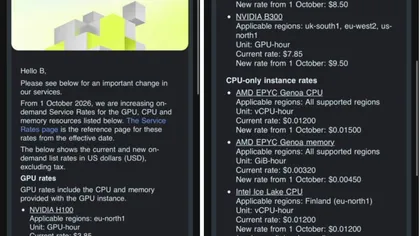
From October 1st, Nebius will raise prices for its entire GPU cloud service line by approximately 20%, with multiple chips from H100 to B300 seeing increases. This marks the second round of price hikes in recent months, and the cumulative increase for B300 has reached 56%. Demand visibility extends beyond 24 months, with customers eager to purchase Blackwell computing power, even willing to pay a premium in auctions. The supply-demand imbalance for AI computing power is reshaping the entire industry’s negotiation landscape, as bargaining power is quietly shifting to the supply side.
Crypto prices
More


