
Are listed companies' exchange losses dragging down performance? The total foreign exchange gains and losses are the real accounts.


Reporter | Shao Huaiyuan Editor | Zhou Yanyan, Zhang Yan
When evaluating the effectiveness of foreign exchange risk control, one cannot look solely at the exchange gains or losses account. Only by considering the exchange rate side and the derivatives side together can one see the real financial record of corporate exchange rate risk management.
In the first half of 2026, semi-annual reports from many listed companies show that, affected by exchange rate fluctuations, the enterprises' losses from exchange rates have increased. For companies with a high share of overseas income and significant foreign currency asset and liability exposure, the short-term impact brought by exchange rate fluctuations is more noticeable.
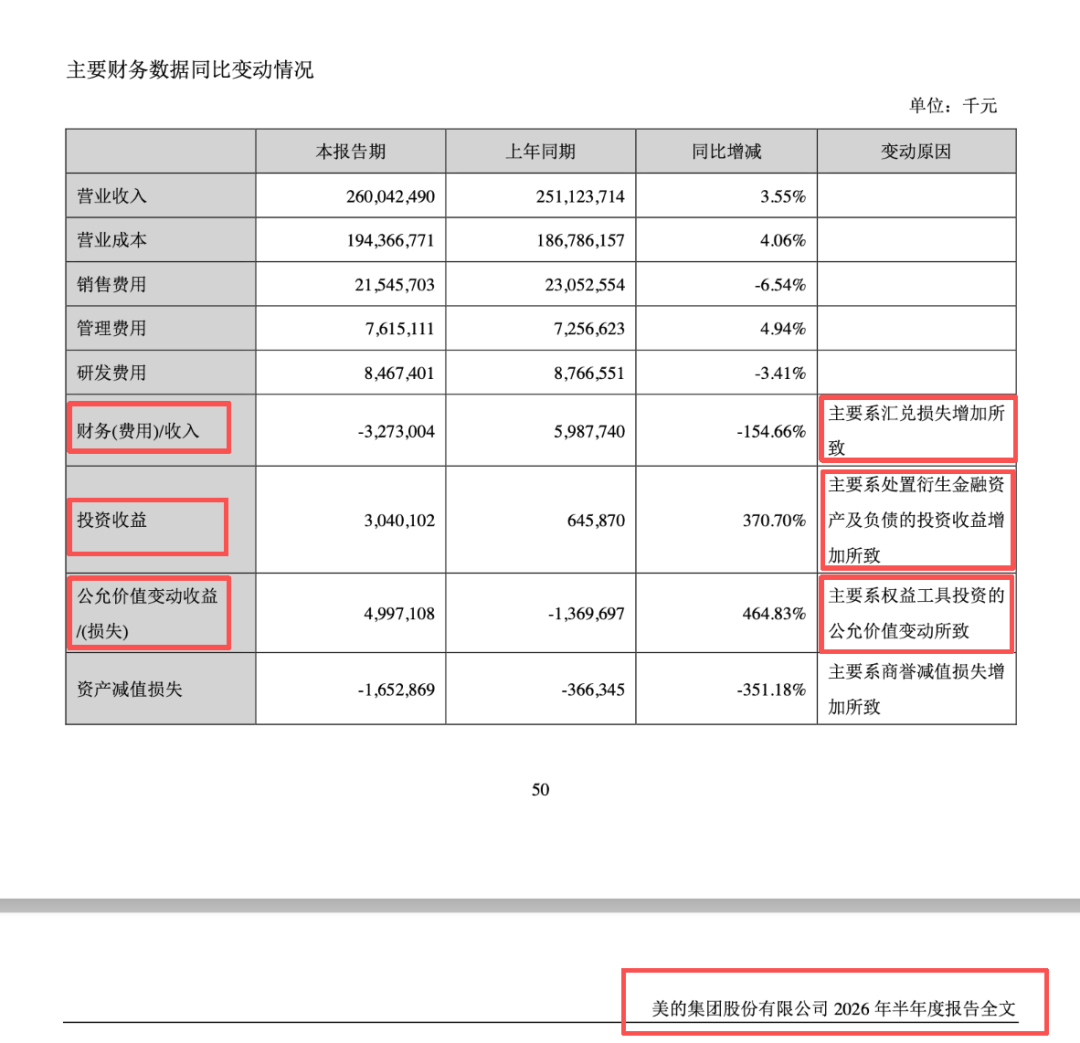
As examples, among three leading overseas companies: CATL posted an exchange loss of 2.81 billion yuan in the first half of this year, compared to a 2.332 billion yuan gain in the same period last year; Luxshare Precision had an exchange loss of 1.986 billion yuan, while the previous year’s same period saw a 493 million yuan gain; Midea Group’s financial expenses changed from a 5.99 billion yuan gain to a 3.27 billion yuan expense, with the financial report indicating the main reason for the change was the increase in exchange rate losses.
After the semi-annual data was released, there was talk in the market that Chinese overseas companies have shortcomings in managing foreign exchange risk, with inadequate hedging coverage failing to effectively counteract exchange rate risks. However, the latest data from the State Administration of Foreign Exchange show that, in the first half of this year, the scale of companies managing exchange rate risks using foreign exchange derivatives such as forwards and options approached USD 1.4 trillion, up 40% year-on-year; the FX hedging ratio reached 35.3%, an increase of 5.3 percentage points from the full year of 2025.
What explains this contrast of “increased hedging ratio, yet expanding foreign exchange losses?” Several interviewed experts told the reporter that this mainly relates to the subject confirmation rules under accounting standards. The crux is that hedging gains and exchange gains or losses are accounted for under different financial subjects. An increased hedging ratio does not directly reduce the figure in the “exchange gains or losses” account; thus, the hedging effect cannot be directly reflected in a single account, so looking only at one financial subject is neither comprehensive nor accurate.
Wang Zhiyi, President of the Cross-border Finance Research Institute, stated thatthis is a common market misunderstanding. Hedging manages the enterprise’s overall foreign exchange risk exposure, while financial statements reflect the results of different assets, liabilities, and derivatives separately in different accounts—the two do not completely correspond. A single exchange gains or losses account cannot reflect the overall effectiveness of the company’s foreign exchange risk management, nor the true impact of exchange rate fluctuations on the company's profits.
Huang Yuting, Deputy General Manager of Zhejiang Commercial Bank's Treasury Operations Center, also pointed out to the reporter that after companies conduct hedging operations, the gains and losses from spot exchange rate fluctuation and from derivatives hedging cannot be combined in reporting, but are instead scattered across different financial subjects. This leads to the market easily seeing apparent losses but finding it hard to spot the hidden gains from hedging, resulting in one-sided judgments.

Single Exchange Gains or Losses Account Is Misleading
The exchange rate loss figures shown in the semi-annual reports of the three listed companies mentioned above do not necessarily equate to failures in exchange rate risk management. The data from Midea Group, Luxshare Precision, and CATL uncover this from different angles.
Midea Group’s financial data clearly illustrate the contrast brought about by the separation of financial subjects. In the first half of 2026, the company’s financial expenses shifted from a 5.99 billion yuan gain to a 3.27 billion yuan expense, with the main reason noted as increased exchange rate losses. However, during the same period, the company’s derivative hedging operations generated considerable gains—investment income increased by 370.7% year-on-year to 3.04 billion yuan, and gains from changes in fair value increased by 464.83% year-on-year to 4.997 billion yuan, both of which include contributions from foreign exchange derivative hedges.
Luxshare Precision points out this accounting issue directly in its financial statements. The company stated that exchange gains and losses are reported under financial expenses, while the gains and losses from forex hedging are recorded under non-operating income and expenses; thus, the overall effect of exchange rate hedging cannot be reflected in one subject. The data show that the company had a 1.986 billion yuan bookkeeping exchange loss in the first half, with corresponding hedging income of 1.297 billion yuan, indicating that risk hedging effectively offset most of the negative impact from exchange rate fluctuations.
The CATL example goes even further, giving a complete calculation: the company posted a 2.81 billion yuan exchange rate loss in the first half of the year, but with regular hedging, the gains and losses from derivatives contracts and foreign currency spot offset each other, leaving the company with an actual comprehensive exchange-related gain/loss of only 170 million yuan. The large-booked loss was mainly a paper loss from accounting for exchange rate revaluations at the end of the period.
While each of the three companies disclosed situations with their own characteristics, they all point to the same conclusion: Under current accounting standards, exchange gains and losses and derivative hedging results are reported under separate categories, splitting up a unified set of exchange rate risk management actions. A single subject cannot objectively reflect the full picture of risk control. Relying solely on the exchange gains and losses subject in financial reports cannot provide an objective assessment of a listed company’s foreign exchange risk management or the real impact of exchange rate fluctuations on business performance.

Effectiveness of FX Risk Control Depends on Total FX P/L
Huang Yuting told the reporter that the market’s misunderstanding of enterprise FX risk control essentially stems from unfamiliarity with the financial accounting logic of hedging. During periods of exchange rate fluctuations, listed companies that engage in currency hedging will see three types of associated profit and loss changes simultaneously in their statements, with all three categories supplementing one another to complete the FX risk control ledger.
First is exchange gains or losses. Items such as foreign currency funds held by corporations, overseas accounts receivable, and foreign-currency-denominated liabilities, must be converted using the current spot rate on the balance sheet date. The conversion difference between the opening and closing rates is included in exchange gains or losses, reflecting the impact of spot FX fluctuations on the book value of the enterprise’s operating foreign currency assets.
Second is gains or losses from changes in fair value. When the company signs foreign exchange derivatives such as forwards or options to hedge FX risk, unrealized gains or losses before delivery must be recognized in accordance with market price changes, recorded under gains or losses from changes in fair value, and not included in financial expenses calculations.
Third is investment income. Once FX derivative contracts mature, are delivered or closed out, the final realized gains or losses are recorded as investment income for the period and shown independently from the exchange gains or losses account in financial statements.
Huang Yuting further explained with a practical case: a company has USD 100 million in 3-month accounts receivable, with a spot rate of 6.80 at signing and a rate of 6.70 at period-end after RMB appreciation, resulting in a 10 million yuan exchange loss. If a simultaneous 3-month forward contract fixes the rate at 6.75, there would be a 5 million yuan gain on the derivative.
In this scenario, the exchange gains or losses account shows a 10 million yuan loss, while derivative gains are reflected under gains or losses from changes in fair value. With one account in the red and another in the black, the actual net effect is around negative 5 million yuan. If one only looks at the exchange gains or losses account, one may get the impression that “foreign exchange management is very poor,” but the real foreign exchange risk exposure is far less than the book figure.
She further clarified that, under current accounting standards, exchange losses on hedged foreign currency assets are reflected in the financial expenses account, whereas derivative gains from risk hedges are scattered in gains or losses from changes in fair value and investment income, creating “visible losses, hidden gains” in reports.
“In reality, you have to combine all three accounts to truly see the effect of hedging,” Huang Yuting emphasized. Losses shown in a single financial account can easily lead investors to underestimate the actual value of hedging. If both the exchange rate and derivative sides are considered together, the real impact of FX fluctuations is often lower than the loss shown in a single account.

Hedging Helps Smooth Profits and Stabilize Operations
According to a relevant official from the State Administration of Foreign Exchange, in practice, companies can first use natural hedges, such as foreign currency revenue and expenditure offsetting, adjusting invoicing currency, and cost-price transmission, to manage exchange rate risk at the source. They may also manage their remaining FX exposures by trading FX derivatives (i.e., by engaging in FX hedging). Actively participating in FX hedging is of great importance for prudent business operations.
First, it reduces uncertainty in operations. Through the use of FX derivatives, companies can lock in future FX earnings or outflows at a certain rate and arrange cost accounting, production, and financing accordingly, uninfluenced by exchange rate fluctuations. In the long run, company profits will be smoother, allowing them to better focus on their main business. In particular, companies proactively using FX hedging can guard against uncontrollable FX losses caused by major FX swings, limit their maximum losses, and prevent operational crisis.
Second, it helps maintain stability in key financial indicators.Foreign currency cash, payables and receivables, and borrowings—these FX-denominated monetary items—generate exchange gains or losses due to differences between the rate at initial recognition and the balance sheet date. For most listed companies, FX gains or losses are included in financial expenses, while FX hedging gains or losses are recorded under gains or losses on changes in fair value or investment income, with both impacting operating profit.
If companies engage actively in FX hedging, FX gains or losses and FX hedging results can partially offset each other, smoothing out operating profits. For those not involved in hedging, operating profit will move sharply up and down with exchange rates, negatively impacting enterprise valuation. Therefore, to accurately and scientifically assess hedging efficacy, one should sum FX gains or losses with FX hedging results, avoiding the bias of focusing solely on changes in financial expenses.
Third, it enhances the overall stability of the FX market environment. From a macro perspective, if companies adhere to a philosophy of FX risk neutrality and make FX fluctuations a regular element of their operations, they will react more calmly in the face of currency swings, avoid momentum-driven FX trading, and reduce pro-cyclical market volatility, thereby improving market resilience and creating a more stable business environment.
From a regulatory perspective, this direction is already clear. Li Bin, Deputy Administrator and Press Spokesperson for the State Administration of Foreign Exchange, stated at the “First Half 2026 Foreign Exchange Receipts and Payments Data Briefing” that as the current external environment is complex with dual-direction FX volatility increasing, companies should adhere to a philosophy of FX risk neutrality and proactively manage FX risk to minimize the impact of FX fluctuations on their core business and finances.
Disclaimer: The content of this article solely reflects the author's opinion and does not represent the platform in any capacity. This article is not intended to serve as a reference for making investment decisions.
You may also like
Uniswap, Near Protocol, Hyperliquid and Bitcoin face critical resistance after surges
Hyperliquid overtakes Arbitrum in chain TVL, climbs to $1.39 billion and #7 rank
NEAR rallies 24% after AI utility expands across 43 models – Is rally built to last?
Crypto prices
More


